




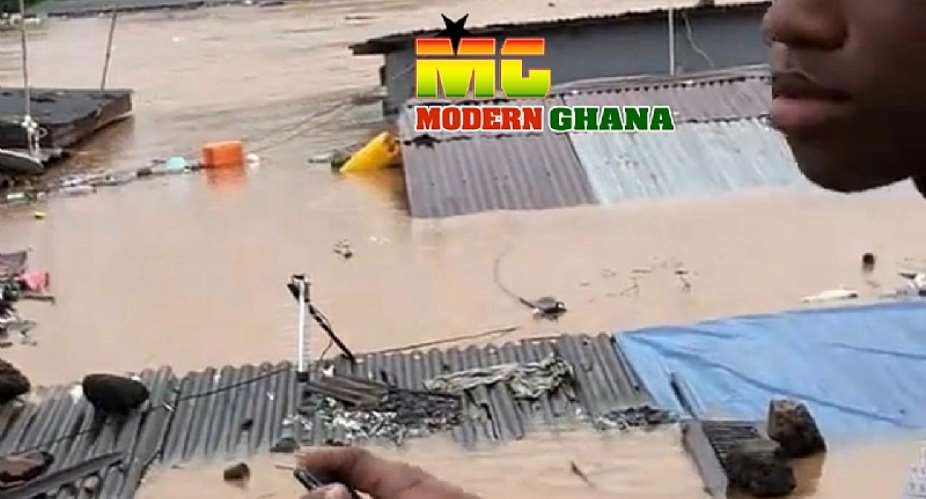
Heavy rains that began on Sunday night to Monday morning, June 29, submerged large sections of Accra, triggering widespread flooding and renewed warnings from authorities over the growing risk of flood-related disasters in the capital.
The downpour, which recorded 169.2 millimetres the highest in June, inundated major roads, homes, markets and businesses, disrupting transport and forcing many residents to flee to safer locations.
Some of the worst affected areas included Kaneshie, Odawna, Adabraka, and the Kwame Nkrumah Circle enclave, where floodwaters stranded commuters and displaced families within hours of the rainfall.
At the Kaneshie Market, traders watched helplessly as floodwaters swept through shops and stalls, destroying goods and leaving many counting their losses.
Flooding was also reported at Klagon, near Ashaiman, where the newly constructed bridge across feeder streams of the Sakumo Lagoon was submerged, cutting off the inner road linking the community to Ashaiman.
Other communities affected included Alajo, Mallam and Dansoman. In Alajo, rising floodwaters entered several homes, forcing residents to evacuate.
Experts have attributed the recurring floods to decades of poor urban planning, weak enforcement of development regulations and widespread encroachment on wetlands and natural waterways.
President of the Ghana Institution of Engineers, Ing. Ludwig Annang Hesse, said the city's natural flood control systems have been severely compromised over the years.
“For the past 30 or 40 years, we have done things the wrong way. We have filled all the water retention areas,” he said.
The Ghana Meteorological Agency (GMet) has also warned that Accra's ability to drain stormwater has significantly declined, indicating that rainfall of as little as 30 millimetres can now trigger flooding in parts of the city.
According to the Agency, the Coastal Zone is expected to receive between 100 and 150 millimetres of rainfall during the period, increasing the likelihood of further flooding.
Meanwhile, authorities are continuing work on major drainage projects, including the Kaneshie Storm Drain under the World Bank-funded Greater Accra Resilient and Integrated Development (GARID) Project, to help reduce flooding within the Odaw River Basin.
However, engineers caution that expanding drainage infrastructure alone will not solve the problem unless wetlands, retention ponds and other natural water storage areas are protected from encroachment.
With more rainfall forecast, authorities have advised residents in low-lying and flood-prone communities to remain vigilant, avoid flooded roads and relocate temporarily where necessary to safeguard lives and property.
 UTAG-UCC rejects GTEC's proposed harmonisation of academic promotion guidelines ...
 Police arrest suspect over robbery, rape and assault in Koforidua
 Nigerian cyber fraud suspect wanted by INTERPOL and FBI arrested in Accra
 High Court nullifies Nii Amoo Dodoo's appointment to Ga Traditional Council Judi...
 Maritime and Related Offences Bill 2026 to combat piracy passed
 Ghana's 593.2mm rainfall in June highest since 1995 as floods kill 12
 169.2mm June 29 rain disaster warns Ghana of more danger ahead
 12 dead, 7 missing, 7761 households hit in June 29 floods in Accra
 TOR clears 6-year backlog of audited financial statements
 Adwoa Safo petitions Attorney General to transfer brother's shooting case to Hig...
