




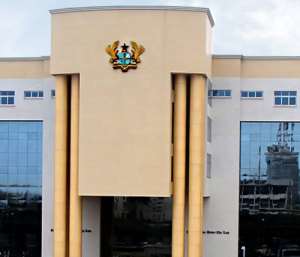
The High Court has declared the appointment of Nii Amoo Dodoo to the Judicial Committee of the Ga Traditional Council null and void, ruling that he does not satisfy the legal requirements for the position under the Chieftaincy Act, 2008 (Act 759).
Delivering judgment on May 13, 2026, Justice Alexander Graham held that the appointment violated Sections 12(2), 14(1) and 29(2) of the Chieftaincy Act.
The case was initiated by Daniel Nii Armah Tette, also known as Nii Attohi, against the Republic, the Ga Traditional Council and Nii Amoo Dodoo.
In its defence, the Ga Traditional Council argued that the High Court lacked jurisdiction because the issue is a matter or cause affecting chieftaincy and also contended that the applicant had no locus standi to bring the action.
Justice Graham dismissed both objections, explaining that although the High Court is prohibited under Section 57 of the Courts Act, 1993 (Act 459) from determining substantive chieftaincy disputes, it retains supervisory jurisdiction over adjudicatory bodies, including Judicial Committees of Traditional Councils.
Relying on Article 141 of the 1992 Constitution and decisions of the Supreme Court, the judge held that the High Court is empowered to intervene where a traditional adjudicatory body exceeds its jurisdiction or breaches the principles of natural justice.
“This is clearly a matter of legality of administrative action, not a chieftaincy dispute,” the court ruled.
On the issue of locus standi, the court found that Nii Attohi had demonstrated sufficient interest in the matter. He identified himself as the head of one of the Royal Families of Ayi Kai Doblo and a party to a related chieftaincy dispute, supporting his claim with court proceedings and orders showing his direct involvement.
The central question before the court was whether Nii Amoo Dodoo had been lawfully appointed to the Judicial Committee.
Justice Graham explained that Section 12(2) of the Chieftaincy Act requires members of a Traditional Council to be listed in the National Register of Chiefs, while Section 14(1) limits council membership to persons whose names appear on that register. Section 29(2) further provides that members of a Judicial Committee must be appointed from among members of the Traditional Council.
According to the judge, the combined effect of these provisions is clear, only persons whose names appear in the National Register of Chiefs are eligible to serve on a Traditional Council and, by extension, on its Judicial Committee.
Evidence presented by the applicant showed that Nii Amoo Dodoo's name does not appear in the National Register of Chiefs, a fact the respondents did not effectively challenge.
The court also considered evidence showing that Nii Amoo Dodoo had previously been restrained by an injunction from holding himself out as a chief and had subsequently been convicted for contempt after breaching that order.
“The 2nd Respondent's claim to chieftaincy status is at best disputed and at worst unlawful,” Justice Graham stated.
“In the face of these statutory requirements and undisputed facts, the appointment cannot stand.”
The judge further held that, under the doctrine of ultra vires, any statutory body acting beyond the authority granted by law acts unlawfully and its decisions are void.
He also found that the Ga Traditional Council had acted unreasonably, contrary to Article 23 of the Constitution, by appointing a person who was subject to an injunction and a contempt conviction.
The court consequently granted three reliefs. It declared the appointment of Nii Amoo Dodoo to the Judicial Committee unlawful and void, issued an order of mandamus directing the Registrar of the Ga Traditional Council to remove his name from the records of both the Council and the Judicial Committee, and granted an order of prohibition restraining him from acting as a member of either body.
Jacob Noye represented the applicant, while Yaw Dankwah appeared for Nii Amoo Dodoo.
 UTAG-UCC rejects GTEC's proposed harmonisation of academic promotion guidelines ...
 Police arrest suspect over robbery, rape and assault in Koforidua
 Nigerian cyber fraud suspect wanted by INTERPOL and FBI arrested in Accra
 High Court nullifies Nii Amoo Dodoo's appointment to Ga Traditional Council Judi...
 Maritime and Related Offences Bill 2026 to combat piracy passed
 Ghana's 593.2mm rainfall in June highest since 1995 as floods kill 12
 169.2mm June 29 rain disaster warns Ghana of more danger ahead
 12 dead, 7 missing, 7761 households hit in June 29 floods in Accra
 TOR clears 6-year backlog of audited financial statements
 Adwoa Safo petitions Attorney General to transfer brother's shooting case to Hig...
