




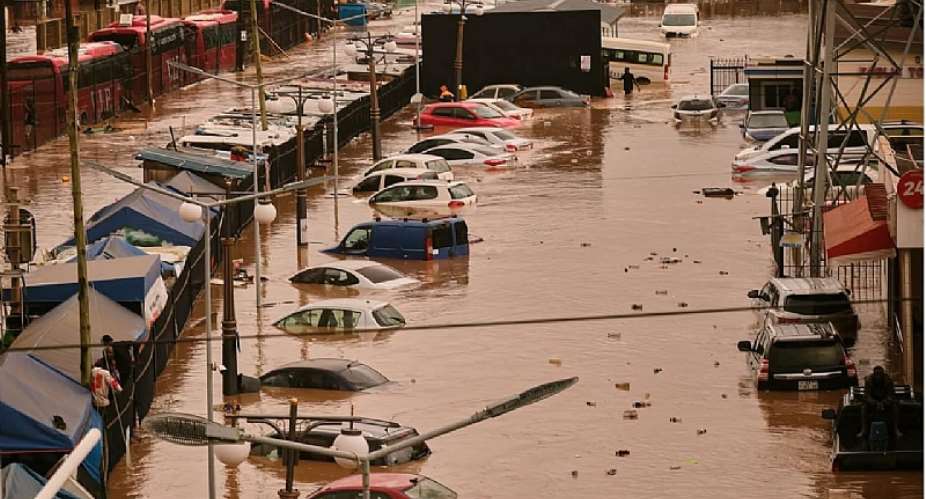
As we bid farewell to June today, Ghana leaves the month with mixed emotions. Yesterday's heavy downpour, particularly in Accra and several parts of the country, was more than just another rainy day.
It was a painful reminder of a challenge we have lived with for far too long.
Lives were lost. Families were displaced.
Businesses watched years of investment disappear within hours. Homes were flooded, roads became rivers, and countless commuters were stranded.
Many workers could not report to their workplaces, bringing productivity to a halt. Children returned home from school disappointed, while some students had their examinations interrupted.
Across social media, heartbreaking videos and voice notes captured the desperation of people pleading for help. We witnessed the incredible commitment of our emergency responders. Personnel from NADMO, the Fire Service, the Military, the Police, and many ordinary citizens risked their own safety to rescue others. Their courage deserves our gratitude.
Yet, after every flood, one question remains:
How do those who lost everything begin again?
- How does the trader whose shop has been destroyed rebuild?
- How does the family that spent the night in floodwater find hope?
- How do parents explain to their children that everything they owned has vanished?
These are not just statistics. They are fellow Ghanaians. The painful truth is that, this is no longer a surprise. It has become a recurring national tragedy.
Governments have changed. Leaders have come and gone. Committees have been formed. Promises have been made. Yet every rainy season seems to leave us counting more losses than lessons. Perhaps it is time to move beyond politics.
Floods do not ask which political party we belong to before entering our homes. Rain does not discriminate.
The solution must become a national responsibility. We must enforce planning regulations without fear or favour. We must stop building on waterways. Our drainage systems must be expanded and maintained. Waste management must become a civic duty, not just a government responsibility. Climate resilience should no longer be treated as an option but as an urgent national priority.
Every institution, from central government to metropolitan, municipal and district assemblies, engineers, planners, traditional authorities, businesses, communities and individual citizens—has a role to play.
Pointing fingers will never stop the next flood. Taking responsibility might.
As June bows out, let us not simply say, "What a terrible rain." Let us ask, "What have we learned?"
May the souls of those who lost their lives rest in perfect peace 🙏. May those who lost homes, businesses and loved ones find strength to rebuild. And may Ghana finally summon the collective will to turn recurring disasters into lasting solutions.
Goodbye, June. May the lessons from the rain stay with us longer than the floodwaters.
 UTAG-UCC rejects GTEC's proposed harmonisation of academic promotion guidelines ...
 Police arrest suspect over robbery, rape and assault in Koforidua
 Nigerian cyber fraud suspect wanted by INTERPOL and FBI arrested in Accra
 High Court nullifies Nii Amoo Dodoo's appointment to Ga Traditional Council Judi...
 Maritime and Related Offences Bill 2026 to combat piracy passed
 Ghana's 593.2mm rainfall in June highest since 1995 as floods kill 12
 169.2mm June 29 rain disaster warns Ghana of more danger ahead
 12 dead, 7 missing, 7761 households hit in June 29 floods in Accra
 TOR clears 6-year backlog of audited financial statements
 Adwoa Safo petitions Attorney General to transfer brother's shooting case to Hig...
