




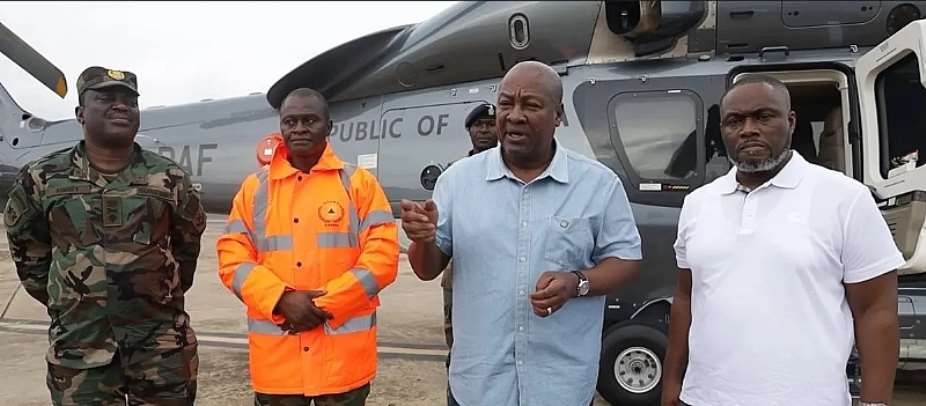
President John Dramani Mahama has attributed the devastating floods that swept through parts of Accra on Monday, June 29, to the combined effects of climate change, poor urban planning and human activities, while announcing a nationwide crackdown on buildings and other structures obstructing the capital's drainage system.
Speaking after an aerial inspection of flood-hit communities, President Mahama expressed sympathy to families who lost property in the disaster and assured affected residents of immediate government support.
"I wish to express my deepest sympathy to all those who have lost property as a result of today's floods. The damage has been extensive, and many families have been severely affected," he said.
According to the President, preliminary data showed that about 140 millimetres of rainfall fell over Accra on Sunday, making it one of the heaviest single-day downpours recorded in recent years. He noted that the highest single-day rainfall recorded last year was about 56 millimetres.
Mahama said the increasing intensity of rainfall is evidence of changing climate patterns, citing data from the Ghana Meteorological Agency indicating that rainfall in Accra has risen significantly over the past three years. He explained that within a 30-day period in June 2024, the capital recorded about 85 millimetres of rainfall, which increased to 172 millimetres in June 2025 and approximately 333 millimetres in June 2026.
"This means that our waterways no longer have sufficient time to recover before more rain falls," he said, adding that rainfall occurred on about 22 days in June this year, leaving only a few dry days.
Beyond climate change, the President blamed poor planning and indiscriminate development for worsening the flooding situation. He said rapid urbanisation had led to buildings being constructed along the natural paths of streams that previously carried floodwaters safely into the Atlantic Ocean.
He stressed the need for major engineering interventions to reopen blocked waterways and improve the city's drainage infrastructure.
Mahama also condemned illegal waste disposal practices, saying residents continue to dump refuse into drains and wetlands, reducing their capacity to absorb floodwaters.
During the aerial inspection, he said government observed several wetlands being used as illegal dumping sites where operators of tricycles paid to dispose of refuse. According to him, some individuals later reclaim and sell the land for housing development, further increasing the risk of flooding.
"We must therefore tackle this challenge from both an engineering and an enforcement perspective by opening blocked channels and identifying structures obstructing the natural flow of water," he stated.
The President announced that the National Security Council would meet urgently to address the flooding crisis, after which all Metropolitan, Municipal and District Assemblies would be directed to identify structures obstructing major drainage channels within their jurisdictions.
He said the identified buildings would be demolished, while the resulting debris would also be cleared to prevent further obstruction of waterways.
"There is no point demolishing a structure if the debris is left behind to continue obstructing the waterways," he said.
Mahama acknowledged that previous attempts to remove structures from waterways had attracted criticism, but maintained that decisive action was necessary to protect lives and property.
He also outlined a long-term strategy to reduce pressure on Accra through the development of a new growth centre outside the capital. The project, expected to span about 20 years, will involve relocating some major government institutions and providing roads, water and electricity to support the new city.
To support victims of the floods, the President directed the National Disaster Management Organisation (NADMO) to identify affected households and provide immediate assistance. He also instructed the Minister for Finance to release money from the Contingency Fund to support relief efforts.
Mahama commended the Ghana Armed Forces, the National Disaster Management Organisation, the Ghana Police Service, the Ministry of Works, Housing and Water Resources, emergency response teams and the 48 Engineers Regiment for their swift rescue operations, saying their efforts helped prevent a greater tragedy.
He urged Ghanaians to adopt better sanitation practices and avoid developing in flood-prone areas, stressing that lasting solutions require both government intervention and public cooperation.
"We must find a permanent solution to the flooding challenge in Accra," the President said. "This time, we must act differently."

 Cedi ends June 2026 selling at GHS12.30 on forex market, GHS11.34 on BoG interba...
 ‘Guard Lake Bosomtwe with special task force like River Nile in Egypt’ – KsTU le...
 Dr Osei Adutwum condemns alleged illegal mining around Lake Bosomtwe
 KNUST Planning lecturer urges Bosomtwe residents to lead fight against illegal m...
 ECOWAS rejects claims of interference in Guinea-Bissau's internal affairs
 Ghana issues travel advisory to nationals amid June 30 planned protests in South...
 Akufo-Addo-Bawumia govt did not ignore Accra flooding crisis — Ahiagbah
 Flood crisis: Mahama blames climate change, poor planning; announces crackdown
 Police arrest four suspected drug peddlers, recover firearm and narcotics in Ash...
 Floods: PURC monitors power outages as ECG, GRIDCo work to restore supply

Comments
Settings President speech will always betrays him. Was it not this same man, who stood on campaign platform and “blasted” former President Akuffo Addo for being ineffective so far as sanitation was concerned. At that time was climate change and poor planning not the issue for poor sanitation in Ghana? Ghanaians should be discerning in seeing through the settings of this government.