




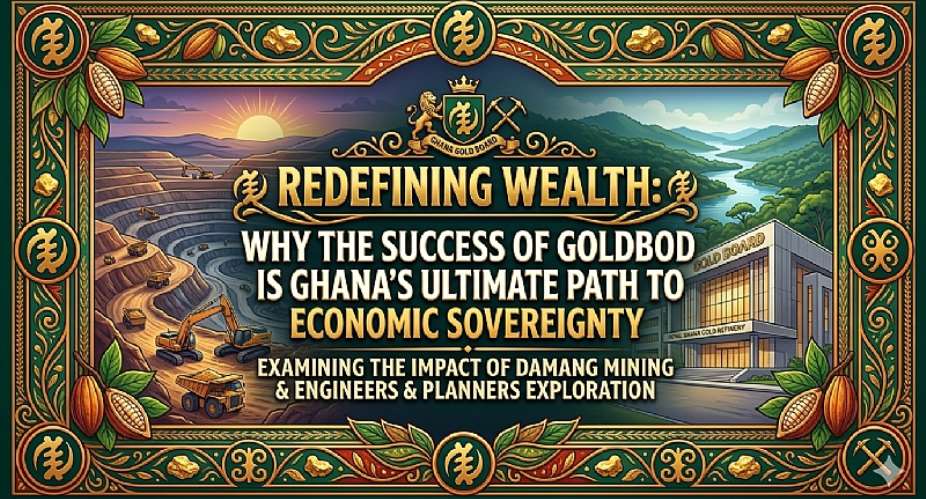
For over a century, Ghana has worn the crown of Africa’s premier gold producer, yet our people have lived through a jarring paradox. We stand atop billions of dollars in geological wealth, yet our national currency regularly battles inflation, our foreign exchange reserves remain vulnerable, and our sacred forest canopies have been systematically scarred by unregulated exploitation. The old model—where raw Ghanaian doré bars are loaded onto planes, flown to foreign shores, and refined into premium bullion while leaving our domestic economy with fractions—is no longer sustainable.
The launch of the Royal Ghana Gold Refinery alongside the Ghana Gold Board (GoldBod) represents our defining moment of economic emancipation. This is not just another regulatory framework; it is an aggressive, multi-front campaign to secure our mineral borders, defend the Cedi, and heal our environment. For the sake of our rivers, our forests, our economy, and the generation of Ghanaians yet unborn, GoldBod must succeed.
The Corporate Catalysts: How Damang and Engineers & Planners Impact the Vision
To appreciate the scale of GoldBod’s mandate, we must look at how critical private and indigenous mining giants are shifting the landscape. The success of the 30% Gold Offtake Agreement relies heavily on high-yield operations and localized operational capacity:
1. The Revitalization of the Damang Mine
- Sustaining National Output: The Abosso Goldfields Damang Mine remains a crown jewel in Ghana’s mining landscape. As it undergoes strategic optimizations to access deeper, high-grade ore bodies, its steady output injects critical volume into the national pool.
- The 30% Impact: With the July 1, 2026 mandate active, 30% of Damang's high-grade production is diverted straight to GoldBod, settled purely in Ghana Cedis (GH¢). This drastically cuts the state's reliance on spending scarce US Dollars to buy back our own refined gold for national bank reserves.
- Community Alignment: As Damang expands its local value retention, it provides a stable operational blueprint for how large-scale miners can seamlessly feed the Royal Ghana Gold Refinery without disrupting global investor relations.
2. The Indigenous Powerhouse: Engineers & Planners (E&P) Exploration
- Breaking the Foreign Monopoly: For decades, heavy mining contract services and deep exploration were dominated by foreign multinationals. The aggressive expansion of Ibrahim Mahama’s Engineers & Planners (E&P) proves that Ghanaian companies possess the world-class engineering capability to run tier-one mining operations.
- Expanding the Resource Base: E&P’s exploration and contract mining footprint across critical concessions injects massive indigenous efficiency into the sector. Because E&P is a wholly Ghanaian-owned corporate citizen, a significantly higher percentage of its operational profits stay within the local banking ecosystem compared to foreign contractors.
- Direct Supply to GoldBod: By successfully extracting gold via local hands and local machinery, E&P creates an uncompromised, clean pipeline of gold that feeds directly into GoldBod’s Blockchain Track and Trace System. This minimizes the risk of capital flight and ensures that Ghanaian engineering directly builds the nation's gold reserves.
Expanded Strategic Recommendations for Policy Implementation
To ensure GoldBod maximizes the immense contributions of assets like Damang and indigenous giants like E&P, the following structural policies must be fiercely executed:
- Incentivize Indigenous Exploration: The Ministry of Lands and Natural Resources must create targeted tax rebates and fast-tracked licensing for indigenous contract miners like E&P. This will encourage more local ownership in deep exploration, ensuring that upcoming concessions are built on a "Ghana-First" foundation from day one.
- Create an Independent Gold Monitoring Council: To completely eliminate the ghost of past financial errors—such as the massive GH¢7 billion losses recorded under previous gold purchase schemes between 2022 and 2024—an independent board comprising representatives from the Ghana Chamber of Mines, the World Gold Council, and local civil society must audit GoldBod's trading books every quarter. Transparency is our greatest shield against corruption.
- Establish the "Green Mine" Micro-Credit Facility: GoldBod should use a portion of its trading margins to create localized micro-credit schemes. This fund will provide modern, eco-friendly processing equipment to registered, formalized small-scale mining cooperatives, helping them completely move away from mercury use and illegal galamsey operations.
- Enforce Strict Local Value-Chain Quotas: No foreign mining company should be permitted to import basic inputs that can be manufactured or serviced locally. Following the E&P model, the state must mandate that heavy earthmoving, engineering services, and local supply chains are strictly reserved for verified Ghanaian companies.
A Resilient, Self-Sustaining Future
When we look at the numbers, the path ahead is clear. Large-scale miners spent an incredible US$7.14 billion inside our local economy in 2025. By capturing 30% of this productivity through GoldBod, deploying immutable blockchain security, processing our gold in our own state-of-the-art refineries, and restoring our destroyed forest reserves like Tano Nimiri, Ghana is building an unbreakable economic shield.
The days of being passive spectators to our own wealth are over. With local engineering driving our mines and state-backed sovereignty securing our bullion, we are finally turning our natural resources into a resilient future for all Ghanaians.
✍️ Retired Senior Citizen
For and on behalf of the Senior Citizens of the Republic of Ghana 🇬🇭
Teshie-Nungua [email protected]

 Cedi ends June 2026 selling at GHS12.30 on forex market, GHS11.34 on BoG interba...
 ‘Guard Lake Bosomtwe with special task force like River Nile in Egypt’ – KsTU le...
 Dr Osei Adutwum condemns alleged illegal mining around Lake Bosomtwe
 KNUST Planning lecturer urges Bosomtwe residents to lead fight against illegal m...
 ECOWAS rejects claims of interference in Guinea-Bissau's internal affairs
 Ghana issues travel advisory to nationals amid June 30 planned protests in South...
 Akufo-Addo-Bawumia govt did not ignore Accra flooding crisis — Ahiagbah
 Flood crisis: Mahama blames climate change, poor planning; announces crackdown
 Police arrest four suspected drug peddlers, recover firearm and narcotics in Ash...
 Floods: PURC monitors power outages as ECG, GRIDCo work to restore supply
