





The public controversy that greeted the announcement that Nigeria’s First Lady, Senator Oluremi Tinubu, would provide N50, 000 grants to women to encourage them involve in such small-scale businesses as frying and selling akara or producing kulikuli revealed far more than disagreements over a government intervention. It exposed the more than less widening gulf between the realities of everyday Nigerians’ lived experiences and the assumptions of those in positions of political authority. It also raised legitimate questions about public policy, the symbolism of leadership, and what constitutes meaningful poverty alleviation in an economy that appears to be interminably struggling with inflation, unemployment and declining purchasing power among working class families.
Obviously, the reactions that followed in the wake of Mrs. Tinubu’s statement were inevitable. Although it did not call for insulting the First Lady or her husband, the President, as many angry Nigerians did with enormous venom on the social media, for many Nigerians, the amount Her Excellency offered became the story itself. At today's exchange rate of roughly £1 to about N1, 900, the sum of N50, 000 would be equivalent to approximately £26. Even when we allow for differences in local purchasing power, it is difficult to argue that such a sum can transform the fortunes of a household, especially at a time when inflation has significantly increased the prices of foodstuffs, transportation, cooking fuel and other essentials. But before we dismiss the initiative outright, it is important to examine what exactly the First Lady intended and whom she was addressing.
Senator Oluremi Tinubu must have been speaking in her capacity as Nigeria's First Lady. In that case, the announcement naturally attracted national scrutiny because the office of the First Lady, although it is not constitutionally defined, carries enormous symbolic influence. Nigerians would understandably assume that any programme announced by the wife of the President is meant to benefit women across the federation. The expectations, therefore, become national. So, if the announcement was intended as a national poverty reduction initiative associated with the office of the First Lady, then Nigerians are justified in evaluating it against the country's economic realities and against the scale of the poverty challenge confronting millions of families.
Nigeria today is a country where inflation has eroded incomes at an alarming rate. Prices of staple foods have multiplied within a relatively short period. Transportation costs have risen sharply following the removal of fuel subsidies. Electricity tariffs have increased for many consumers. Rent, school fees, healthcare and virtually every component of household expenditure now consume a much larger share of family incomes than they did only a few years ago.
Against this backdrop, N50, 000 does not possess the purchasing power it once had. A decade ago, the amount could have financed a respectable inventory for a roadside trader. Today it may barely purchase the raw materials required to sustain a small food business for a short period. Anyone attempting to establish an akara business would need groundnut oil, beans, pepper, onions, cooking gas or firewood, utensils, packaging materials and perhaps a suitable location. These costs alone could consume a significant portion of the grant before any meaningful trading begins.
But that does not mean that the money is worthless. For a widow struggling to feed her children, a disabled woman attempting to rebuild her livelihood or a market trader seeking to replenish depleted stock, N50, 000 can provide temporary relief. It can enable someone to restart a tiny enterprise or avoid falling deeper into financial distress. Small grants have helped individuals throughout history.
The problem arises when isolated success stories are presented as evidence that such grants constitute a comprehensive solution to widespread poverty. Poverty is rarely caused by the absence of a single cash payment. It is usually the consequence of structural economic weaknesses, unemployment, inadequate infrastructure, poor educational opportunities, unstable electricity supply, insecurity, limited access to affordable credit and persistent inflation. Without addressing these deeper problems, cash transfers will continue to become temporary palliatives rather than engines of economic transformation. This explains why economists consistently distinguish between welfare support and sustainable development. Welfare programmes are designed to provide immediate assistance to vulnerable populations during periods of hardship.
Such interventions have their welcome place, particularly during economic crises. However, sustainable development focuses on creating conditions in which citizens can earn stable incomes through productive employment, profitable businesses and expanding economic opportunities. Countries that successfully reduced mass poverty did not do so by generally relying on isolated cash grants but on sustained economic growth, industrial expansion, agricultural productivity, investment in education, reliable infrastructure and macroeconomic stability. Nigerians’ greatest need is not merely more empowerment ceremonies but an economic environment in which entrepreneurs can thrive without facing crippling inflation, multiple taxation, erratic electricity supply and prohibitive borrowing costs.
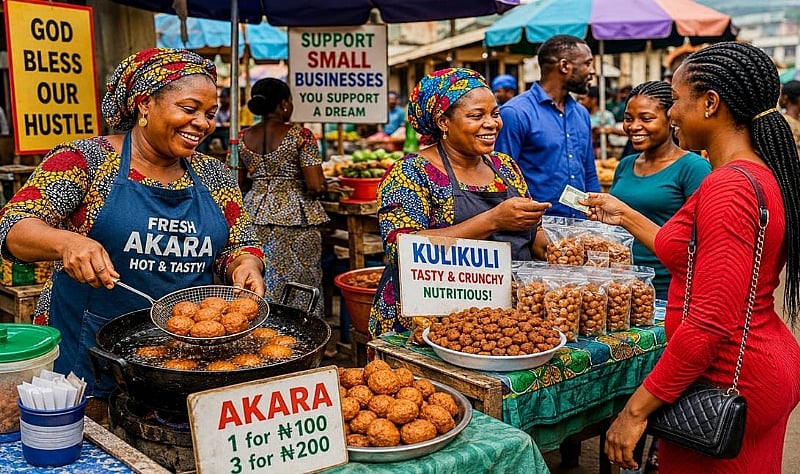
There is also an important psychological dimension to this controversy. Many Nigerians could not interpret the reference to frying akara or producing kulikuli as encouragement towards entrepreneurship but as an indication that political leaders possess limited appreciation of the aspirations of educated young-adult Nigerians professionals and struggling middle-class families whose economic circumstances have deteriorated dramatically. There is nothing inherently degrading about selling akara. Honest labour deserves respect regardless of occupation. Across Nigeria, countless families have survived and educated their children through small food businesses. Many successful entrepreneurs began with humble ventures.
The issue is not the dignity of the occupation. Rather, it concerns the scale of national ambition. Citizens naturally expect governments to pursue policies that are capable of generating higher-productivity employment in businesses like manufacturing, technology, agriculture, services and creative industries while they also support micro-enterprises. The development strategy of a nation should aspire to create opportunities at every level rather than appear to suggest that informal survival businesses represent the highest realistic aspiration for millions of its citizens.
Above all, political communication matters almost as much as policy itself. Leaders must appreciate how their words resonate with an anxious population experiencing economic hardship. Statements intended as encouragement can easily be interpreted as evidence of diminished expectations if they are not carefully framed within a broader vision of economic transformation.
Equally important is the issue of accountability. Public attention should not remain perpetually fixed on the announcement itself. The more important questions concern implementation and measurable outcomes. How many women actually received the N50, 000 grants? Were beneficiaries selected through a transparent and verifiable process? Was distribution conducted fairly across political, religious and ethnic lines? Did recipients establish sustainable businesses? Were their household incomes improved six months or one year after receiving the grants? How many businesses survived beyond the initial period? Were there any mechanisms for the monitoring, mentoring and supporting of beneficiaries after disbursement?
Without credible answers to these questions, public debate risks becoming dominated by political sentiment rather than by evidence. Many empowerment programmes in Nigeria have long been known to generate impressive launch ceremonies, colourful photographs and optimistic press releases but ended up receiving very little independent evaluation afterwards. Therefore, success should never be measured by the amount announced or even by the number of cheques distributed. It should be measured by lasting improvements in people's lives. If thousands of women genuinely increased their incomes, expanded their businesses and became financially independent because of the initiative, then the programme would deserve recognition irrespective of the modest size of each grant. Conversely, if distribution lacked transparency or beneficiaries experienced little long-term improvement, then criticism would be justified regardless of the good intentions behind the scheme.
Nigerians, rather than increase their blood pressure by being unnecessarily angry with the government should evaluate such interventions through evidence rather than political emotion. The country's poverty challenge is too serious for simplistic conclusions. Therefore, neither outright dismissal nor unquestioning praise serves the public interest. Small grants can provide temporary assistance and could even change individual lives. But they cannot substitute for comprehensive economic reforms capable of creating prosperity on a national scale.
Nigeria's leaders face a larger responsibility than announcing periodic empowerment programmes. They must build an economy in which businesses can flourish, inflation is controlled, investors have confidence, infrastructure supports productivity and young people can obtain meaningful employment without depending indefinitely on government handouts. A one-off grant will definitely relieve immediate hardship for some beneficiaries. It can even help a determined entrepreneur take the first step towards self-employment. But no serious economist would argue that grants of this nature alone can lift millions of families permanently out of poverty.
Lasting poverty reduction in every single case requires sustained economic growth, productive investment, expanding employment opportunities, stable prices and institutions that enable enterprise to thrive. Those are the foundations upon which prosperous societies are built. And that is ultimately where Nigerian leaders should direct their greatest energies. Empowerment grants may provide temporary comfort, but only sound economic governance can provide lasting hope for the vast number of Nigerian people.

 A/R: Kumasi tomato traders push for revival of local tomato industry
 Don't let free primary health care go waste — Mahama urges Ghanaians
 We are still engaging the investor to revive Komenda Sugar Factory — Mahama
 We will defeat Croatia — Mahama predicts
 Nearly 6.8 mn people may be affected by Venezuela quakes, UN says
 Notre Dame Girls’ SHS student dies after writing last WASSCE paper
 GTEC questions dismissal of Bolgatanga Technical University Vice Chancellor
 'You can't come and abuse Ghana's resources and run away to avoid accountability...
 Dr. Adutwum Campaign Aide appeals for calm as Ken Agyapong row deepens
 Mahama demands strict quality checks before road payments


