




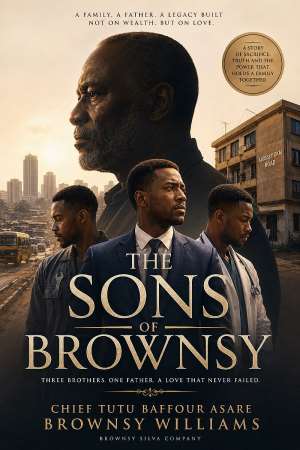
There is a proverb tucked inside the opening pages of The Sons of Brownsy that does not announce itself with fanfare. It arrives quietly, the way the most important things always do: "A man who stops moving is a man who has already died." Those ten words belong to the Williams family of Kumasi, passed down like a gene rather than a lesson, and by the time you reach the final page of this novel, you will understand that this single sentence is not merely a family motto. It is the skeleton of everything that follows — the invisible architecture holding up 250 pages of one of the most honest, emotionally devastating, and quietly magnificent pieces of African fiction to emerge from Ghana in recent memory.
This is not a review that will be gentle with its admiration. The Sons of Brownsy deserves better than gentle admiration. It deserves the kind of direct, full-throated reckoning that it extends to its own characters — clear-eyed, unsparing, and rooted in the conviction that the truth, even when it is difficult, is the only thing worth saying.
Who Wrote This Book and Why That Matters
Chief Tutu Baffour Asare Brownsy Williams is a Ghanaian author, columnist, and creative director operating under the umbrella of Brownsy Silva Company, a multi-disciplinary creative enterprise that has, in a remarkably short period, established itself as one of the more distinctive voices in contemporary West African literary and media culture. His column on Modern Ghana has covered everything from infrastructure policy to geopolitics to women's health, always with the analytical confidence of someone who sees the human story beating beneath the news story. His fiction portfolio — which spans the African mythology epic Reborn: The River of Girls, the dark romance The Ghost of Yesterday's Blood, and the Diaspora Kings drama series, among others — demonstrates a range that is genuinely unusual: an author equally comfortable in myth and realism, in political commentary and intimate domestic fiction.
The Sons of Brownsy sits at the center of that range. It is his most personal work. It is, on its surface, the story of a father and his three sons navigating poverty, ambition, shame, and love in Accra, Ghana. Beneath that surface, it is a meditation on what fatherhood actually costs — not in money, though it costs plenty in money too — but in the silent, daily, invisible expenditure of a man who has decided that he will not stop moving no matter what the world does to him.
The novel is published under Brownsy Silva Company's First Edition imprint (June 2026) and is available to read on both Wattpad and Medium, where it has been made accessible to the widest possible audience — a deliberate choice that tells you something important about the author's priorities.
What This Novel Is: Genre, Form, and the Shape of the Story
The Sons of Brownsy is a work of contemporary African literary fiction. It is a family saga compressed to its essential pressure points — lean, precise, and with none of the sprawl that can soften the impact of the form. It is divided into five named parts and an epilogue, each section building on the last with the structural logic of a tragedy that refuses, in the end, to become one.
The novel is set primarily in Accra, Ghana, in the present day, with significant flashback context rooted in Kumasi. Its timeline covers eighteen years of the Williams family's life, from the moment Tutu Baffour Brownsy Williams packs his three sons into a taxi after financial ruin in Kumasi and drives south to start over — with nothing but dignity and determination — to the quiet, luminous morning decades later when he sits at his kitchen table and discovers, in the way only a man who has survived everything can discover, that he is still here. And that that is enough.
It is a novel in the tradition of domestic realism — in the company, spiritually if not geographically, of works that treat the interior of the family home as the most revealing site of human drama. Think of it as what happens when the Ghanaian story of migration, class, ambition, and shame is told not through spectacle but through the granular, accumulated texture of daily life: rent columns in a notebook, engine grease in knuckle creases, a sofa covered with a market throw, reading glasses bought for twelve cedis from a Kaneshie vendor.
This is the literary tradition of the seen but unseen — fathers who are everywhere and nowhere in the cultural imagination, who carry civilizations on their backs without press coverage or ceremony, and who are only truly understood, if they are understood at all, by the children who were watching them more carefully than they knew.
The Full Story: Plot Overview
The novel opens in Kumasi, at the moment of collapse. Tutu Baffour Brownsy Williams — maintenance engineer, patriarch, and a man raised on the gospel of forward motion — watches creditors padlock the gate of the family compound. His business has failed. The money he was owed was never repaid. The world he built has closed around him like a sentence with a final period. He has three sons: Kwame, sixteen, already calculating and proud; Kofi, fourteen, brilliant and constitutionally impatient with the world's administrative requirements; and Ebo, twelve, who still believes his father can fix anything. On a Tuesday morning in October, Tutu loads his boys and their two bags into a taxi and leaves.
They arrive in Accra to a city that does not welcome them. It tests them. They live for six weeks in two rooms behind Uncle Boateng's provisions store in Nima. Tutu applies for every position available to a man with his skills and not enough connections. He repairs generators on weekends. At night, he does his accounts in a notebook, in a corridor, alone, because the numbers do not improve by avoiding them.
Six months later, he secures a permanent position as a maintenance supervisor at a manufacturing plant on the industrial corridor and signs the lease on a third-floor apartment on Abossey Okai Road. He presents it to his sons as a palace. Kwame is skeptical. Kofi finds the room with the best light for his books. Ebo asks if he can have his own corner.
"You can have whatever you build," Tutu tells him.
Eighteen years pass. The novel traces what is built.
Kwame becomes a lawyer at a prestigious firm in Airport Residential — ambitious, polished, driven, and quietly ashamed of where he came from. When he falls in love with Adaeze Osei-Bonsu, daughter of prominent legal patriarch Chief Emeka Osei-Bonsu, he begins constructing a performance version of himself — describing his father as being "in industrial management," never mentioning Abossey Okai Road, keeping the two worlds hermetically separated. He tells himself these are not lies. They are edited truths. He believes this with the desperation of a man who needs to.
Kofi becomes the most diagnostically gifted resident in his cohort at a teaching hospital in Accra — and the one most likely to send the administrative coordinator to an early grave. His relationship with deadlines is philosophical. His brilliance has always been just sufficient to rescue him from his own tendencies without ever forcing genuine reform. He is thirty-two, completing his residency, and quietly falling in love with Abena Owusu — who happens to be the same woman his youngest brother Ebo has been in love with, silently and completely, for four years. Kofi does not know this because Ebo has not told anyone. This is an oversight that will matter.
Ebo is the son who most resembles his father. He went directly from school to a garage, then to an automotive workshop in Achimota, then to six days a week of labor whose wages quietly made it possible for Kwame to sit bar exams and for Kofi to complete medical school without a second job. He has never said this to anyone. He comes home with engine grease that never fully washes off. He watches football with his father in the evenings. He is in love with Abena Owusu and has been building up to saying so for four years, waiting until conditions are right, until he has more to offer.
The conditions, as they tend to, shift before he speaks.
The novel's central crisis arrives in three detonations. First: Chief Emeka Osei-Bonsu's quiet research into Kwame's background, and Adaeze's decision to go find Tutu Williams herself — arriving at Abossey Okai Road on a Wednesday afternoon, sitting on the recovered sofa, and having the conversation with a father that his own son had never allowed to happen. Second: Kofi's arrest, following his decision to divert controlled medications for a pharmaceutical distributor — a decision made, in the elemental error of good men in desperate situations, because Abena's mother needed a procedure he could not afford legally. Third, and most devastating: the arrival at the apartment door of Emmanuel Asare-Kusi, the man who borrowed money from Tutu's business eighteen years ago and never repaid it — and who is also, as Tutu has always known and never told, the biological father of Kwame Williams.
The collision of these three truths — Kwame's performed identity, Kofi's criminal charge, and the secret Tutu has carried for thirty-four years — strips every Williams man down to what he actually is. What follows is the novel's most powerful sequence: Tutu telling Kwame the truth at the kitchen table, Kwame's face breaking open for the first time, and the long, difficult, irreversible process of repair.
The Characters: Who They Are and What They Carry
Tutu Baffour Brownsy Williams is the moral and emotional center of the novel, and he is — without any contest — one of the most fully realized father figures in recent African fiction. He is sixty-three by the epilogue, though the novel tracks him from his mid-forties. He is a maintenance supervisor. He buys his reading glasses from a market vendor for twelve cedis. He keeps accounts in a small notebook. He wakes before dawn and sits with calculations that never quite resolve and allows himself, for exactly as long as it takes to finish one cup of tea, to feel the full weight of everything — and then washes the cup and goes to bed.
He is not soft. He is not demonstrative in the language his culture reserves for sentiment. His love is expressed through presence — through the specific, daily, untheatrical act of continuing to show up. When Kwame hides him from Adaeze's family, he says nothing. When Kofi is arrested, he sits at the table for three minutes, puts on his shoes, and goes. When the truth about Kwame's parentage must finally be spoken, he speaks it with the same precision he brings to his notebook columns: clearly, without cruelty, and without asking for absolution he has not earned.
He is also, and this is what makes him extraordinary rather than merely admirable, a man with a secret. He has known for thirty-four years that he is not Kwame's biological father. He has chosen, every single day of those years, to be his father in the way that matters — and he has protected Kwame from a truth he judged, in the early years rightly and in the later years with the accumulating weight of habit, would cause more pain than it resolved. The revelation of this secret, and Tutu's explanation of it — "I have never once, not in thirty-four years, wished you were not my son" — is the novel's single most powerful moment, and it earns every syllable.
Kwame Williams is thirty-four, a lawyer, and the novel's most psychologically complex portrait of class aspiration and inherited shame. His ambition is not shallow. It is the ambition of a man who watched his world collapse at sixteen and has spent every subsequent year building walls against that kind of collapse — walls that are, unfortunately, also walls against the people inside them. His relationship with Adaeze forces the novel's central question: what is a man made of when the performance version of him encounters a woman perceptive enough to see through it? His journey from the man who hides his father to the man who sits in the kitchen and lets his face break open is the novel's spine.
Kofi Williams is thirty-two, a medical genius, and the novel's most morally complicated character. His arrest is not the story of a corrupt man. It is the story of a brilliant man who has never been forced to confront the real consequences of his tendencies — until a woman's mother needs a procedure he cannot afford legally and he makes the choice that good people in desperate situations have always made. What makes Kofi interesting is not the crime. It is the specific quality of his intelligence — the kind that processes complexity easily but resists the administrative architecture of consequences until the architecture falls on him.
Ebo Williams is thirty, an automotive mechanic, and the character who will quietly destroy you. He has subsidized his brothers' educations and careers for a decade without once mentioning it. He is in love with a woman for four years without saying so because he is waiting to be sure the conditions are right. He is the novel's most Tutu-like figure — not in biography but in moral temperament — and his quiet declaration to Abena on the veranda ("You have been offering me exactly what I needed for four years already") is the novel's second most powerful scene.
Adaeze Osei-Bonsu is Kwame's fiancée — perceptive, well-raised, and equipped with the specific inheritance of a thorough father. She does not embarrass the novel by being naive about Kwame's omissions. She sees them. She drives to Abossey Okai Road herself, meets Tutu without announcement, and has a conversation that shifts something in her she will spend weeks trying to name. She is not a figure of judgment. She is a figure of choice — and her choice, at the end, to say "Let's start from here" is the novel's most quietly earned moment of hope.
Emmanuel Asare-Kusi is not a villain. He is a man who made specific bad choices, borrowed money he did not repay, and lived in London for twenty-two years with the consequences — which is not the same as atonement but is its own species of punishment. His arrival at the apartment door by accident — looking for a different address entirely — is the novel's most perfectly constructed piece of structural irony. Fate, the novel suggests, has never been particularly interested in convenience.
Abena Owusu is the woman both Kofi and Ebo encounter, for different reasons and without knowledge of each other's interest. She is warm, practical, funny in the deadpan register of people who have learned to find comedy in difficulty, and she handles the situation with the directness of a woman who does not manage information dishonestly. Her telling Ebo about Kofi's approach — rather than keeping it from him — is a small moment that tells you everything about her character.
The Scenes That Stay With You
There are novels you finish and forget within weeks. There are others that leave specific images lodged in you permanently, images that surface unexpectedly months later the way a song does. The Sons of Brownsy is the second kind of novel. Here are the moments it plants in you without asking permission.
The padlock clicking shut on the family compound in Kumasi — a sound the novel describes as "a period at the end of a sentence he had spent fourteen years writing." You hear it. You do not unhear it.
Tutu at the kitchen table at night, doing his accounts in the narrow corridor outside the boys' room, looking carefully at numbers that do not improve by being looked at carefully. He looks anyway. Because a man who cannot face his numbers has already surrendered to them.
Tutu presenting the third-floor apartment on Abossey Okai Road as though it were a palace. "This is where we start again. Not where we end up. Where we start." Kwame is skeptical. Kofi finds the window. Ebo asks for a corner. The father stands in an empty room and wills his conviction to substitute for the facts.
Adaeze visiting the apartment — arriving in a car that costs more than three years of Tutu's salary, dressed simply because she is too well-raised to overdress — and Tutu serving her himself, asking her genuine questions, making her laugh twice with the unguarded laughter that catches a person off-guard and reveals something true about them. Kwame watching his father charm his fiancée with "the complicated feeling of a man who is simultaneously proud and terrified." This is the scene that defines what the novel means by love as performance versus love as presence.
Tutu's line after she leaves: "A marriage built on a man's performance cannot survive the night he's too tired to perform." He delivers it without theatre and leaves the room. Kwame lies in the dark looking at the ceiling in the silence that follows things that are true.
Adaeze's visit to Tutu — alone, unannounced, on a Wednesday when Kwame is in court. She tells him Kwame described him as "a family friend." He says: "He told you what he needed to tell you." Then: "The tragedy is that the story we came from is the best thing about him. He just can't see it yet." Then: "Whoever you marry, make sure you're marrying the real one." He says all of this while looking at the woman his son is hiding him from, and he says it without bitterness, without self-pity, without anything but the clear precision of a man who has long since stopped requiring the world to be fair.
Ebo in Kwame's office reception — workshop clothes, engine grease in his knuckles, sitting without embarrassment on the polished floors while suited colleagues glance at him. Kwame comes out and says he can't just leave. Ebo says: "Kwame." Just the name. "He's your brother. He's in a police station. Daddy is with him. And you are the lawyer." The weight behind that sentence — twelve years of subsidized exams and fees and silences, compressed into a single line — is almost unbearable.
The kitchen table scene where Tutu tells Kwame the truth about Emmanuel Asare-Kusi. The reading glasses on the table. Two cups of tea. The measured, unhurried voice of a man who has been preparing for this conversation for thirty-four years and has decided that the time for preparation is over. "I have never once — not in thirty-four years — wished you were not my son." Kwame's face breaking open. Quietly. In the specific way of a man whose composure was always a performance, finally in the presence of the person from whom performance was never necessary.
Ebo on the veranda, telling Abena he loves her with Accra spread below them in its chaotic entirety. Four years. He waited four years. And her response — "You have been offering me exactly what I needed for four years already. You just didn't know that what you were offering was enough" — is what the entire novel has been building toward: the idea that what is genuinely given, even quietly, even without announcement, is not invisible.
The epilogue — Tutu at sixty-three, at the kitchen table, in the morning light, writing the date in a new notebook in the same careful upright hand. The apartment quieter now. The numbers finally moving in the right direction. The reading glasses proper ones now, from a real optician, because Ebo drove him to the appointment and refused to accept the cancellation. "You spent thirty years taking care of us. Sit in the chair." He sat in the chair. And now he writes the date. And picks up his tea. And looks at the light on the wall of the neighboring building. And is still here. And that, in the end, was everything.
The Dynamics, Twists, and the Architecture of Pain
The novel's most precisely constructed element is not its plot. It is its pattern of knowledge withheld. Every major crisis in The Sons of Brownsy is produced not by action but by the absence of speech — by what characters choose not to say, and what accumulates in that silence.
Tutu has not told Kwame the truth of his parentage for thirty-four years. Ebo has not told Kofi about Abena. Kwame has not told Adaeze who his father is. Kofi has not told anyone about the pharmaceutical arrangement. Each withheld truth operates like pressure beneath a sealed valve — building, building, until Emmanuel Asare-Kusi knocks on the wrong door and the release is simultaneous and total.
The twist of Emmanuel's arrival — a man walking into the wrong building and detonating a thirty-four-year secret simply by showing his face — is one of the novel's most technically daring choices. It refuses the melodrama of a planned confrontation. The truth arrives not because anyone sought it, but because a man in Accra for unrelated reasons knocked on the wrong door. This is how life actually works. The novel knows this.
The other structural daring is in what the novel refuses to do. It refuses to make Kwame's shame a character flaw requiring condemnation. It refuses to make Kofi's crime a simple moral failure. It refuses to make Ebo's sacrifice a nobility requiring recognition. These men are doing what people do — navigating, imperfectly, the conditions they were given — and the novel treats them with the same clear, non-judgmental precision that Tutu brings to his notebook columns. It just writes down what is there.
Selected Quotes That Deserve to Live Beyond This Novel
"A man who stops moving is a man who has already died."
"The numbers did not improve by looking at them more carefully, but he looked carefully anyway, because a man who cannot face his numbers is a man who has already surrendered to them."
"The tragedy is that the story we came from is the best thing about him. He just can't see it yet."
"A marriage built on a man's performance cannot survive the night he's too tired to perform."
"He told you what he needed to tell you."
"You can have whatever you build."
"I have never once — not in thirty-four years — wished you were not my son."
"You have been offering me exactly what I needed for four years already. You just didn't know that what you were offering was enough."
"You spent thirty years taking care of us. Sit in the chair."
"And that, in the end, was everything."
What This Novel Means — and Why It Arrives Now
African literary fiction has, in recent decades, produced an extraordinary body of work around the figure of the migrant, the returnee, the child of diaspora, the post-colonial subject. These are necessary stories. But there is a figure who has existed at the center of these stories all along, carrying the weight of every migration and every aspiration, who has rarely been given his own narrative space: the father who stayed. The man who did not leave. Who got up every morning in the apartment on Abossey Okai Road and put on his work clothes and came back in the evening with the wages of his labor and organized them in a notebook. Whose children grew up and moved into gleaming offices while he kept the same chair at the same table. Who loved them without requiring them to witness that love in the register they would later understand it deserved.
The Sons of Brownsy gives that man his story. And in doing so, it gives us something the literary moment has genuinely needed — not the father as symbol or obstacle or source of intergenerational trauma, but the father as protagonist in his own right, with his own interior life, his own losses, his own dignity, his own cups of tea at the kitchen table, his own complex decisions about what truths to carry and when to set them down.
This is why Tutu Baffour Brownsy Williams names this novel after his sons rather than himself. Because that is who he is. He has always understood his story in relation to theirs — as the ground they grew from, the weight they did not know they were being lifted by. The title is the final, most complete expression of his character: a man who defines his own significance through what he made possible for others.
That is not sacrifice. It is a philosophy of love. And The Sons of Brownsy is its document.
Where to Read This Novel
The Sons of Brownsy by Chief Tutu Baffour Asare Brownsy Williams is available now on Wattpad and Medium, published under Brownsy Silva Company's First Edition imprint (June 2026).
Follow the author's columns and creative work on Modern Ghana under the byline Chief Tutu Baffour Asare Brownsy Williams, where he publishes regular opinion and feature writing on Ghanaian public life, African affairs, and the human stories that exist beneath the headlines.
Chief Tutu Baffour Asare Brownsy Williams is a Ghanaian author, columnist, and creative director based in Accra. He is the founder of Brownsy Silva Company and the author of multiple works of fiction including Reborn: The River of Girls, Storm Over Paradise, The Ghost of Yesterday's Blood, and The Sons of Brownsy. His column appears regularly on Modern Ghana. His work can be read on Wattpad, Medium, and Amazon KDP.


 CUTS Raises Cartel Concerns Over Cement Manufacturers’ Uniform GH¢12 Surcharge
 I have not been invited by OSP over fake GH¢70,000 memo — Patricia Appiagyei
 Vetting committee has never taken bribes or gifts from nominees — Bernard Ahiafo...
 Chief Justice Baffoe-Bonnie clarifies controversial remarks
 Dunkwa-Ayanfuri road construction to commence in 2027 – Finance Minister
 PRESEC, St. Augustine’s College and Accra Academy set for NSMQ grand finale on S...
 Appiagyei denies alleged GH¢70,000 vetting payment in memo
 Lawyer challenges GRA’s power to grant passenger baggage tax exemptions
 Agbogbloshie waste heap is as high as 10-storey building – Mahama Ayariga
 'After getting the gold, you will get thirsty' – Kwaku Bonsam explains why galam...

