




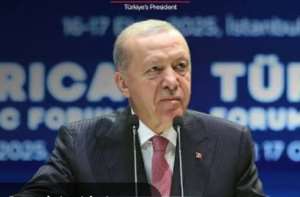
When a young police officer from the Republic of Congo stepped forward to receive his diploma from Turkish President Recep Tayyip Erdoğan at the National Police Academy in Ankara last week, and delivered a salute so sharp it halted entire hall of Turkish security officials and drew spontaneous applause, something more was on display than military courtesy. It was a small but vivid illustration of a profound geopolitical shift that has been unfolding across Africa for more than two decades the rise of Türkiye as the continent's preferred new partner, built not on the barrel of a colonial gun, but on schools, mosques, scholarships, airports and a carefully cultivated narrative of brotherhood.
The contrast with the European approach to Africa centuries of extraction, indirect rule, structural adjustment conditionality’s and post-independence paternalism dressed up as development aid could hardly be starker. And Africa, especially a new generation of Africans engaged in active decolonial movements, is noticing.
The Burden of Europe's African History
To understand why Türkiye's approach to Africa resonates so deeply, one must first reckon honestly with what came before. The European colonial project in Africa, which reached its peak after the Berlin Conference of 1884–85, was built on indirect rule the systematic co-optation of African political structures to serve imperial economic ends. Britain governed through chiefs. France imposed assimilation. Belgium used terror. Portugal held its colonies longest, conceding independence only after armed liberation wars.
Even after formal decolonization, the European relationship with Africa has remained structurally unequal. France's CFA franc a currency controlled from Paris locked fourteen West and Central African nations into a monetary arrangement that critics argue prioritized French financial interests over African economic sovereignty for decades. Western development aid arrived laden with conditions: governance reforms, fiscal austerity, privatization and structural adjustment programmes that gutted public sectors and deepened dependency rather than building indigenous capacity.
The International Monetary Fund and World Bank institutions dominated by Western voting power dispensed assistance with political and economic conditionality that African leaders increasingly resented. And when Africans sought to migrate to the very European countries whose corporations were extracting their continent's resources, they encountered increasingly hostile visa regimes and, at Europe's borders, barbed wire and detention centers.
This was the architecture of indirect rule not the formal chains of colonial administration but the invisible chains of economic dependence, monetary control, conditioned aid and selective engagement that kept Africa structurally subordinate long after the flags of independence were raised.
Türkiye Enters From a Different Door
Into this landscape stepped Türkiye and crucially, it entered from a door that Europe had never used: the door of genuine historical solidarity.
President Erdoğan has repeatedly stressed what he calls Turkish exceptionalism in Africa, arguing that "our ancestors have never had a colonial post in Africa in their millennial history … Our ancestors, who established states that spread across three continents, have never acted with imperialist purposes in other regions."
Whether or not one accepts this framing entirely, the historical point carries weight. The Ottoman Empire, at its greatest extent, touched the northern and northeastern edges of Africa Egypt, Libya, Tunisia, Algeria and parts of the Horn but it was never a colonizing power in the extractive European sense. It left no plantation economy, no racial hierarchy enforced by law, no deliberate cultural erasure.
Türkiye does not position itself as a rival to the other major players on the African scene. Its strategic and diplomatic pull in Africa is informed by a non-interventionist and sovereignty-centered approach to international politics. The commonalities between the African and the Turkish worldviews of the changing international order and continuous global inequalities are striking, with both sides seeking reform in the existing global governance architecture.
Unlike the often stringent conditions imposed on aid from Western nations, Türkiye's assistance comes with fewer obligations regarding comprehensive political and economic reform. This approach, which it shares with other emerging powers like India and China, is closely aligned with the preferences of African leaders who prioritize their ability to shape their own developmental pathways.
The Architecture of Embrace
Türkiye's engagement with Africa did not happen overnight. It was built methodically over more than two decades through a layered strategy that combined diplomatic expansion, economic investment, educational outreach, religious solidarity, security cooperation and cultural presence a full-spectrum partnership architecture that no European power had offered Africa on comparable terms.
The numbers tell part of the story. Türkiye's trade volume with Africa increased from $4.3 billion in 2002 to approximately $40 billion by the end of 2025, while Turkish investments on the continent reached $10 billion in 2024. Ankara also expanded its diplomatic footprint in Africa, increasing the number of Turkish embassies on the continent from 12 in 2002 to 44 as of 2024. At the same time, the number of African embassies in Ankara rose from 10 in 2008 to 38 in 2024.
Türkiye has signed Trade and Economic Cooperation Agreements with 50 African countries, Agreements on the Reciprocal Promotion and Protection of Investments with 32 countries and Double Taxation Avoidance Agreements with 17 countries. Turkish contractors had undertaken 2,031 projects across the continent worth a combined $97 billion as of the end of 2025.
Those projects are not abstract. Turkish contractors built the Dakar Arena a 15,000-seat multisport complex the Dakar International Conference Centre, and Blaise Diagne International Airport. Turkish companies have completed projects ranging from the Kigali Convention Centre in Rwanda to the parliament building in Cameroon to the Niamey Airport in Niger.
Türkiye's engagement with Africa took a major leap in 2008, when the first Türkiye-Africa Cooperation Summit was held in Istanbul, with 49 African countries and 11 international organizations participating, producing two landmark documents: the Istanbul Declaration and the Framework for Cooperation. Since then, Türkiye's Africa policy has evolved from the Opening to Africa initiative launched in 1998 to the Africa Partnership Policy in 2013.
Schools, Scholarships and the Human Dimension
Perhaps the most consequential pillar of Türkiye's African strategy is its investment in people particularly in education. This is where the contrast with Europe's colonial legacy is sharpest. While European powers spent the colonial era suppressing African languages, dismantling indigenous knowledge systems and training Africans only insofar as they could serve administrative functions, Türkiye has invested in building genuine educational capacity and human connection.
At least 62,000 African students are studying in Türkiye as of the end of 2024, mostly on Turkish government scholarships. The Maarif Foundation runs more than 230 institutions in 27 African nations. The Yunus Emre Institute provides Turkish language and cultural programmes in 18 centers across 15 countries.
The Gülen movement pioneered Türkiye's soft power approach in Africa with Turkish schools, starting with institutions in Dakar in 1997. At the end of the 1990s, a network of Turkish business leaders and social activists under the Turkish Confederation of Businessmen and Industrialists, which claimed over 100,000 member companies, expanded Türkiye's influence across Africa. Back in 2003, Türkiye had only 12 diplomatic missions across Africa. Today that number has grown to 44.
After the 2016 political rift between Erdoğan and the Gülen movement, those schools were transferred to the state-run Maarif Foundation without coercion and with the consent of African host governments, because the Turkish government prioritised soft measures as a sign of its respect for the sovereignty of African countries.
President Erdoğan has made 53 visits to 31 African countries, making him the only world leader to have travelled so extensively within the continent. That personal engagement the handshake, the shared meal, the mosque inauguration, the diploma presentation is not incidental to Türkiye's Africa strategy. It is the strategy. It is the deliberate human architecture of embrace.
The Religious Dimension: Solidarity Without Supremacy
Türkiye has also deployed religious solidarity as a distinctive tool of African engagement one that resonates in a continent where Islam is the faith of over 600 million people and where the memory of being Christianized by colonial missionaries remains a live grievance.
One of Türkiye's two key approaches to Africa is institutional power driven by state-backed agencies, including embassies, the religious affairs directorate Diyanet, and the economic cooperation agency TIKA. The other is more grassroots, led by non-state actors such as religious foundations and NGOs.
Turkish agencies like TIKA, DSİ, Türkiye Diyanet Foundation and Turkish Red Crescent have built hundreds of wells across Nigeria, Ethiopia, Sudan, Mali, Burkina Faso and Somalia. TIKA has 22 offices in Africa and implemented 1,884 projects between 2017 and 2022 in fields such as health and agriculture. The National Mosque of Ghana in Accra modeled after Istanbul's Blue Mosque is perhaps the most visible symbol of this religious architecture in West Africa, a gift that speaks not of superiority but of brotherhood. Türkiye's presence in Africa is now visible in several symbolic ways: in Maarif schools, murals at Abidjan airport, the "Le Istanbul" restaurant in Niamey's government district, and the National Mosque in Accra.
Security Cooperation Without Occupation
Where Europe sent colonial armies and later peacekeeping missions that Africans increasingly resent, Türkiye has taken a different approach to security partnership one that builds African capacity rather than substituting for it.
In the Sahel and the Horn of Africa, Türkiye is perceived as less problematic than Moscow and the Wagner group, and more popular than the former colonial powers. This is a significant diplomatic asset in a region where France has been expelled from Mali, Burkina Faso and Niger, and where the Russian private military presence, while welcome in some quarters, carries its own reputational costs.
Türkiye maintains a military base in Mogadishu and security training partnerships that are expanding into the Sahel including, as of 2025, Niger. Turkish defence companies sell drones to African governments. The graduation of police officers from Congo, Somalia, Rwanda and elsewhere at the Ankara Police Academy represents the soft end of this security engagement the training of African professionals who will return home as institutional partners of Türkiye, carrying with them not only technical skills but personal relationships with Turkish institutions and people.
Ankara's foreign policy in Africa rests on a careful balance of soft and hard power. On one hand, Türkiye's cultural and political engagement with Africa has been a prominent element in Ankara's foreign policy since the late 1990s. France is leaving behind a power vacuum; Türkiye's strategy in Africa offers lessons for how to fill it.
The Critique: Is This Really Different?
Honest analysis requires acknowledging that Türkiye's Africa engagement is not without critics or contradictions. In substance, some analysts argue Türkiye's strategy is not so different from that of France or China. It also carries traces of colonial thinking, even though its approach leans more on religious soft power like building mosques across Africa. Unlike France, which used force in its colonial past, Türkiye is trying to gain influence through other means familiar tools: embassies, schools, cinema, security services and development agencies.
Türkiye has pursued what some scholars call Third Worldism in its Africa policy, portraying itself as a benevolent actor in stark contrast to Western imperialists in the continent's past and present. The Turkish discourse is framed as sterile and apolitical, fully humanitarian, emanating from a state without colonial ambition and inspired by goodwill. Critics note that this narrative, however sincere in parts, also serves Turkish commercial and geopolitical interests.
There is also the question of reciprocity. While Türkiye has opened its doors with scholarships, investment and diplomatic missions, African citizens seeking to migrate to Türkiye as individuals as workers, asylum seekers or irregular migrants have encountered a far less welcoming reality. African nations have opened their markets, their airspace, their contracts and their goodwill, but what they have not received in return is comparable openness for their own citizens.
These are legitimate concerns. But they do not negate the structural difference between what Türkiye offers and what Europe's colonial and post-colonial record delivered. The choice for Africa is not between a perfect partner and imperfect ones. It is between partners who come with chains, however gilded, and those who come however imperfectly without them.
A New Africa, A New Calculus
The more recent contact with Africa comes at a time when Western hegemony faces growing criticism from a new generation of Africans engaged in decolonial movements. While access to Europe, the US and Canada has become more difficult due to stricter visa rules, Türkiye has opened its doors, eased visa procedures for African business people, expanded its universities and promoted medical tourism.
For African countries, the Turkish aid model is also advantageous. Although funding is limited, the fact that grants are negotiated under bilateral schemes makes it an appealing alternative to aid from international institutions that comes with hefty political demands.
What makes Türkiye's African policy sustainable is closely linked to the question of ownership. This policy is not formulated in a vacuum. It has been built on a solid long-term strategy implemented through strong cooperation and coordination among various state and non-state actors. Any change in Türkiye's political scene will not likely cause instability or uncertainty in the policy.
That institutional depth is the mark of a relationship built to last. Europe's relationship with Africa was built on extraction and lasted as long as extraction remained profitable. Türkiye's relationship with Africa is being built on investment, education, religious solidarity, trade and institutional partnership a foundation that, however imperfect is designed to outlast any single government or leader.
The young Congolese police officer who stood before President Erdoğan in Ankara last week and delivered a salute that stopped a room was not merely showing military courtesy. He was, in his own way, representing a continent that has decided it is time to be embraced not ruled, not condescended to, not extracted from, but genuinely embraced and that is choosing, with increasing deliberateness, the partners willing to do so.
Mustapha Bature Sallama.
Medical/ Science Communicator,
Private Investigator, Criminal investigation and Intelligence Analysis.
International Conflict Management and Peace Building.USIP
[email protected]
+233-555-275-880
References
The Conversation "Turkey Is Stepping Up Its Influence in West Africa What's Behind Its Bid for Soft Power," Issouf Binaté, August 15, 2025. https://theconversation.com/turkey-is-stepping-up-its-influence-in-west-africa-whats-behind-its-bid-for-soft-power-256929
GIS Reports Online "Turkey Is Gaining Ground in Africa," April 9, 2024. https://www.gisreportsonline.com/r/turkey-influence-africa/
Atlantic Council "Turkey's Approach to Africa Can Shed Light on NATO's Future Engagement on the Continent," December 20, 2023. https://www.atlanticcouncil.org/blogs/turkeysource/turkeys-approach-to-africa-can-shed-light-on-natos-future-engagement-on-the-continent/
Atlantic Council "To Counter Chinese and Russian Influence in Africa, Turkey Could Be a Decisive Ally for the US and Europe," September 15, 2025. https://www.atlanticcouncil.org/blogs/africasource/to-counter-chinese-and-russian-influence-in-africa-turkey-could-be-a-decisive-ally-for-the-us-and-europe/
Taylor & Francis / Tandfonline "Beyond the Soft–Hard Power Binary: Resource Control in Turkey's Foreign Policy Towards Sub-Saharan Africa," 2023. https://www.tandfonline.com/doi/full/10.1080/19448953.2023.2236510
Afripoli "Assessing Turkey-Africa Engagements," February 24, 2026. https://afripoli.org/assessing-turkey-africa-engagements
ITSS Verona "Türkiye, the New Regional Hegemonic Power in Africa," January 14, 2025. https://www.itssverona.it/turkiye-the-new-regional-hegemonic-power-in-africa
European Journal of Development Studies "Examining Foreign Development Assistance in Africa through Emerging Power Dynamics: A Focus on Turkey's Engagement in the Horn of Africa," December 30, 2023. https://eu-opensci.org/index.php/ejdevelop/article/view/15317
Türkiye Today "Türkiye-Africa Trade Reaches $40B as Ties Deepen Across Continent," May 26, 2026. https://www.turkiyetoday.com/business/turkiye-africa-trade-reaches-40b-as-ties-deepen-across-continent-3220640
TRT Global "Why Türkiye's 'Win-Win' Ties With African Countries Are Flourishing," August 11, 2025. https://trt.global/afrika-english/article/04f51bf96e60
TRT Afrika "Istanbul Hosts Türkiye-Africa Business and Economic Forum 2025," October 16, 2025. https://www.trtafrika.com/english/article/59d52a10c745
TABEF "Bilateral Relations: Türkiye-Africa," Türkiye-Africa Business and Economic Forum. https://tabef.org/bilateral-relations.html
ModernGhana.com "Turkey's Open Hand in Africa, Closed Fist to Africans: The Reciprocity Illusion," June 2026. https://www.modernghana.com/news/1503277/turkeys-open-hand-in-africa-closed-fist-to-afric.amp
Italian Ministry of Foreign Affairs / CeSPI "Turkish Influence in Africa: Diplomacy, Trade," 2024. https://www.esteri.it/wp-content/uploads/2025/10/CeSPI-Linfluenza-turca-in-Africa-MAECI-UAP-2024_compressed.pdf
Bernd Braun "Turkish Investment in Africa: A New Competition for Europe?" February 22, 2022. https://www.berndbraun.eu/en/les-investissements-turcs-en-afrique-une-nouvelle-concurrence-pour-leurope/
Dergipark / Academic Journal "Türkiye's Development Assistance: Current Status and the Road Ahead." https://dergipark.org.tr/en/download/article-file/4886041
African Union "The 3rd Africa-Türkiye Summit Adopts Five Strategic Cooperation Areas for the Period 2022–2026," December 2021. https://au.int/en/pressreleases/20211220/3rd-africa-turkiye-summit-adopts-five-strategic-cooperation-areas-period-2022
The Africa Report "How Türkiye Built an Invisible Architecture of Power in Africa," November 2025. https://www.theafricareport.com/396552/how-turkiye-built-an-invisible-architecture-of-power-in-africa/

 A/R: Kumasi tomato traders push for revival of local tomato industry
 Don't let free primary health care go waste — Mahama urges Ghanaians
 We are still engaging the investor to revive Komenda Sugar Factory — Mahama
 We will defeat Croatia — Mahama predicts
 Nearly 6.8 mn people may be affected by Venezuela quakes, UN says
 Notre Dame Girls’ SHS student dies after writing last WASSCE paper
 GTEC questions dismissal of Bolgatanga Technical University Vice Chancellor
 'You can't come and abuse Ghana's resources and run away to avoid accountability...
 Dr. Adutwum Campaign Aide appeals for calm as Ken Agyapong row deepens
 Mahama demands strict quality checks before road payments



Comments
My ex fiance was cheating on me but I had no proof and I felt crazy and paranoid at that time, I even felt I was losing my mind. I needed closure badly and I hired Medialord although it's unethical and it's something I had to do. Just tell him I sent you… Though I am not proud of what I did but I had no choice, I was almost driven to the brink of suicide , he can also improve credit scores..you can also whatsapp or text him on +1774 2029445