




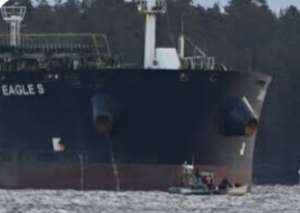
On September 27, 2025, the French navy boarded an oil tanker called the Boracay off the coast of Saint-Nazaire. The vessel was carrying Russian oil bound for India. It was flying the flag of the Republic of Benin. When the news reached Cotonou, it landed like a diplomatic grenade. The Beninese Maritime Prefecture issued an immediate denial: the Boracay was not listed in any national registry. And in a detail that sharpened the outrage considerably, Benin had never opened its maritime registry to international registration in the first place. The flag that the Boracay was flying was a forgery. Benin's sovereignty had been hijacked — at sea, without warning, and in the service of a sanctions evasion architecture built by Moscow.
The Boracay was not, as subsequent investigations made clear, an isolated incident. It was a single visible data point in a systemic and calculated fraud. Between May and October 2025 alone, investigators working on behalf of the International Maritime Organization (IMO) identified 33 vessels operating illegally under the Beninese flag. They found forged documents bearing the letterhead of the Government of the Republic of Benin. They uncovered a request addressed to the IMO Secretariat seeking recognition of a fictitious official one 'Thomas Koupaki, Director General of the Benin Merchant Marine' as the administrator of the organization’s Beninese national account. Had that request succeeded, the fraudsters would have gained the formal institutional mechanism to register multiple ships under the Beninese flag through official IMO channels. The ambition of the operation was not merely criminal. It was sovereign in scope.
The Architecture of the Dark Fleet
To understand what happened to Benin, it is necessary to understand what the Russian Dark Fleet actually is and how it operates. Since Russia's invasion of Ukraine in February 2022 and the subsequent imposition of sweeping Western sanctions on Russian energy exports including the G7 price cap on Russian crude oil set at $60 per barrel Moscow has systematically constructed a parallel maritime infrastructure designed to keep Russian oil flowing to markets in Asia, the Middle East, and beyond, beyond the reach of Western enforcement.
The Dark Fleet, estimated at between 600 and 1,400 vessels, consists overwhelmingly of oil tankers more than fifteen years old, acquired on the secondhand market through networks of shell companies registered in jurisdictions with weak disclosure requirements. The fleet's defining operational characteristics are consistent across cases: actual ownership concealed behind offshore entities; frequent changes in vessel names, registration numbers, and flags; deliberate deactivation of AIS geolocation transponders to make ships disappear from tracking systems; widespread ship-to-ship transshipment of oil in international waters to obscure the origin of the cargo; and insufficient or entirely absent marine insurance. By March 2026, the fleet was generating an estimated €713 million approximately $827 million per day in revenue for the Russian state and associated entities.
The flag dimension of the Dark Fleet's operations is the one that directly affects African states. Under international maritime law, every merchant ship operating beyond its home state's territorial waters must fly a flag. The flag state assumes jurisdiction over the vessel and regulatory responsibility for its operations. That legal architecture was designed to ensure accountability. The Dark Fleet operators have inverted it into a tool for avoiding accountability: by flagging vessels in states with weak oversight, minimal enforcement capacity, and limited international maritime infrastructure, they create layers of legal ambiguity that complicate boarding, detention, and prosecution.
Africa as the Preferred Operational Theatre
In April 2026, the IMO convened its Legal Committee session in London and issued new guidelines on fraudulent ship registration the most significant institutional response to the shadow fleet crisis to date. The organisation confirmed that 529 ships had fraudulently flown the flag of a member state in the preceding year. Of the IMO's 176 member states, 40 had their flags used without their knowledge or consent. The statistic that should alarm every African government, every African port authority, and every African maritime administration is this: more than half of all reported cases of fraudulent flag registration involve African flags.
The continent is not a peripheral player in this crisis. It is the principal operational theatre. The Comoros leads with 83 vessels fraudulently claiming registration. Cameroon's maritime registry expanded by 126 percent in a single year, with 127 of 193 vessels flying the Cameroonian flag by end-April 2026 identified as belonging to the shadow fleet. Gabon saw approximately 98 percent of its registered tonnage in 2024 dedicated to transporting sanctioned Russian oil — effectively converting the entire Gabonese maritime registry into a dedicated sanctions-evasion infrastructure. In Sierra Leone, the registered shadow fleet went from zero to 10 percent of all sanctioned vessels in eighteen months. Guinea, Gambia, Madagascar, Malawi, Zimbabwe, Eswatini, and Tanzania have all been documented as targets of fraudulent flag use. In several cases Malawi, Eswatini, and Benin among them the countries involved do not even operate international ship registries. The flags being flown simply do not exist in any legal sense.
The pattern of proliferation is not accidental. Russia's fleet operators, and the intermediary companies acting as their operational architects, have conducted a systematic evaluation of the international maritime registration system and identified its weakest structural points. African flag states offer a combination of factors that make them uniquely vulnerable: limited technical capacity to verify vessel ownership and operational history; registration fee revenue that represents a meaningful income stream for smaller economies; inadequate coordination with international enforcement bodies; and, in several cases, the absence of any formal international registry at all making fraudulent registration easy to execute and difficult to detect.
Benin's Response and Its Significance
The Beninese government's response to the Boracay boarding and the subsequent discovery of the broader fraudulent operation deserves recognition as a model of responsible state conduct in the face of a sovereignty violation. Beninese authorities cooperated closely with their French, German, Belgian, and American counterparts to identify vessels fraudulently flying the Beninese flag and trace the networks responsible. The Ministry of Living Environment and Transportation formally referred the matter to the IMO in October 2025, submitting what the organization’s own files record as a formal complaint from Benin's then-Minister of Transport describing the situation as a 'concerning situation regarding the fraudulent use of the Beninese flag.'
That referral was, in diplomatic terms, a remarkable act. A sovereign state formally notified the world's maritime regulatory authority that it had lost effective control over its own national identity at sea. The candour required to make that admission publicly in an IMO submission that becomes part of the permanent international record is not something to be taken for granted. Many states in similar positions have been slower to act, more protective of the revenue streams that come with registration fees, and more reluctant to invite the scrutiny that a formal fraud disclosure brings. Benin's swiftness was exemplary.
The West African Dimension
The Benin case is not an isolated West African incident. It is part of a pattern that extends across the sub-region and that has significant implications for every coastal state in the Gulf of Guinea. The Gambia was reportedly required to exclude more than 70 vessels suspected of using fake or non-compliant certificates. Sierra Leone's sudden emergence as a flag state of choice for shadow fleet operators within eighteen months represents a structural transformation of its maritime registry. Guinea has seen a 76 percent expansion in registered tonnage linked to the shadow fleet. And in Senegal, the incident of the tanker Mersin at the end of 2025 the details of which prompted Dakar to intensify surveillance of Dark Fleet operations along its coast served as a national wake-up call for a country that has been simultaneously building its space-based maritime surveillance capability through the Senegalese Agency for Space Studies and its partnership with the French company Promethee Earth Intelligence.
Ghana, for its part, is not immune to this threat despite the relative strength of its institutional frameworks. The Gulf of Guinea is one of the world's most important shipping lanes, handling a significant share of West African oil exports and imports. The same maritime corridors through which Ghana's own offshore oil production from the Jubilee, TEN, and Sankofa fields is exported are navigated by tankers connected to the shadow fleet network. The environmental and liability implications of this proximity are not abstract. Dark Fleet vessels are characteristically old, poorly maintained, and operated without adequate insurance. If one runs aground, catches fire, or sinks in Ghanaian or adjacent waters, the legal framework for establishing liability and securing compensation collapses because the vessel's true ownership is deliberately obscured behind layers of shell companies.
What Moscow Has Actually Done to Africa
There is a dimension of this story that goes beyond maritime law and enforcement mechanics. Russia has, for years, presented itself to African audiences as a partner in sovereignty a counterweight to Western hegemony, a friend of African independence, a power that respects the dignity of African states in ways that former colonial powers do not. That framing has been deployed consistently by Russian Foreign Minister Sergei Lavrov in his African tours, by Russian diplomats across the continent, by the Russian Houses that serve as soft power centers in cities from Accra to Bamako, and by the Africa Corps military deployments that have sold themselves to Sahelian governments as security solutions on terms Western partners refuse to offer.
The Dark Fleet fraud exposes the gap between that rhetoric and Russia's actual operational behavior towards African states. Moscow's fleet operators did not partner with Benin's government to develop its maritime registry. They did not offer Beninese authorities revenue from legitimate ship registration. They forged Beninese government letterhead, invented Beninese officials, and submitted fraudulent documents to the IMO in the name of the Beninese state without any consultation, notification, or consent. They used Beninese sovereignty as a raw material to be exploited, discarded when detection became likely, and replaced with the flag of another African state. As the journalist Eric Topona wrote in a June 2026 analysis: 'This increasing power of Moscow in fraudulently circumventing Western sanctions speaks volumes about the little regard it has for its African partners, whom it claims to guarantee their dignity and sovereignty on the international stage.'
That analysis is correct, and it extends beyond the maritime domain. The same Russia that forged Beninese government documents to flag oil tankers is the Russia that recruited African nationals including at least one Ghanaian, Samuel Awatey of Dofopa FM in Kumasi, who died fighting in Ukraine into its war effort through deceptive campaigns. It is the Russia whose Africa Corps forces abandoned their Malian military partners during the fall of Kidal to the Azawad Liberation Front in April 2026, retreating when the fighting became too difficult and leaving the soldiers they were supposed to be training to face the consequences alone. The pattern across all three domains flag fraud, military recruitment, and combat abandonment is consistent: Russia treats African states and African people as instruments of Russian strategic interest, not as genuine partners.
The Institutional Response and Its Limits
The international response to the Dark Fleet's exploitation of African registries has been slow relative to the scale of the problem, but it is now accelerating. The IMO's April 2026 guidelines on fraudulent registration represent the most significant multilateral response to date. Cameroon, under sustained international pressure, launched a large-scale audit of its maritime registry in February 2026, froze suspicious new registrations, deregistered more than 20 vessels in early 2026, and on May 29, 2026 announced sanctions against approximately 40 additional vessels. When the tanker Tagor was intercepted on May 31, 2026 and Cameroon was asked about its status, the Ministry of Transport issued a categorical statement on June 8: the vessel 'does not appear on any official lists of ships authorized to fly the Cameroonian flag.'
The European Union's 20th sanctions package introduced restrictions targeting port infrastructure connected to the Russian ports of Murmansk and Tuapse, and for the first time in the history of maritime sanctions, designated a third-country port Karimun in Indonesia for its role in shadow fleet operations. A January 2026 Open Letter signed by Belgium, Denmark, Estonia, Finland, France, Germany, Latvia, Lithuania, the Netherlands, Norway, Poland, Sweden, the United Kingdom, and Iceland formally called on the international maritime community to ensure that shadow fleet vessels comply with applicable law when transiting their territorial waters.
These are meaningful steps. But they remain insufficient in isolation, because the structural vulnerability they are trying to address is not simply one of inadequate rules. It is one of inadequate capacity. African states with weak maritime administrations, limited technical expertise, and small regulatory budgets cannot independently verify the ownership and operational history of every vessel seeking registration or claiming to fly their flag. The IMO's new guidelines help establish what states should do. The missing element is sustained, systematic capacity-building support from the IMO itself, from Western states pressing hardest for African compliance, and from the international shipping industry to enable African maritime administrations to actually do it.
What Ghana and West African States Must Do
For Ghana and its neighbors in the Gulf of Guinea, the lessons of the Benin case point toward a set of concrete actions that are both urgent and achievable.
First, every West African coastal state should conduct an immediate audit of its maritime registry to identify vessels whose ownership, operational history, or AIS behavior is inconsistent with legitimate commercial shipping. Ghana's own maritime administration, the Ghana Maritime Authority, has the institutional capacity to lead such an audit. The findings should be submitted to the IMO and shared with regional partners through ECOWAS maritime security frameworks and the ECOWAS Maritime Safety and Security Centre.
Second, states that do not operate international ship registries should proactively notify the IMO and register that fact formally as Malawi and Benin have done so that any vessel claiming registration in their name can be immediately identified as fraudulent. That is a simple administrative step that costs nothing and closes a significant vulnerability.
Third, the narrative framing of Russia as a partner in African sovereignty must be interrogated against the evidence of Russian conduct. When a government forges your letterhead, invents your officials, and submits fraudulent documents in your name to international organizations as was done to Benin that is not partnership. That is predation. African policy communities, media institutions, and civil society organizations have both the right and the obligation to name it accurately.
The Boracay was boarded in the waters off Saint-Nazaire on September 27, 2025. Its Beninese flag was a lie. The tanker carried Russian oil under a stolen identity. The story it tells about Russia's relationship with Africa is one that every African government, every African port authority, and every African journalist should know. Sovereignty is not only threatened on land. It can be stolen at sea quietly, systematically, and profitably by a partner that smiles at summits and forges your signature when your back is turned.
Mustapha Bature Sallama.
Medical/ Science Communicator,
Private Investigator, Criminal investigation and Intelligence Analysis.
International Conflict Management and Peace Building.USIP
[email protected]
+233-555-275-88
References
Jeune Afrique. "Flotte Fantome Russe: Quand le Benin Devient un Faux Pavillon de Complaisance." Jeune Afrique, October 2025. https://www.jeuneafrique.com/1805893/politique/flotte-fantome-russe-quand-le-benin-devient-un-faux-pavillon-de-complaisance/
Banouto (Benin). "Arraisonnement de Petrolier Russe Battant Pavillon Beninois: Voici Pourquoi le Benin Doit se Premunir Contre le Dark Fleet." October 22, 2025. https://www.banouto.bj/societe/article/20251022-arraisonnement-de-petrolier-russe-battant-pavillon-beninois-voici-pourquoi-le-benin-doit-se-premunir-contre-le-dark-fleet
Datacameroon. "Trafic: Sale Temps pour des Bateaux Russes sur la Cote Ouest-Africaine." https://datacameroon.com/trafic-sale-temps-pour-des-bateaux-russes-sur-la-cote-ouest-africaine/
Institute for Security Studies Africa (ISS Africa). "African Ship Registries: A Safe Harbour for Shadow Fleets?" March 17, 2026. https://issafrica.org/iss-today/african-ship-registries-a-safe-harbour-for-shadow-fleets
Africa Defense Forum. "Russia's Shadow Fleet Exploits African Shipping Registries to Skirt Sanctions." May 12, 2026. https://adf-magazine.com/2026/05/russias-shadow-fleet-exploits-african-shipping-registries-to-skirt-sanctions/
ModernGhana. "Ghost Ships and African Flags: How Russia's Shadow Fleet Found Shelter Along West Africa's Coastline." June 2026. https://www.modernghana.com/news/1500820/ghost-ships-and-african-flags-how-russias-shadow.html
Financial Afrik. "From Ghost Fleets to the Usurpation of African Flags." June 16, 2026. https://www.financialafrik.com/en/2026/06/16/from-ghost-fleets-to-the-usurpation-of-african-flags/
United24 Media. "How Russia Hid Its Shadow Fleet Behind African Flags, Making $827 Million a Day." May 2026. https://united24media.com/world/why-are-so-many-tankers-suddenly-flying-african-flags-follow-russias-oil-money-19090
Robert Lansing Institute. "Sanctions at Sea: How Russia Uses African Flags to Protect Its Oil Exports." March 18, 2026. https://lansinginstitute.org/2026/03/18/sanctions-at-sea-how-russia-uses-african-flags-to-protect-its-oil-exports/
Atlantic Council. "Russia's Growing Dark Fleet: Risks for the Global Maritime Order." https://www.atlanticcouncil.org/blogs/new-atlanticist/russias-growing-dark-fleet-risks-for-the-global-maritime-order/


 President Mahama urges African countries to fund own peace operations, warns aga...
 Govt to borrow GHS15.38 billion from domestic market, plans DDEP bond buyback
 Finance Ministry says all 2026 ABFA allocations reserved for Accra-Kumasi expres...
 'Surprised and disappointed' — GTA CEO Efua Houadjeto responds to Abeiku Santana...
 Police arrest NDC delegates for allegedly photographing ballots at Bimbilla cons...
 Gambia’s Chief Justice pays courtesy call on Asantehene at Manhyia Palace
 NDC Constituency polls: Delegates invoke 'Antoa' deity over alleged album manipu...
 NDC Oforikrom constituency election stalls over ballot paper delays
 Former NDA CEO Sumaila Abdul-Rahman, three others fined GH¢84,000 each over proc...
 Wa: Abandoned newborn baby boy rescued at Sombo


