




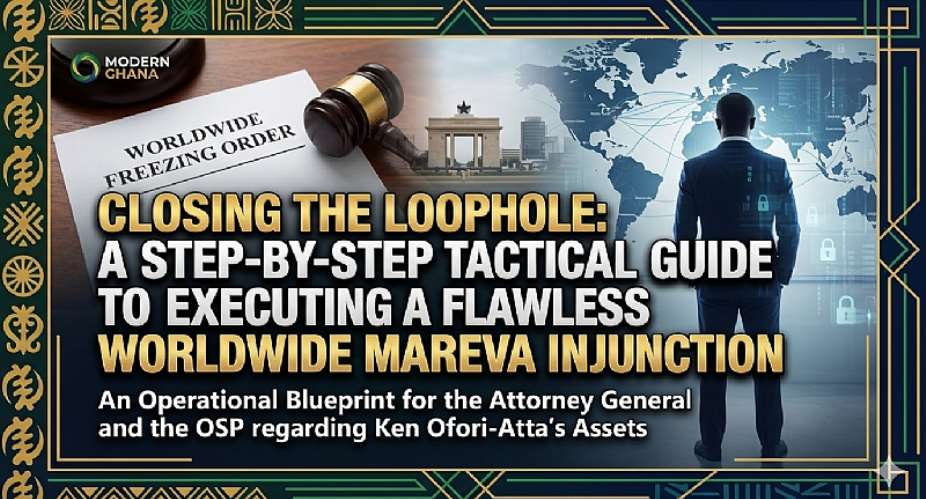
When dealing with sophisticated transnational wealth, a standard prosecution strategy is not enough. The 78 corruption-related charges brought by the Office of the Special Prosecutor (OSP) against former Finance Minister Ken Ofori-Atta over the GH¢1.4 billion Strategic Mobilisation Limited (SML) deal represent a crucial test for Ghana's legal institutions. However, if the state relies solely on slow-moving criminal trials while the accused holds lawful permanent residency in the United States, it plays directly into the hands of a highly skilled corporate defense team. High-net-worth defendants do not wait for a final verdict to restructure their portfolios; they exploit every procedural delay to move liquid wealth into unassailable jurisdictions.
To prevent this, the Attorney General (AG) and Minister of Justice, alongside the Special Prosecutor, must launch an aggressive, synchronized civil asset-recovery campaign. They must secure a Worldwide Mareva Injunction—a legal mechanism that can freeze assets globally before a trial concludes. This cannot be a rushed or sloppy filing. Ken Ofori-Atta’s legal team will actively search for any procedural error, vague statement, or technical loophole to dismantle the state's application. This article provides a strict, step-by-step tactical blueprint for the AG and the OSP to execute an airtight, bulletproof freezing order that leaves no room for evasion.
The Step-by-Step Tactical Blueprint for the AG and OSP
To ensure the High Court grants the injunction and international courts enforce it, state prosecutors must execute these six consecutive steps with absolute precision:
THE AIRTIGHT FREEZING PIPELINE │ ▼ [ STEP 1: MULTI-AGENCY EVIDENCE BUNDLE ] Unifying OSP, FIU, and GRA Asset Tracing │ ▼ [ STEP 2: CIVIL ASSET-RECOVERY LAWSUIT ] Bypassing Criminal Delays via C.I. 47 Order 25 │ ▼ [ STEP 3: PROVING REAL RISK OF DISSIPATION ] Evidencing US Residency, Resignations & Missing Funds │ ▼ [ STEP 4: SATISFYING THE OBLIGATION OF DISCLOSURE ] Volunteering Weaknesses to Preempt Defense Defeats │ ▼ [ STEP 5: STATE-BACKED UNDERTAKING AS TO DAMAGES ] AG Indemnity Guarantee to Protect Innocent Shareholders │ ▼ [ STEP 6: CROSS-BORDER ENFORCEMENT & MLA ] Mirroring the WFO in US and UK Commonwealth Courts
Step 1: Build a Unified, Multi-Agency Forensic Evidence Bundle
- Consolidate Intelligence: The OSP must instantly merge its SML investigative files with intelligence from the Financial Intelligence Centre (FIC), the Ghana Revenue Authority (GRA), and the Registrar-General's data on beneficial ownership.
- Map the Network: The bundle must map every bank account, equity share, and offshore shell corporation linked to Databank, Enterprise Group, and proxy family holdings. Vague assertions of wealth will lead to a dismissed case; prosecutors must present specific account numbers, swift codes, and registration numbers.
Step 2: File under Independent Civil Asset-Recovery Chambers
- Bypass Criminal Stalls: Do not tie the freezing order to the slow-moving criminal trial. The AG and OSP must file an independent civil asset-recovery lawsuit under Order 25 of the High Court Civil Procedure Rules (C.I. 47).
- Seek an Ex-Parte Order First: The initial application must be made ex-parte (without notifying the defense). If Ken Ofori-Atta’s lawyers receive advance notice of the hearing, they can legally move hundreds of millions of dollars with a single keystroke before the judge can sign the order.
Step 3: Establish an Incontrovertible "Real Risk of Dissipation"
- Document the Flight Risk: To satisfy the strict legal threshold for a Mareva order, prosecutors must prove the defendant is highly likely to hide his assets.
- Present Clear Factors: The state must formally present three facts to the judge: the defendant's physical relocation to the United States under permanent residency status, his strategic resignation from key domestic corporate boards, and the unexamined trail of the historical missing 500 million bank transfer. Together, these factors demonstrate a clear pattern of decoupling from the domestic jurisdiction.
Step 4: Maintain Absolute, Unassailable "Full and Frank Disclosure"
- Preempt the Defense: The fastest way for a defense lawyer to overturn a Mareva injunction is to prove the state hid relevant facts from the judge during the ex-parte hearing.
- Volunteer All Facts: The OSP and AG must explicitly disclose any weaknesses in their own case, including ongoing jurisdictional disputes or past audit contradictions. By voluntarily revealing these facts first, they neutralize the defense's ability to claim the state misled the court.
Step 5: Provide a Robust State-Backed Undertaking as to Damages
- Protect Third Parties: A Mareva injunction requires the applicant to promise to pay for any financial losses if the injunction is later found to be wrong. Ken Ofori-Atta's lawyers will argue that freezing Databank or Enterprise Group will ruin innocent everyday investors and violate court rules.
- Deploy AG Indemnity: The Attorney General must step in and provide a formal, state-backed financial indemnity. This guarantee ensures the court that any legitimate, third-party commercial losses are insulated, removing the judge's hesitation to sign a sweeping corporate freeze.
Step 6: Execute Immediate International Mirroring Motions
- Go Beyond Ghana's Borders: A Ghanaian court order does not automatically bind a bank in New York or London. The moment the High Court of Ghana grants the Worldwide Freezing Order (WFO), the AG must activate Mutual Legal Assistance (MLA) Treaties.
- File in Foreign Courts: Counsel in the UK and US must immediately file mirroring motions in the High Court of London and US Federal District Courts. This forces international banking conglomerates to enforce the freeze across global financial networks under penalty of international contempt.
Key Recommendations to Close Legal Loopholes
- Incorporate Strict "Living Allowance" Caps: Avoid an outright asset ban, which defense lawyers can easily appeal as a human rights violation. Instead, the order should include a strict, pre-approved monthly spending cap for the defendant's legal and living expenses, forcing all remaining millions to stay frozen.
- Issue Mandatory Disclosure Orders: Ensure the WFO contains an explicit clause forcing the defendant to swear an affidavit disclosing the exact location and value of all assets worldwide within 7 days, under penalty of perjury.
- Enforce Strict Anti-Tipping Rules for Banks: Serve the order alongside Section 4 of the Bank of Ghana AML/CFT Guidelines, warning local bank compliance officers that secretly alerting the defendant's team about the freeze will trigger immediate prosecution and loss of their banking license.
A Worldwide Mareva Injunction is a highly precise legal instrument. It requires flawless technical execution, total institutional cooperation, and absolute speed. If the Attorney General and the Special Prosecutor follow this step-by-step approach, they can neutralize the procedural maneuvers of high-priced corporate defense teams. This strategy protects the integrity of the state's case, safeguards billions of cedis in public funds, and ensures that the final judgment of Ghana's courts cannot be evaded. True accountability requires swift, decisive action to secure public assets before they disappear.
✍️ Retired Senior Citizen
For and on behalf of all Senior Citizens of the Republic of Ghana 🇬🇭
Teshie‑Nungua
[email protected]


 GoldBod’s gains must be weighed against full cost to Ghana – Prof. Bokpin
 ‘Afenyo-Markin’s smear campaign against me is about extortion’ – Sammy Gyamfi
 August 22: Cedi sells at GHS12.30 on forex market, GHS11.13 on BoG interbank
 There is a deliberate smear campaign against GoldBod from Minority – Sammy Gyamf...
 ‘If GoldBod wants credit, it must accept blame for losses’ – Dr Owusu Sarkodie
 Akosombo control system to be restored next month – Energy Minister
 ‘Temporary Akosombo system not very robust’ – Energy Minister on recent power ou...
 Mike Ocquaye Jr reacts to Adwoa Safo’s reported return to NPP Dome-Kwabenya race
 Foreign Affairs Ministry urges Tijjaniya pilgrims to Senegal to travel by air ov...
 Bono Police Arrest 36‑Year‑Old in GH¢1.1M Fake Gold Deal; Hunt for Three Others ...

