




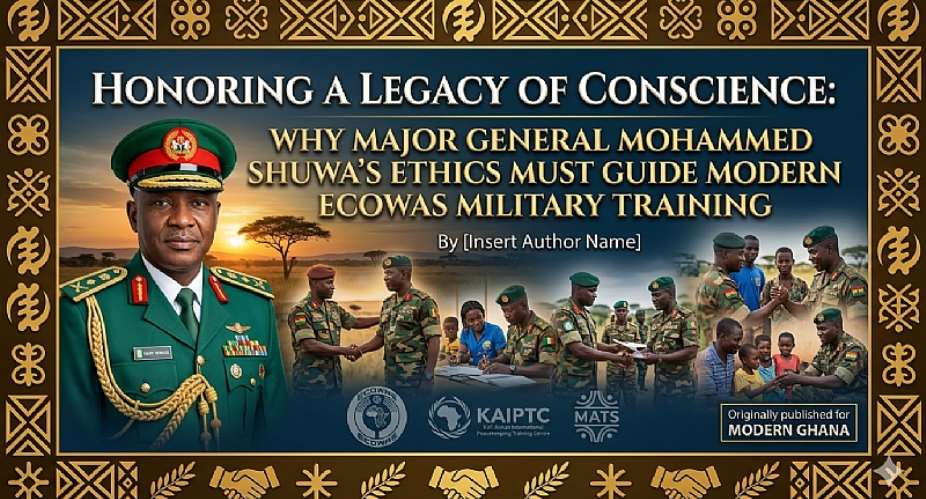
The history of warfare is often written in the blood of the innocent, but its most profound lessons are found in the restraint of the principled. During the Nigerian Civil War (1967–1970), Major General Mohammed Shuwa, serving as the General Officer Commanding (GOC) of the First Division, famously refused to endorse the mass killing of civilians. Standing his ground against brutal directives in areas like the Mid-West and Eastern regions, Shuwa proved that military discipline must never eclipse human conscience. Decades later, his tragic assassination on November 2, 2012, did not silence the truth of his legacy: even in the chaos of conflict, there is a line of conscience that professional soldiers must not cross.
For premier West African institutions like the Kofi Annan International Peacekeeping Training Centre (KAIPTC), the Military Academy and Training School (MATS), and various Non-Commissioned Officer (NCO) academies, General Shuwa’s legacy is far more than a historical footnote. It is an urgent operational blueprint.
The Modern ECOWAS Security Context: The Crisis of Asymmetric Warfare
Today, the Economic Community of West African States (ECOWAS) faces unprecedented security challenges. The rise of violent extremism in the Sahel, protracted insurgencies by groups like Boko Haram and Islamic State West Africa Province (ISWAP), and cross-border banditry have fundamentally changed the nature of conflict.
Modern West African soldiers are no longer fighting conventional armies on clearly defined battlefields. Instead, they operate in asymmetric environments where terrorists embed themselves within local populations. In this highly volatile context, heavy-handed military operations that cause civilian casualties do not defeat insurgencies—they fuel them. Aggressive actions alienate local communities, destroy trust in the state, and serve as the primary recruitment tool for extremist groups.
To win the war against terrorism, ECOWAS forces must win the "hearts and minds" of the people. This requires a shift from raw firepower to radical ethical resilience. General Shuwa’s historical example provides the exact framework needed to navigate these contemporary operational crises.
Strategic Recommendations for KAIPTC (Peacekeeping & Command Level)
KAIPTC plays a vital role in training regional and international actors for complex peace support operations. To foster strategic leaders who prioritize civilian protection under intense political and operational pressure, the center should:
- Introduce the "Shuwa Case Study" in Operational Law: Move beyond standard lectures on International Humanitarian Law (IHL). Use General Shuwa's wartime choices as a core case study to analyze the legal, political, and moral dilemmas of defying illegal commands during counter-insurgency operations.
- Address the Counter-Insurgency (COIN) Paradox: Integrate modules demonstrating how ethical restraint directly improves intelligence collection. When troops protect civilians, communities are far more likely to provide the critical, actionable intelligence needed to neutralize asymmetric threats.
- Inject Ethical Stressors into Simulations: Introduce realistic, high-pressure scenarios into peacekeeping pre-deployment exercises. Force trainees to choose between fulfilling a destructive tactical objective or safeguarding an at-risk civilian population hidden within a hostile zone.
Tactical Recommendations for Military Academies (Officer Cadet Level)
Commissioned officers set the moral compass of the military. At foundational institutions like MATS, character development must be given equal weight to combat readiness:
- Codify the Duty to Disobey Manifestly Illegal Orders: Explicitly teach cadets that true military honor includes refusing commands that violate basic human rights. Cadets must learn to distinguish between legitimate operational discipline and blind obedience to atrocities.
- Curriculum on Civil-Military Relations (CIMIC): Shift the military mindset from viewing civilian populations as an operational hurdle to seeing them as the primary partner in security.
- Peer-Led Ethical Debates: Force cadets to confront historical and modern battlefield grey areas through regular debate. This builds the critical thinking skills required to make split-second, ethical choices under the stress of modern combat.
Operational Recommendations for NCO Training Schools (The Backbone of the Force)
Non-Commissioned Officers (NCOs) and senior enlisted personnel are on the front lines of execution. They directly control the daily behavior of troops on the ground:
- Scenario-Based Ethics for Asymmetric Frontlines: NCOs require practical tools rather than abstract philosophy. Field exercises should simulate handling angry mobs, managing prisoners of war, and protecting displaced civilians without violating rules of engagement.
- The "NCO as the Moral Anchor" Doctrine: Train NCOs to view themselves as the frontline guardians of the military's reputation. They must be empowered and expected to pull a fellow soldier back from the brink of a human rights violation in real-time.
- Clear, Simplified Rules of Engagement (ROE): Translate complex international laws into clear, actionable battlefield mandates. NCOs must be able to instantly recognize what constitutes an illegal act on the ground and halt it immediately.
Safeguarding Humanity to Ensure Peace
Major General Mohammed Shuwa understood a timeless truth that every modern ECOWAS soldier must learn: power without conscience is merely brutality, and brutality breeds further instability.
As West Africa navigates deep security crises, its military institutions must evolve. By integrating General Shuwa’s historic example of restraint into KAIPTC, MATS, and NCO training frameworks, the sub-region can build a new generation of security forces. These will be professional forces that do not just win wars or keep the peace, but actively preserve the very humanity they are sworn to protect.
✍️ Retired Senior Citizen
For and on behalf of all Senior Citizens of the Republic of Ghana 🇬🇭
Teshie‑Nungua
[email protected]


 US 'steals' Bawumia’s idea, launches America.gov for public services five years ...
 “Disband Black Stars, sack FA and let FIFA ban us for two years” – Sam George af...
 NPP executive elections: Justin Kodua dismisses claims of blocking constituency ...
 South Africa summons US ambassador for 'record' third time
 Israel-bound flight diverted to Saudi Arabia after brawl between pilots
 Dangote to launch $16bn refinery in Kenya
 GNFS rescues driver trapped in overturned tipper truck at Bolgatanga
 Ghana, Luxembourg to explore visa waiver agreement
 Tullow loses $393m tax arbitration case against Ghana – Finance Minister
 Bawumia outlines policy proposals to grow Ghana’s insurance industry


