




"A nation within a nation".
"A Shining example in cultural preservation or apartheid nostalgia?"
Introduction
Whilst black on black violence is on the rise in South Africa (SA) due to xenophobic and afrophobic tendencies, there exists an unusual place in SA today. A place where history, Identity, politics collide.A place where the "notion of rainbow nation" is put to the test. A "whites- only settlement". A place where Africans are not welcome. But for a country built on unity after division of apartheid, a country which describes itself and prides itself as a "rainbow nation", the existence of Orania, a private, whites-only Afrikaner town in South Africa's Northern Cape province raises serious questions without easy answers.
Article 235 Of South African Constitution
Article 235 of the South African Constitution guarantees the right of self-determination for the country's people as a whole. It specifies that this right does not prevent, within its framework, the recognition of the right of self-determination for any community sharing a common cultural and language heritage.
ORANIA: The Name
Orania is a White separatist town found in South Africa. It is situated in the Karoo region of the Northern Cape, on the R369 highway, roughly midway between Pretoria and Cape Town. It has an estimated population of between 3,000- 3500 residents, and is growing.The name Orania is derived from the adaptation of the Afrikaans word "oranje". It was chosen to reference the neighboring Orange River (known in Afrikaans as the Oranjerivier), which flows directly past the town.
Genesis
Orania was founded in 1991, on the eve of SA majority rule led by Nelson Mandela in 1994. Orania founders detested the idea of living in a fast approaching post apartheid SA by then.Thus, Afrikaner ideologues, including Carel Boshoff (the son-in-law of apartheid architect, Hendrik Verwoerd), established the idea of Orania. Originally, Orania was envisioned as part of a broader plan for an independent Afrikaner homeland (Volkstaat).Orania functions on the premise of self-determination, the cultural preservation of the Afrikaans language, and Calvinist Christian values. Founders of Orania believed that their Afrikaans language, identity, way of life needed to be protected and preserved and to them that feat was impossible to achieve in Nelson Mandela's "rainbow nation" or post apartheid/post 1994 SA.
Orania Citizenry
Orania, as a controversial establishment by white Afrikaners seeking cultural preservation, self-determination, self-governance, and a way of life separate from the rest of SA as a country. Therefore, Orania is set up as a private, self-sufficient nation located deep in SA’s Northern Cape province. It is an exclusively white Afrikaans nation .This Oranian nation operates its own local government, schools, bank, currency(called Ora), and infrastructure.
Orania Flag
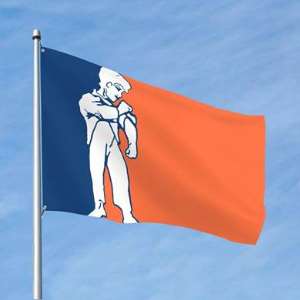
The Orania flag uses the vertical orange, white, and blue bands inspired by the historical Dutch "Prinsenvlag" (Prince's Flag), which were also present on the pre-1994 SA flag. Orange signifies the Afrikaner struggle for freedom, white reflects their heritage, faith, and ideals of peace and purity, while blue stands for the collective effort invested in building Orania. The figure at the center of the flag, (a boy rolling up his sleeves) known as the “Little Giant,” serves as a symbol of self-reliance and determination.
"You'll have to roll up your sleeves and do the work yourself. And that is symbolically to say, create your own future yourself", Joost Strydon Orania Town leader and spokesperson said.
Arguments For Existence of Orania
"Cultural Project Not Racial Project"
Oranians claim Orania Town is a cultural project, not a racial one. Constitutionally and legal, Orania exists entirely on 8 000 hectares of privately owned land. According to proponents of this so- called experiment in cultural preservation point out that Orania is legal and constitutional because of South Africa, Article 235 which guarantees minority groups right to cultural preservation.Supporters and residents of Orania's existence point out that the existence of Orania is constitutionally protected and serves to preserve the Afrikaner culture.Joost Strydom, the town’s leader and spokesperson, is on record for saying,
"As is stated very clearly in the South African Constitution, Article 235 very clearly stipulates that cultures in South Africa has got the right to preserve their culture and build out cultural self determination, but someone has to uphold that right, and that's what we've done here. We've started the process of upholding our rights".
Therefore, Orania does not only guarantee Afrikaner cultural preservation and self determination . It also allows the Afrikaners to preserve their language, history and traditions, a legitimate exercise of minority rights. Also, the experiment supports and sustains self- reliance (selfwerksaamheid),as all work,all labor is done by members of Orania town. Another argument is that Orania is a safety haven in crime ridden South Africa. Therefore, Orania is a safe haven.
Despite being a safe haven from crime, proponents of the Orania movement, say Orania, is a way for them to preserve the white African ethnic group, the Afrikaners, and to remain true to their culture and language; it is not about racism. Rather, they say, it is an effort not to lose their Afrikaner way of life or to "melt" into Mandela's "rainbow nation".
Arguments Against the Existence of Orania
"Racial Project Not Cultural Project"
Critics claim Orania Town is a racial project, not a cultural one.While supporters view Orania as a peaceful, self-reliant, and safe alternative to high-crime areas. Opposers to the existence of Orania point out that Orania is nothing more than promotion of racial segregation and revoking apartheid nostalgia. Orania town, with streets lined with statues of Afrikaner heroes, like Paul Kruger, Hendrik Verwoerd , John Vorster etc is viewed as a town seeking to maintain racial discrimination.
Critics vehemently argue that, "cultural self-determination" is nothing more than an euphemism used to mask racial supremacy and maintain historical privilege.Though proponents of existence of Orania quote article 365 of South Africa constitution , protagonists point out that Orania, fundamentally undermines the country's constitutional principles. Its very existence, primarily opposes the ground that it violates non-racialism, promotes segregation, and threatens South Africa's social cohesion.Orania from such a perspective is viewed as a "constitutional contradiction", for it directly opposes the constitutional values of equality and non-racialism. According to the author Tembeka Ngcukaitobi, Orania,
"represents the reversal of the constitutional project of nation building", Strongly arguing that anyone who cares about South Africa,
"would be offended by what Orania represents,which is an enduring legacy of racial mobilisation".
Orania is also opposed on grounds of trying to "recreate apartheid". Orania as a "white ethnostate" rejects the concept of a single, unified , rainbow South African nation. It is based on exclusionary policy, which is interpreted by those against the existence of Orania, pointing out that "exclusion" is apartheid-era segregationist policy and apartheid which favoured the concept of separate development. Mr David Kgabo of Africa National Congress (ANC) pointed out that settlements like Orania,
"...are defended as cultural preservation projects,we should recognise them for what they are: a manifestation of a resistance to our constitution's commitment to non-racial South Africa. Also as minority groups that suffer from apartheid hangover_ ".
Orania & The Question Of Racism
Founders, residents and supporters of the existence of Orania, categorically point out that their motivations are not at all rooted in racism. Framing their motivation not as racism but ethnic & cultural self- determination, the goal, protection & preservation of Afrikaner identity, language, history, culture, traditions and Calvinist Christian values, which from their perspective are under threat from the "rainbow nation " of South Africa. And to them, so far, Orania is a safe haven, a success, shining story in cultural preservation.
Some critics, observers and commentators are not convinced.They describe Orania town as the "most racially segregated place globally".The existence of "whites- only settlement" decades after the supposed end of apartheid naturally draws scrutiny, debate and even criticism. To some, Orania is nothing but ideological continuation of apartheid after its official end.The argument being that Orania is a "recreation of apartheid".
Orania & The Question Of Nation Building
Nation-building as a deliberate process of constructing, structuring or strengthening a national identity and unity within a country is seriously challenged by Towns or exclusively white- only settlements like Orania.Carl Niehaus of the Economic Freedom Fighters (EFF) highlighted danger posed by such settlements,
" These are not mere settlements,they are strongholds for racial segregation meticulously designed to fracture our nation", adding that,
"their mortal intent is to sabotage non- racialism and to shred the fragile threads of social cohesion and the very soul of our nation - building endeavours".
Orania is seen as emboldening discrimination and betraying the struggle against apartheid, representing a direct hostility to the nation's vision of a united country. Thus, Orania is dismissed as a threat to nation building.
Ms Lerato Ngobeni (Action SA) suggested that these race-based and racist settlements are proof that Hendrik Verwoerd (architect of apartheid) is alive and well in post-apartheid South Africa.
“Let’s crack the veneer of comfort and the silence of complicity and call this country to consciousness by exposing the threat of these enclaves to the foundation of our democracy".
These are not cultural enclaves, she said, but rather they
"promote racial ideological fault lines dressed up as heritage. In essence, they are a betrayal to our democratic promise and nation- building”.
Conclusion
Oranians argue that, Orania Town is a cultural project. A cultural project which is legal and constitutional as validated by Article 235 of the South African Constitution.The argument goes that Orania as an intentional white-only community constructed on the basis and principle of self- determination, thus, Orania is perceived as a sanctuary for preserving Afrikaans history, language, culture and traditions...but is it only that? Not everyone is convinced. To some, Orania exposes the lie of the new South Africa, or the "myth of the rainbow nation". Orania's existence is a shameless challenge to the rainbow nation project to which South Africans were signed up at the end of apartheid. And to some observers, Orania is a downright hostility to the notion of a single, united, non- racial, rainbow country. After all said and done, what does Orania or any other such similar settlement in SA really stands for? Is it a cultural project? Is it a racial project? Is it a combination of both? or its something more? Should Orania be celebrated as a shining example of cultural preservation or should Orania be scorned as nothing but an attempt to continue the world frowned and discarded discriminatory apartheid?
F. Madondo ( African Teacher) [email protected]

 'I couldn’t have refused an order' – Major Adjei-Ampofo explains why he took par...
 'Some NDC members are working with NPP to get your GoldBod job' – Kevin Taylor w...
 'It is too early for you to take this political heat' – Kevin Taylor cautions Ay...
 NPP knows GoldBod is our strength, that is why they want to bring it down – Suhu...
 Stop using radio airtime for greetings, talk about Mahama’s economy – Suhuyini t...
 IEA proposes binding long term national development plan to stop successive gove...
 Health Minister moves to prevent stockouts of HIV, TB and Malaria commodities
 IEA wants MPs, ministers barred from serving on State-Owned Enterprise boards
 Constitutional review: IEA warns against changes that could turn judiciary into ...
 Eastern Regional Minister orders temporary closure of two SHSs after violent stu...

