




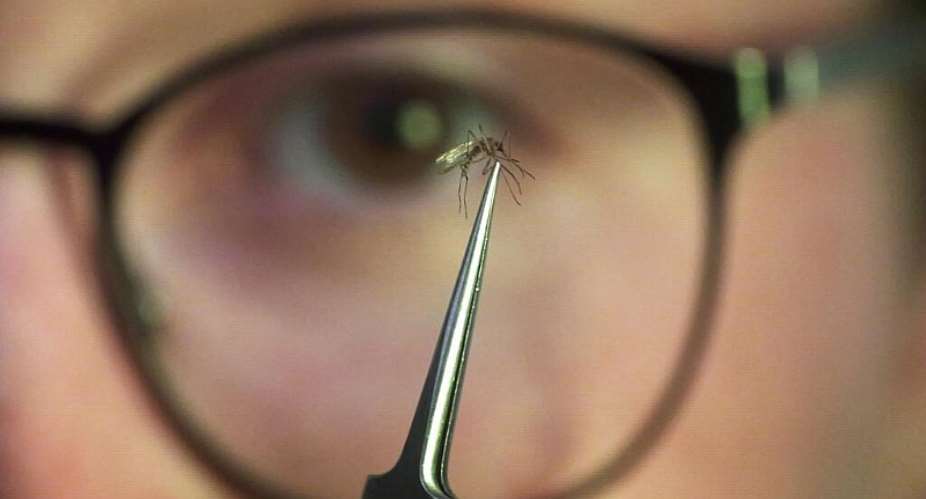
The tiger mosquito, known scientifically as Aedes albopictus, can transmit dengue, Zika and chikungunya. First detected in mainland France in 2004, it is now present across most of the country.
Public health authorities recorded an unprecedented 809 locally transmitted cases of chikungunya and 30 locally transmitted cases of dengue in France in 2025.
The same year also saw 2,398 imported chikungunya cases and 81 local transmission clusters.
One effort to reduce the insect's numbers is taking shape in Montpellier, where French startup Terratis breeds male mosquitoes before sterilising and releasing them.
Rising temperatures in Europe open door to spread of chikungunya virus
Mosquitoes against mosquitoes
"After sterilisation, we release them into urban areas. They look for females and mate, but when the females lay eggs, those eggs are empty," Terratis co-founder Clélia Oliva told the French news agency AFP.
Male mosquitoes are exposed to X-rays in batches of 400,000, making them infertile. The aim is to flood an area with sterile males so fewer viable eggs are produced and the population gradually declines.
First developed 50 years ago for agriculture, the sterile insect technique is now being adapted to fight mosquitoes as disease-carrying species continue to multiply.
Terratis produces 1.5 million sterile mosquitoes a week and aims to reach 40 million within two years.
"This year, we've seen a surge in orders," Oliva said, citing strong interest from cities struggling to control mosquito populations.
France sees record spike in chikungunya cases as tiger mosquito spreads
Scaling up
"In principle, the sterile mosquito technique works," said Frédéric Simard, head of the Institute of Research for Development in Montpellier, which helped launch Terratis.
Major challenges remain, including increasing production, reducing costs and adapting the method to different regions so it can be competitive and sustainable, Simard said.
"If I had to compare it, I'd say we're at the iPhone 1.0 stage," he said.
Other approaches are also being used. In parts of South America and Asia, mosquitoes are infected with a bacterium called Wolbachia, which prevents them from transmitting certain viruses.
In Brazil, one facility produces as many as 100 million eggs a week using the method.
No single solution will be enough, Simard told AFP. "The Wolbachia technique, sterilisation, traps, insecticides – all of this needs to be combined," he said.
Wolbachia is an "emergency response" to immediate health risks, while sterilisation forms part of a longer-term strategy.
Reunion Island deploys sterile mosquitoes to stop the spread of disease
Cost and regulation
In Montpellier's Malbosc district, a trial that began in August 2025 is continuing this year.
"Twice a week, we release 100,000 mosquitoes across 31 locations," Terratis employee Florian Vernichon told AFP.
The programme remains expensive. The current experiment is estimated to cost around €70,000.
"We don't have the means to finance releases on the scale of an entire city, and we believe this should be handled by the state and regional health agencies," said Montpellier deputy mayor Stéphane Jouault.
The approach also faces a regulatory hurdle in France. Sterile mosquitoes fall into a grey area because they are neither biocides, designed to control harmful organisms, nor genetically modified organisms. The uncertainty could discourage private investment.
Early results have been encouraging. In Brive-la-Gaillarde, where Terratis released 11 million sterile mosquitoes in May 2025, half of the eggs ready to hatch in spring were sterile, Oliva said.
The proportion is expected to reach 90 percent by the end of summer 2026.
The goal is not to eradicate the species entirely, but to reduce its numbers significantly and sustainably.
(with newswires)


 Ahafo Ano South West MP involved in road accident
 Constitutional Review alone will not solve Ghana’s problems – Kwesi Pratt Jnr.
 East Legon Football Academy applauds NPA Boss for supporting youth football
 Gov't didn't show NPP enough respect in constitutional review process – Martin K...
 September 18: Cedi sells at GHS12.15 on forex market, GHS11.53 on BoG interbank
 Lawyer challenges two-week remand of Salomey over connection to wanted 'Ghana Jo...
 Minority calls for NSA boss Ampofo Ankrah, others to be dismissed over alleged 2...
 ‘You gave us GH¢60,000 to run 66 offices nationwide and expect us to function?’ ...
 Russia seizes assets of Swiss food giant Nestle and three French firms
 Russia votes in parliamentary election as war in Ukraine drags on


