




They were the men who saluted the flag and commanded the battlefield. They ran military formations, briefed presidents, evacuated the wounded, and buried colleagues killed in action. They were the institutional backbone of Nigeria's armed forces men whose ranks were earned through decades of discipline, sacrifice, and service. Yet from the earliest days of the Boko Haram insurgency in 2009 to the bandit-ridden highways of Katsina in 2026, Nigeria's generals have been hunted, ambushed, abducted, and executed by the very forces they were trained to defeat. This is the story of how insecurity in Nigeria once a distant problem for anonymous citizens in remote villages has climbed the chain of command to claim some of the nation's most decorated military minds.
THE ORIGIN: HOW NIGERIA'S SECURITY CRISIS BEGAN
Boko Haram was founded in 2002 by Mohammed Yusuf in northeastern Nigeria. Its increasing radicalization led to a military suppression operation and the killing of Yusuf in July 2009. What followed was unexpected: a mass prison break in September 2010 in Bauchi triggered resurgence, accompanied by increasingly sophisticated attacks initially against soft targets, but progressing in 2011 to include suicide bombings of police buildings and the United Nations office in Abuja.
Since the insurgency formally began in 2009, Boko Haram has killed tens of thousands of people in frequent attacks against the police, armed forces, and civilians. The conflict has resulted in the deaths of more than 300,000 children and has displaced 2.3 million from their homes.
From those early years, Nigerian commanders began paying the ultimate price. What follows is a chronological account of the senior officer’s generals, colonels, and commanders who were consumed by this conflict.
PHASE ONE: THE NORTHEAST THEATRE (2016–2020)
The early years of the insurgency claimed ordinary soldiers in large numbers, but it was from 2016 onwards that high-ranking commanders began to fall with alarming regularity in the northeast.
Lieutenant Colonel Muhammad Abu Ali was killed by Boko Haram on November 4, 2016, in Mallam Fatori, Borno State, a year after his promotion from major. He commanded the 272 Tank Battalion and was known for his bravery in battle.
During an insurgent attack on a forward base, he was killed in a firefight after stepping out of his tank to assess the situation. Before his death, he had served in United Nations missions in Liberia and Darfur, and had received an accelerated promotion and a gallantry award in September 2015.
Also in November 2016, Lieutenant Colonel B. U. Umar and soldiers of his 114 Task Force Battalion were ambushed by Boko Haram fighters following a bomb explosion along the Bitta–Pirang Road, Adamawa State, during a patrol towards Mubi. Although the troops repelled the ambush after a gun battle, Umar lost his life at the scene.
In December 2016, Lieutenant Colonel O. Umusu, commanding officer of the 118 Task Force Battalion in Borno State, was killed alongside his soldiers by an improvised explosive device. He and his men were returning from Maiduguri to their base when the incident occurred between Zare and Gudumbali.
In November 2018, Lieutenant Colonel Ibrahim Sakaba, commander of the 157 Task Force Battalion, was killed during a large-scale insurgent attack on a military base in Metele, northern Borno State. The assault overwhelmed the base and led to heavy casualties, becoming symbolic of the risks faced by commanders stationed in remote bases near Lake Chad.
In September 2020, Colonel Dahiru Chiroma Bako was ambushed near Wajiroko in Borno State and later died from his injuries despite undergoing surgery at a military hospital. He was regarded as a prominent field commander, and the then-Chief of Army Staff Tukur Buratai described him as a fighter who gave everything for the unity and peace of the nation.
PHASE TWO: VIOLENCE REACHES THE NORTHWEST (2018–2021)
As the northeast remained engulfed, a parallel and in some ways more insidious crisis was taking shape across Nigeria's northwest one that would ultimately claim generals not on the battlefield but on public roads and in their own homes.
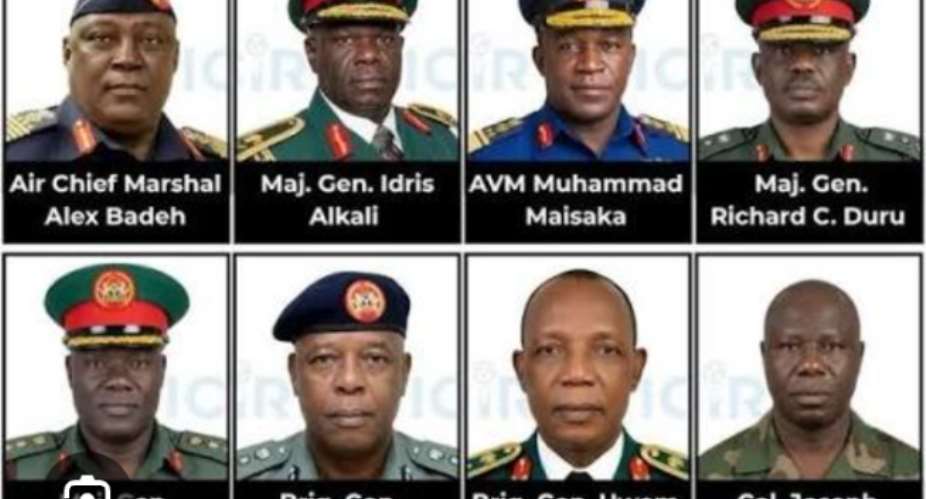
On September 2, 2018, Major General Mohammed Idris Alkali (retd.), former Chief of Administration at the Army Headquarters, was travelling from Abuja to his farm in Bauchi State when he passed through an area of civil unrest in Jos South Local Government Area of Plateau State.
He was reportedly stopped, identified as a military officer, and subsequently attacked and killed. Following intelligence-led operations, his remains were recovered from an abandoned well in Guchwet, Jos South, on October 31, 2018, and he was buried in Abuja in accordance with Islamic rites.
Months later, on December 18, 2018, former Chief of Defence Staff Air Chief Marshal Alex Badeh (retd.) was killed by unidentified gunmen along the Abuja–Keffi Expressway while returning from his farm. He was reportedly shot alongside his driver during the attack. Badeh had served as Chief of Air Staff under President Goodluck Jonathan from October 2012 before becoming Chief of Defence Staff in April 2014.
In November 2021, retired Air Vice Marshal Muhammad Maisaka was murdered alongside his grandchild by gunmen who attacked his residence in Rigasa, Igabi Local Government Area of Kaduna State. A former Director of Medical Training and Operations at Defence Headquarters, Maisaka had reportedly been recovering from a medical condition that left him paralysed for more than three years when he was killed.
Also in November 2021, Brigadier General Dzarma Zirkusu, commander of the 28 Task Force Brigade in Chibok, was killed alongside other soldiers in an ISWAP ambush in Borno State.
In September 2020, Lieutenant Colonel Z. Manu was killed during an operation in Katsina State after bandits ambushed his patrol in Unguwar Doka village, Faskari Local Government Area. His death at the time highlighted how insecurity had expanded beyond the northeast into other parts of northern Nigeria.
PHASE THREE: THE RANSOM ECONOMY TARGETS THE MILITARY (2023–2025)
On January 1, 2023, suspected bandits abducted retired Army officer Colonel Rabi'u Garba Yandoto and his two children along the Gusau–Tsafe Road in Zamfara State. The kidnappers initially demanded ₦50 million. Following negotiations, Yandoto and his children were freed on January 10, 2023, after a reported ransom payment of approximately ₦10 million.
In September 2023, retired Major General Richard C. Duru was abducted in Owerri, Imo State, while his vehicle was stolen. Despite reports that a ransom of $50,000 was paid for his freedom, Duru was subsequently killed by his abductors.
In October 2025, Boko Haram fighters killed Colonel Aliyu Saidu Paiko, commanding officer of the 202 Battalion in Bama Local Government Area, along with other soldiers.
In November 2025, Brigadier General Musa Uba was ambushed by ISWAP fighters along the Damboa–Biu axis in Borno State. The Nigerian Army initially declared him safe, but ISWAP subsequently published photographs confirming his capture and execution. The group confirmed in its propaganda newsletter Amaq that it had interrogated and killed the general.
In early 2026, retired Brigadier General Maharazu Tsiga, former Director-General of the National Youth Service Corps (NYSC), was abducted in his hometown in Bakori Local Government Area of Katsina State along with nine civilians on February 2, 2026. He spent 56 days in captivity. Reports indicated that approximately ₦60 million was paid as ransom, with some sources suggesting the actual amount was significantly higher.
PHASE FOUR: THE GENERALS FALL IN 2026
The year 2026 has proved the most devastating for Nigeria's senior military establishment, with generals falling in both active operations and civilian life.
On March 1, 2026, ISWAP fighters attacked a military formation in Mayenti, Bama Local Government Area, killing Lieutenant Colonel Umar Ibrahim Mairiga, the commanding officer, and several soldiers.
On April 9, 2026, Brigadier General Oseni Omoh Braimah lost his life while commanding the 29 Task Force Brigade during a fierce terrorist assault on a military formation in Benisheikh, Borno State. Reports indicated that the attack involved heavily armed insurgents who overwhelmed security positions in one of the most significant confrontations of the year.
Then came the case that stopped Nigeria cold.
Major General Rabe Abubakar Batsari (rtd.) was one of Nigeria's most recognizable military communicators, with a career spanning nearly three decades. Widely known for his tenure as Director of Defence Information, he served as the chief spokesperson for the Nigerian Armed Forces between 2015 and 2017, becoming the public face of the military during the height of the Boko Haram insurgency.
On Saturday, May 30, 2026, the retired major general and his wife were kidnapped by suspected terrorists along the Matazu axis of Katsina State while travelling through the area. Their driver managed to escape despite sustaining a gunshot wound. A week after the abduction, the kidnappers released a video outlining conditions for release.
He was subsequently killed in captivity. The Katsina State Commissioner for Internal Security and Home Affairs, Dr. Nasir Mu'azu Danmusa, confirmed that security authorities had received intelligence indicating the retired officer was murdered by his captors.
Armed bandits handed over his body to Katsina State officials and family members in broad daylight a moment described not merely as a tragedy but as a national indictment.
His wife, Hajiya Amina Abubakar, was rescued by the Nigerian Army on June 15, 2026, barely 48 hours after her husband's death was announced.
THE SYSTEMIC FAILURE BEHIND THE STATISTICS
Reaching the rank of general in the Nigerian Army requires between 25 and 35 years of dedicated service, sacrifice, discipline, and commitment to the nation. These are not ordinary individuals. Generals and all well-trained security personnel, whether active or retired, are strategic national assets. Their experience, intelligence, leadership, and institutional knowledge are invaluable to any country. When a nation begins to lose such high-ranking officers to terrorists and bandits, it is a clear indication that the threat has grown beyond ordinary criminality.
One security analyst drew a sobering comparison: during Nigeria's civil war, not a single general died. In the wars between Russia and Ukraine, and between Iran, America and Israel, no generals have lost their lives in combat. Yet within a period of three months in 2026, Nigeria lost nearly four generals with no significant reprisal.
According to a report by SBM Intelligence, no fewer than 4,722 people were kidnapped across Nigeria between July 2024 and June 2025, with approximately ₦2.57 billion paid in ransom despite total demands exceeding ₦48 billion.
Between January and May 2026 alone, approximately 5,272 Nigerians were killed in violence-related incidents. A Nigeria Watch report documented 222,137 Nigerians killed in 46,182 violent incidents across all 36 states and the Federal Capital Territory between 2006 and 2025, with insurgency and banditry among the leading drivers.
The convergence of local banditry and global counter-terrorism efforts ensures that the stability of northwest Nigeria will remain a pivotal focus for both domestic policy and international security partners. The tragic fate of a high-ranking officer like General Rabe Abubakar sends a chilling message across West Africa underscoring severe strain on the Economic Community of West African States (ECOWAS) and its regional defence strategies.
Former Chief of Army Staff General Tukur Buratai has warned that governors and ministers may themselves become targets of insecurity. Yet the question must be asked: why should the possibility of elite victimhood suddenly be alarming, when farmers, schoolchildren, traditional rulers, soldiers and entire communities have long been emptied by the same forces? For years, insecurity was treated as a distant affliction affecting anonymous people in remote places. Today, the walls separating the vulnerable from the powerful appear increasingly fragile.
CONCLUSION: A WAR NIGERIA MUST NAME AND FIGHT
What started with Boko Haram has since evolved into multiple factions, including the Islamic State West Africa Province, which is linked to the Islamic State. ISWAP intensified its attacks in 2025 when it launched what it described as the "burning of the camps" a strategic campaign aimed at weakening the operational capacity of security forces by targeting military positions. The onslaught has led to the killing of more senior officers in 2026.
Nigeria's Defence Minister has publicly acknowledged that contemporary security challenges can no longer be addressed through military operations alone, stressing that terrorism has become an increasingly complex threat requiring collective national action.
From Lieutenant Colonel Muhammad Abu Ali killed in a Borno firefight in 2016, to Brigadier General Dzarma Zirkusu ambushed in Chibok in 2021, to Air Chief Marshal Alex Badeh shot on the Abuja–Keffi Expressway, to Major General Rabe Abubakar Batsari dying in a bandit's forest in Katsina in June 2026 Nigeria has been burying its generals for over a decade. The flags have been folded. The tributes have been read. The investigations have stalled. And still the bandits and the insurgents advance.
Nigeria's insecurity crisis is no longer a problem of the north. It is no longer a problem of the poor. It is no longer a problem of the anonymous. It has climbed to the very summit of the military hierarchy, and there it has planted its flag. Until Nigeria confronts this reality with the full weight of political will, institutional reform, intelligence coordination, and community-led peacebuilding, the generals will keep falling and the nation will keep being shocked, as though each death were the first.
Aisha Lawal Malumfashi
A criminologist from Department Sociology, University of Abuja
With
Mustapha Bature Sallama.
Medical/ Science Communicator,
Private Investigator, Criminal investigation and Intelligence Analysis.
International Conflict Management and Peace Building.USIP
[email protected]
+233-555-275-880
REFERENCES AND SOURCES
- Promise Eze, "AT A GLANCE: Top Military Officers Killed by Terrorists Since Start of Boko Haram Insurgency." TheCable, April 11, 2026. https://www.thecable.ng/at-a-glance-top-military-officers-killed-by-terrorists-since-start-of-boko-haram-insurgency/
- Mukhtar Ya'u Madobi, "FEATURE: Badeh, Alkali, 8 Other Top Military Generals Killed, Abducted by Terrorists." PRNigeria, June 7, 2026. https://prnigeria.com/2026/06/07/rabe-badeh-alkali-bandit/
- "Major Gen Rabe Abubakar: How Nigeria Lost Retired Military Officer to Banditry." Tribune Online, June 2026. https://tribuneonlineng.com/major-gen-rabe-abubakar-how-nigeria-lost-retired-military-officer-to-banditry/
- "A General's Last Battle: The Life and Tragic Passing of Rabe Abubakar." BusinessDay NG, June 2026. https://businessday.ng/features/article/a-generals-last-battle-the-life-and-tragic-passing-of-rabe-abubakar/
- "Bandits Kill Retired Major General Rabe Abubakar in Captivity." Nigeria Info FM, June 13, 2026. https://www.nigeriainfo.fm/port-harcourt/news/homepage/bandits-kill-retired-major-general-rabe-abubakar-in-captivity/
- "Editorial: General Rabe's Death and Burial: A Wake-Up Call to Wipe Out Insurgency in Nigeria." Pegasus Reporters, June 15, 2026. https://www.pegasusreporters.com/2026/06/15/editorial-general-rabes-death-and-burial-a-wake-up-call-to-wipe-out-insurgency-in-nigeria/
- "Abduction of Major General Rabe and His Wife: The Inside Story." Within Nigeria, June 1, 2026. https://www.withinnigeria.com/2026/06/01/abduction-of-major-general-rabe-and-his-wife-the-inside-story/
- "ISWAP Confirms Kidnapping, Killing Nigerian Army General." AllAfrica, November 17, 2025. https://allafrica.com/stories/202511180097.html
- Olalekan Adigun, "How Many More Generals Must Die Before Nigeria Admits It Is at War?" National Accord Newspaper / Daily Intel Newspapers, June 15, 2026. https://www.nationalaccordnewspaper.com/how-many-more-generals-must-die-before-nigeria-admits-it-is-at-war/
- "Nigeria Insecurity: Bandits Launch 50+ Attacks in One Week." The Punch, June 2026. https://punchng.com/police-report-bandits-launch-over-50-attacks-in-one-week/
- "Nigeria Security Crisis: Who Controls the Rhythm of This War?" Reporters At Large, June 2026. https://reportersatlarge.com/nigeria-security-crisis-rhythm-of-this-war/
- "Nigeria Is at War with Bandits." Blueprint Newspapers, June 2026. https://blueprint.ng/nigeria-is-at-war-with-bandits/
- "Insecurity in Nigeria: Deep Concerns as 5,272 Killed, Details Emerge." Legit.ng, June 15, 2026. https://www.legit.ng/nigeria/1714553-insecurity-nigeria-tears-5272-killed-details-emerge/
- "Ex-NYSC DG, Other Retired Generals Killed in Nigeria's Insecurity." Legit.ng, June 2026. https://www.legit.ng/nigeria/1713519-kidnapping-list-generals-killed/
- "Breaking: Wife of General Killed in Bandits' Captivity Rescued." Legit.ng, June 15, 2026. https://www.legit.ng/nigeria/1714650-breaking-wife-general-killed-bandits-captivity-regains-freedom/
- "Kidnapped Retired Nigerian Army General Dies in Captivity." GBC Ghana Online, June 2026. https://www.gbcghanaonline.com/africa/kidnapped-nigerian-army/2026/"Boko Haram." Wikipedia. https://en.wikipedia.org/wiki/Boko_Haram
- "Boko Haram." Encyclopaedia Britannica, updated 2026. https://www.britannica.com/topic/Boko-Haram

 ‘We have turned the tide’ – Ato Forson says Ghana is ready to take off
 Sammy Gyamfi refuses to file defence, hides behind technicalities — Lawyers
 Osahen Afenyo-Markin vows to pursue case against Sammy Gyamfi despite high court...
 Let us all be mentors to our younger generation - Mahama
 Court stops Osenase homecoming over security concerns
 Supreme Court dismisses Solomon Asamoah's bid to stop Sky Train trial
 GRA denies imposing new 20% tax on Netflix, Google and Amazon subscriptions
 Police arrest 16 suspects, seize 209 rounds of ammunition at Gbane mining site
 ‘Mahama has lost his moral high ground’ – Dr Zaato on Affi Agbenyo’s EC appointm...
 Cassava, hemp could offer alternatives to plastics – Zanetor challenges scientis...


