




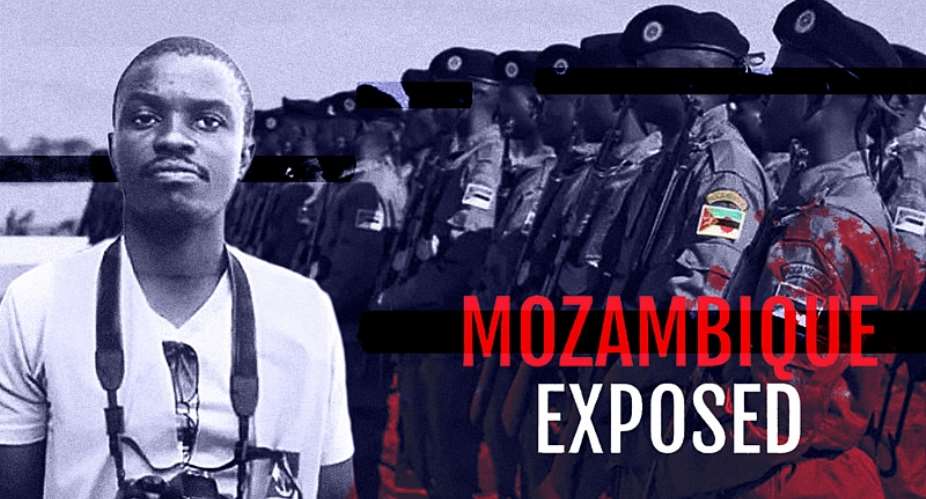
“Mozambique Exposed” is an investigation being carried out by a consortium of 30 journalists from ten different media outlets based in France, Germany, the United States, Portugal, the United Kingdom, Rwanda and Mozambique and coordinated by Forbidden Stories. FRANCE 24 and RFI are partners in this project.
In a video posted in private WhatsApp groups on January 4, 2025, Arlindo Chissale's voice and face are grave as he speaks to the camera. Behind him are the small backstreets of Pemba, the capital of the Mozambican province of Cabo Delgado.
“We are sad, but motivated, right? Sad about the death of one of our great leaders, who could have been elected as the administrator of the district of Montepuez,” he says. In this video, filmed in Pemba and shared in a private WhatsApp group on January 4, 2025, Arlindo Chissale speaks out about the assassination of a leader of the Podemos political party in the city of Montepuez, in Cabo Delgado.
The night before, a member of the opposition political party Podemos was assassinated: shot in the middle of the street in Montepuez, a city in Cabo Delgado. The assassination occurred in the midst of a serious political crisis that engulfed the country following general elections held on October 9, 2024. In the presidential race, Venâncio Mondlane, the candidate backed by Podemos, lost to Daniel Chapo, the candidate from FRELIMO, the party that has been in power in the country since it obtained independence in 1975.
Ten days later, two of Mondlane's high-level supporters, lawyer Elvino Dias and artist Paulo Guambe, were in a car together when they were gunned down. Mondlane accused the Mozambican security forces of killing the pair. The government, for its part, said they were opening an investigation into the killings – an investigation that is still open. These murders marked the beginning of a wave of assassinations of high-level figures in Mondlane's movement, especially those in Cabo Delgado.
On January 3, 2025, a young man named Abudo Bacar Lawia was assassinated in Montepuez. The next day, Chissale, a Podemos member himself, posted a video denouncing the death. In it, he featured another high-level member of the party, who said:
“The authorities are the most skilful [...] because they muddy the waters so that people won't discover that the people carrying out these acts are members of SISE, SERNIC or UIR [Editor's note: The Mozambican intelligence service, the criminal police and the riot police, respectively].” In this video posted on January 4, 2025, the day after a young man named Abudo Bacar Lawia was murdered, Arlindo Chissale filmed a leader from the Podemos movement who directly accused the Mozambican security forces of the murder.
Three days later, Chissale got onto a bus. He was travelling from Pemba, where most of his political activities took place, to Nacala, a town in the neighbouring province of Nampula, where his primary residence is located. Chissale never arrived at his destination. Instead, he vanished without a trace, joining the long list of opposition figures who have been killed or disappeared in the post-election violence: at least 55 people, including 26 in Cabo Delgado, according to internal documents from Mondlane's movement, which we were able to consult. Chissale is the only one from his province whose fate remains unknown; all of the rest were killed. He was only 46 at the time of his disappearance.
'The election results will be annulled. If not, things will go badly'
In the months leading up to his disappearance, Chissale was also speaking out about electoral fraud committed during the October 2024 general elections, which both local NGOs and some international observers said had been rigged.
Chissale sometimes spoke on behalf of Podemos in both local and international media outlets. He can be identified, wearing a beige hat, in a November 7, 2024, report by “Radio Seim Fronteras” about a protest in Pemba, which he appears to be leading.
“It's not true that Venâncio Mondlane didn't win in any province in Mozambique. At the very least, the election results will be annulled. If not, things will go badly.” In this report by local media outlet Radio Sem Fronteiras released on November 7, 2024, Chissale speaks as a representative of the Podemos party in Cabo Delgado. He calls for, among other things, the annulment of the results of the 2024 general elections in Mozambique. In this interview, he is wrongly identified as “Abudo Feraz”. It's not clear if this was an error on the part of the journalist interviewing him or an alias that Chissale was using.
This protest was part of a wave of demonstrations disputing the results of the election in the months that followed it. The authorities carried out a brutal crackdown on protesters who heeded Venâncio Mondlane's call to take to the streets, says Wilker Dias, president of the civil society organisation and monitoring group Decide.
“At least 416 people were killed during this period. More than 7,200 were arrested, 1,500 of whom remain in detention. In most cases, there is no clear charge against them. It's always the same thing: these were people arrested in the street [Editor's note: during protests] and accused of being criminals.”
Our team contacted the Mozambican ministry of the interior for comment regarding the crackdown on post-election protests. They had not responded at the time of publication.
'When the conflict broke out in Cabo Delgado, Arlindo was one of the first journalists to obtain images of it'
The FRANCE 24 Observers team knew Arlindo Chissale not as a political activist, but as a journalist. He shared videos, information and contacts with our team. These contributions enabled us to cover the mass displacement of Cabo Delgado's population in 2020 at the height of the Islamist insurrection. The insurgency was launched in 2017 by a group called Ansar al-Sunna, which later affiliated with the Islamic State group.
Read more Thousands flee Islamist insurgents in northern Mozambique
Thereafter, communication between our team and Chissale grew sporadic as he devoted more and more of his time to political endeavours. This transition also caused him to drift away from several of his former colleagues, including Tomas Queface, a journalist with Mozambican media outlet Zitamar News and a researcher with the conflict monitoring program ACLED:
"At the time of his disappearance, we spoke very little because he was deeply involved in political matters. For my part, I remained focused on the insurrection."
Along with Chissale, Queface is one of the founders of the independent news platform Pinnacle News, one of the only platforms that regularly covered the situation in Cabo Delgado, which was difficult for foreign journalists to access.
“When the conflict broke out in Cabo Delgado, Arlindo was one of the first journalists to obtain images of the first attack, which took place on October 5, 2017 [Editor's note: jihadists attacked the coastal city of Mocímboa da Praia]. He wrote to me on WhatsApp, asking me what he should do with these images and I told him that he should share them on Facebook, along with context. Then, we created a website: that's how Pinnacle News was born.”
'It's extremely risky for a journalist to report on Cabo Delgado'
In his role as a journalist, Chissale didn't hesitate to question how the authorities were managing the crisis as well as to report on how soldiers were treating civilians and refugees. In June 2020, Chissale carried out an interview for Pinnacle News with an anonymous source who described himself as a “resident of Mocímboa da Praia”, a town in Cabo Delgado. This person had fled the city after the terrorist attacks that took place in March of the same year.
“Some [of the soldiers] mistreat the population. Especially when it comes to money. For example, at checkpoints [Editor's note: on the road people took to flee the city] in Cabo Delgado, if you have 10,000 [Editor's note: 10,000 meticais, the currency of Mozambique, equivalent to around €135], they call you “shabab” [Editor's note: a term used in Mozambique to designate Islamist insurgents]. They ask you where the money came from. Then they say, it isn't yours, you are a criminal. Then, they take it from you! If you are lucky, you get away with your life. But sometimes people are even killed at the hands of the military.” In June 2020, Chissale interviewed this anonymous source, who says that they are a refugee from the Mocímboa da Praia district in Cabo Delgado. The interview was never broadcast.
Omardine Omar is a journalist with the Mozambican media outlet Integrity Magazine who also covered the situation in Cabo Delgado. He was also Chissale's friend and said that carrying out interviews like this attracted the attention of the Mozambican authorities.
“Reporting on Cabo Delgado during those first years was a very, very violent affair. Journalists faced enormous threats and persecution.
The governor at the time called together almost all of the journalists in the province and told them to stop covering terrorism. The aim was to try to extinguish this avalanche of news circulating about Cabo Delgado.”
The Mozambican government had good reasons for wanting to limit the spread of information about the insurgency in Cabo Delgado. The region is rich in mineral resources and finds itself at the centre of several major liquefied natural gas (LNG) projects led by energy giants such as France's TotalEnergies, Italy's Eni, and America's ExxonMobil. One of these projects, called “Mozambique LNG”, could make up to €30 billion for the Mozambican government, a sum that represents six times its total 2025 budget.
However, the project was frozen in light of the intensification of terrorist attacks and the rebels' invasion of Palma, one of the region's main towns, in April 2021. Work on the project only began again in January 2026.
Chissale's phone contained military sources and accusations against security forces
At the heart of this explosive security situation, Chissale was able to gather incredibly sensitive intelligence from a network of sources. Data from his phone, which the Observers team was able to access, shows that he was in contact with people within the security forces and the army who were providing him with information. In this WhatsApp conversation between Arlindo Chissale and a source from January 2023, the journalist was receiving sensitive information about soldiers killed in combat or those who were let go from the military because they fled in the face of the terrorists. Our team redacted the soldiers' names as well as the places mentioned. We also blurred images of their faces to protect the anonymity of the soldiers as well as the source.
In other WhatsApp conversations with Chissale, sources directly accused soldiers in Cabo Delgado of human rights abuses against civilians, including sexual violence against women. In this November 2022 WhatsApp message to Arlindo Chisssale, which was forwarded to one of his groups, a source accuses Mozambican soldiers of sexual violence against two women. The source says, “We met on Wednesday in the village of X. Locals complained that a mother and daughter were sexually assaulted by eight soldiers when they were returning from the fields and that the leaders did nothing when this was reported [...] Publish this story, man.” Our team was not able to independently verify this account. We redacted the name of the village where this assault was said to have taken place to protect the anonymity of potential victims.
We were not able to independently verify this account. But several news articles and reports from both local and international NGOs have documented sexual violence perpetrated by Mozambican soldiers. One of the NGOs, the Observatory of Rural Areas, documented several accounts. One accused “very young… soldiers” of forcing “young girls [to have sexual relations] with them”.
Insurgent Islamist groups in Mozambique have been found guilty of extremely serious cases of sexual violence against women in the zones that they control. Some women are forced into sexual slavery; there have also been reports of gang rape.
When our team asked about potential surveillance Chissale may have been under because of his journalistic work, the Mozambican ministry of the interior and the armed forces did not respond to requests for comment.
'Chissale was working with individuals close to the former president Filipe Nyusi'
In addition to his political and journalistic activities, several people close to Chissale said he also worked directly for the authorities in the past. One acquaintance, speaking on the condition of anonymity, told our team:
“I believe that around 2020 or 2021, he was working with individuals close to the former president Filipe Nyusi [Editor's note: affiliated to FRELIMO, who preceded the current president, Daniel Chapo]. These individuals asked him to distribute phones to soldiers in Cabo Delgado, which he did. My understanding is that Nyusi's inner circle wanted to gather information directly from the troops. This was at a time when there were suspicions that the intelligence services were withholding full information from president Nyusi.”
The same source said that during this period, Chissale travelled to Mozambique's capital, Maputo, to meet Nyusi in person.
A high-level FRELIMO figure also told us that Chissale was “a journalist, but also an informant for the defence and security forces”. But he accused him of providing intelligence to Islamist insurgents in Cabo Delgado as well.
“He was bringing information to defence and security forces, but also to terrorists. I knew it perfectly well. On two occasions, we wanted to feed information to the terrorists so they would use it, and we could trap them. He was the one [who passed it on]."
Our team has no information confirming that he was in contact with individuals linked to Islamist insurgents outside his professional journalistic duties. We also reached out to the Mozambican presidency to verify the information provided by our sources, but received no response.
'Chissale contributed greatly to journalism, but he disappeared amidst the political struggle surrounding his activism'
On April 7, 2020, a journalist working for a state-funded local radio station, Ibrahimo Mbaruco, had already suddenly disappeared in Cabo Delgado. In his final message to a co-worker, he said he was surrounded by military forces, according to a statement by MISA, a media rights organisation. No trace of the journalist has been found since.
Journalist Omardine Omar, who has been monitoring this case, said that, just like Chissale, Mbaruco had been accused of links to terrorist groups.
“Back then, anyone who fell into the hands of the authorities [in Cabo Delgado] was instantly labelled a terrorist collaborator, agent or informant. That's what they tried to pitch about Mbaruco. But the truth, for those of us who worked with him, is that he was simply the person whom others would suggest to the [security] agencies themselves, saying: 'Talk to him, because I'm not on the ground. He can give you the information.”
However, "there is a difference" between the cases of Chissale and Mbaruco, Omar said.
“Chissale contributed greatly to journalism, particularly through his coverage of the insurrection. But ultimately, he disappeared amidst the political struggle surrounding his activism. Mbaruco, for his part, was killed because of his reporting on terrorism in Cabo Delgado.”
Another acquaintance who knew him well confirmed that the way Chissale juggled journalism, activism and close ties to the authorities may have put him in danger.
“He operated in a highly ambiguous grey zone. At times, he wore the mask of a journalist; at others, that of a consultant or a political leader. When you operate that way, it eventually catches up to you in terms of credibility.”
To better understand the reasons for Chissale's disappearance, we pieced together his last days. Read the second instalment of our investigation:
This article has been translated from the original in French by Brenna Daldorph.
Mariana Abreu (Forbidden Stories), Gaëlle Laleix (RFI) and the team with the Mozambican media outlet Zitamar News contributed to this article.


 'EOCO attempted arrest of Baffour Awuah was unprofessional' — James Agalga
 'Building a congregation of 20,000 will kill you' – Duncan-Williams tells young ...
 September 29: Cedi finishes day selling at GHS12.20 on forex market, GHS11.67 on...
 ‘We’ll explore another constitutional option for narcotics probe’ – Minority on ...
 Speaker Bagbin adjourns Parliament indefinitely after rejecting narcotics probe ...
 Food Buffer Stock seeks stronger liquidity buffer despite record GH¢91.7 million...
 Ex NAFCO Boss trial: Court adjourns trial to hear application for return of seiz...
 Bagbin backs Mahama’s call for national dialogue on social media insults


