




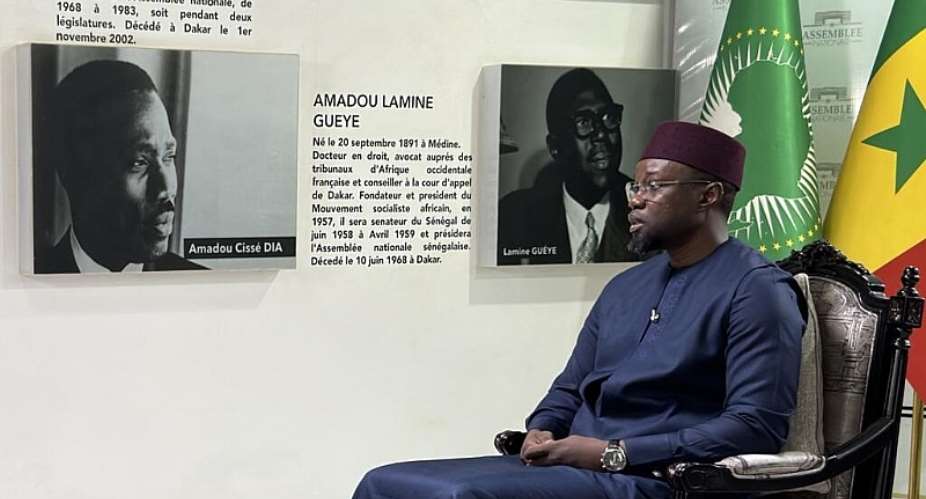
On 22 May 2026, President Faye fired his long-standing political ally Sonko as prime minister and dissolved his entire government.
Just four days later Sonko was elected Speaker of Senegal's National Assembly, and in June he was re-elected leader of the ruling Pastef party with a resounding 589 out of 598 votes.
He spoke to RFI's Léa-Lisa Westerhoff and France 24's Marc Perelman at the National Assembly in Dakar on 14 June.
RFI: Three weeks after dismissing you, President Bassirou Diomaye Faye referred in his latest speech to the differences that have set you against each other for months, saying that "no quarrel is worth tearing apart the country we share". What do you make of that?
Ousmane Sonko: I do not think there's any quarrel. Senegal is bigger than any political differences we may have. I can reassure everyone that there will be no tearing apart. There may be political differences, differences over programmes, but there will be no division of the country.
France 24: Looking back, given the difficulties Senegal is facing and your ambitions for the 2029 presidential election, was being dismissed perhaps a good thing for you?
OS: No, I wouldn't look at it that way. That episode now belongs to Senegal's political history. This institutional separation is not the most significant aspect of my political career.
Today, I must first thank the Senegalese people for placing their trust in a candidate that I also selected. Then they renewed that trust by giving us an overwhelming majority in the National Assembly and, in effect, by choosing me to lead this prestigious institution.
From now on, my energy will be focused on giving this institution the role and standing it deserves. The executive will do what it must do under its constitutional powers. The legislature will do its part in a complementary way because we all have an obligation to make this mandate a success. It's our mandate, after all.
Senegal president sacks prime minister amid mounting power struggle
RFI: You have repeatedly said that Bassirou Diomaye Faye has betrayed the Pastef project. Could he be expelled from the party?
OS: Betrayal is more a matter of morality and emotion. I prefer to approach this from a political perspective.
Commitments were made to the Senegalese people during 10 years in opposition. Many of those commitments have been completely distorted by the direction that has been chosen.
Today, I believe that many of the commitments we made to the Senegalese people are not being respected and there is no willingness to respect them.
As for expulsion, Pastef is a highly structured and organised party. It has rules and procedures. We are not at that stage. The party will decide. The party is not Ousmane Sonko.
France 24: You recently said the government could be censured if Pastef wished. Under what circumstances would that happen?
OS: There is no blank cheque that we would hand to the president of the republic or to the government.
Since we're not here to obstruct the work of the executive, we will, as far as possible, avoid censure. We won't engage in political manoeuvres, using censure to settle scores or weaken government action.
But if circumstances require censure, it's a constitutional power of the National Assembly. We will not hesitate to use it.
A new government has just been installed. We are observing it, giving it time to find its footing. The country's situation requires restraint and wisdom from all of us.
France 24: What if local elections [due in January 2027] were postponed?
OS: Elections cannot be postponed. There's no valid reason for them to be postponed.
They will take place on the scheduled date. Whatever manoeuvres may be attempted, the elections must take place on the scheduled date.
The law governs the organisation of elections and requires the president of the republic to take the necessary measures. We believe he will fulfil his legal responsibilities.
Macky Sall pitches four decades of power as his UN calling card
RFI: One of the new government's priorities is dealing with the country's huge debt burden, inherited from the previous administration [under Macky Sall]. The team from the IMF is due in Dakar this week. If the executive decides to restructure the debt, what will you do?
OS: We're not locked into fixed positions. We look at the situation with clear eyes.
We didn't want a disorderly restructuring. I opposed it throughout my time as prime minister because the country was not in default. It was meeting its obligations. Our indicators were relatively sound and our growth prospects were also positive.
At the same time, we accept that the state is a continuity.
Today, we must assess developments as they unfold. As the outgoing prime minister, I know we're going through a particularly difficult period.
But if a solution is adopted that is not in Senegal's interests, that sacrifices our options for systemic and structural change on the altar of short-term ratios, then we won't accept it. And where the National Assembly has powers, we will use them to say no.
France 24: You've spoken at length about economic sovereignty. Yet Senegal has continued to accumulate debt with international donors, both public and private. Looking back, do you regret not demanding outright cancellation of what you have called 'hidden debt'?
OS: We chose a particular course. We wanted to start from a sound footing rather than conceal figures because that would eventually have caught up with us.
Once you reveal the real figures, you have to deal with them. Debt comes with repayments. It has to be serviced and that can't wait.
A country that wants to be sovereign has to repay its debts. Debt is refinanced. In reality, all countries refinance and roll over debt.
RFI: But you could have called for it to be cancelled as 'odious debt' [a debt incurred without the knowledge of the people and against their interests].
OS: I used it once or twice. It's a whole process. I didn't have all the levers of power.
When I spoke about it on certain occasions, I was speaking as a political party leader expressing an opinion.
Don't forget that I was only prime minister. The powers of the prime minister are extremely limited in this country.
RFI: Were you in disagreement with the president on this issue?
OS: We never discussed it. We were always aligned on debt management until our last discussion, when the issue was raised and he confirmed to me that the line had not changed.
But on the question of odious debt, these are my personal views. International law has accepted, since the work of the economist Alexander Sack, that when debt has been contracted without the knowledge of the people and against their interests, that debt is odious and can be rejected.
Part of this debt is indeed odious because it did not even pass through approval by the National Assembly. It was approved neither directly by the people nor indirectly through their representatives.
The procedures and mechanisms were not respected and the Senegalese people must now bear the burden.
It takes political courage to open that debate. I have spoken about it on several occasions as a politician. I simply hope the current executive will take responsibility and pursue discussions aimed at cancelling part of the debt.
RFI: Why didn't you do that earlier?
OS: It was proposed.
RFI: But not adopted?
OS: No.
RFI: Another issue during your time as head of government was the university crisis. Do you regret authorising the intervention of security forces on the campus of Cheikh Anta Diop University?
OS: No, not at all. An investigation was opened and it was launched very promptly. The file is now before the prosecutor. We don't have the conclusions yet.
There are two separate issues. One is maintaining public order. Whenever my responsibilities require it, I will take all necessary measures.
The second issue concerns the methods used by certain defence and security forces, methods that we ourselves criticised [when in opposition, up until 2024], notably the disproportionate use of force.
Senegal prosecutor says student died in fall, amid claims of police torture
RFI: So disproportionate force was used?
OS: We must wait for the conclusions of the investigation and judicial inquiry into the causes of the student's death.
Based on the images I saw, I do believe there was disproportionate use of force.
When unarmed young people are beaten publicly while surrounded by security forces, that is disproportionate use of force.
When motorcycles are smashed and destroyed, that is disproportionate use of force.
RFI: Are you not responsible for that?
OS: No, because I'm not the one carrying out the operations.
What I can do is ensure public order is maintained and instruct that public buildings should not be set on fire. That was the instruction.
As for how operations are conducted on the ground, it's not the prime minister who goes into the field telling individual officers what to do.
Abdoulaye Wade at 100: from challenger to 'old lion' of Senegalese politics
France 24: On homosexuality, the law has doubled the penalties for same-sex relations. This has drawn sharp criticism at the United Nations, and particularly in France. More than 100 people have been arrested. People's cellphones are being checked. Why is there a crackdown on homosexuals in Senegal?
OS: There is no crackdown on homosexuals. There is a Senegalese law that is more than 30 years old. What changed was the severity of the penalties.
The law has existed since the time of president Léopold Sédar Senghor. So the law did not come with us. It was already there.
There were arrests in the past, and those arrests began before the vote that increased the penalties for homosexuality.
It all stems from two things. The phenomenon of homosexuality combined with the deliberate transmission of HIV. The Western press seems intent on glossing over this second aspect, which is extremely important: the deliberate transmission of HIV.
Senegal is a sovereign country. It doesn't have to justify the laws it adopts – whether to the West or to anyone else.
France has implemented laws that the United Nations Human Rights Committee considered harmful to human rights, particularly regarding the hijab, and minors. You didn't hear us commenting on that. We expect the same courtesy and the same respect.
We are a country with our own religious beliefs and cultural values. We are a sovereign nation that legislates according to what its society rejects.
France 24: You're not going to repeal this law?
OS: No. Why would I repeal this law? If there is a need to strengthen this law, we will strengthen it, but we will absolutely not repeal it.
RFI: There's also concern about the rights of defendants because more than 100 people have reportedly been arrested and there have been searches of mobile phones. Lawyers themselves have expressed concerns about defendants' rights not being respected.
OS: The judiciary is independent. I'm not a prosecutor and I'm not an investigating judge.
Every citizen has an absolute right to liberty and, above all, to security within the national territory.
I was also the first person here to condemn the fact that we have no right to expose entire families to public condemnation.
There are children who are now struggling to go to school. There are wives whose lives have been shattered. We don't have the right to do that.
As for investigations, I can't interfere because that falls under judicial independence. But there may be aspects of concern, and this is not limited to homosexuality cases. It applies to all cases.
Senegal doubles jail terms for same-sex relations amid crackdown
RFI: You have been Speaker of the National Assembly for nearly a month. What do you make of people challenging the legality of your election before the Constitutional Council? And will you abide by its ruling?
OS: Of course. What else would I do but abide by it?
We will wait for the ruling and I have no further comment to make on the matter.
I think it was the Constitutional Council itself that proclaimed the final results of the parliamentary elections on 27 November 2024 and held that Ousmane Sonko, head of the Pastef list, was a member of the National Assembly.
So the Constitutional Council has already answered that question definitively.
France 24: Will you be a candidate in the 2029 presidential election?
OS: It's far too early to talk about candidacies.
I see many initiatives speaking about an Ousmane Sonko candidacy in 2029, but I would prefer to wait for the appropriate time.
I belong to a political party and that party will choose whichever candidate it wishes to nominate. We're not at that stage yet.
France 24: Do you think the president will seek re-election?
OS: I do not concern myself with the president's candidacy. I think he has his own path to follow. I have mine.
I'm not going to speculate about a possible candidacy by the incumbent president.
RFI: In the Sahel, military leaders [of Burkina Faso, Mali and Niger] who seized power have refused to hand power back to civilians. As someone who defends democracy, do you condemn these developments?
OS: First of all, I respect the sovereignty of every country. It's not my role to condemn this or that leader.
Questions about how a state functions should first and foremost be dealt with by that country's own citizens.
We're following developments very closely.
Senegal passes law to protect whistleblowers in 'historic moment for democracy'
RFI: Were these countries right to the Economic Community of West African States (Ecowas)?
OS: I'm a committed pan-Africanist. I work towards bringing African countries closer together.
Having the whole of Africa as a single country is virtually impossible. But I believe we can move towards closer integration through strong regional blocs.
In West Africa, I believe we all have an interest in remaining very close to one another, in working together and in continuing this process of integration.
My wish is for the whole family to come back together.
If the Ecowas bloc is properly organised and structured, it can become a major power. In terms of population, it represents close to 500 million people. It's starting to be a market, an economy. But fragmentation and division benefit nobody.
France 24: These states asked French forces to leave, more than three years ago, and turned to Russia for support. The security failure is clear. We can see it on Senegal's border with Mali. Apart from the democratic backsliding, isn't that security failure also their responsibility?
OS: French forces were present for nine years [with the Serval then Barkhane military operations] and many millions of euros were spent. That didn't resolve the security problem.
The debate is not really about whether a foreign power should be present. The real question is this: what mechanisms and what organisation should we, as Africans, develop to take responsibility for our own security?
We can all see that the security situation has deteriorated. It means we have a shared interest within the Ecowas area in dealing with these security challenges together.
Senegal cannot escape the consequences if Mali collapses.
I've always said that our choice is not to replace one flag with another.
Our choice is to work towards our own sovereignty so that we can genuinely take responsibility for these issues ourselves.
France 24: In 2002, Senegal beat France in the opening match of the World Cup. The two countries meet again on 16 June in their opening match of the 2026 tournament. What's your prediction?
OS: I think Senegal will win. At least, that's my hope, like every Senegalese person.
In any case, it's only a football match. But if you want to look at the match politically, [given the number of players of African origin in the French team] then whoever wins, Africa will have beaten Africa.
Africa's finest: Senegal, runners-up with something to prove
That brings me to a broader reflection on relations between France and Africa.
Just looking at the make-up of the French national team tells us something about where the real need lies.
The message I always give to Africans is that if we understand our own value and embrace it – we have natural resources, we have human resources, we have a rapidly growing and overwhelmingly young population and we have a strategic position – then I believe the balance of needs is not where people often think it is.
That would also bring us back to debates about migration and many of the issues that exist between the West more generally and Africa.
This is a shortened version of the original interview in French.

 Ghana's missing billions: What 16 years of Auditor-General reports show
 'Go ahead and imprison me because of my friendship with Bawumia, I will come bac...
 Prayer must not replace action and accountability in GoldBod debate — Karbo to D...
 'NPP will win 2028 elections if we are united' – Bawumia
 Health Minister cautions Boards against interfering in day-to-day management
 President Mahama wants Ghana where no woman dies giving birth – Deputy Health Mi...
 One dead after tanker and Toyota Voxy collide on Kasoa-Winneba road
 20-year-old man drowns while crossing Ghana-Togo border river in Tempane
 Ghana’s currency is long overdue for security refresh to curb counterfeiting — M...
 Declining enrolment, poor infrastructure justified 70-year-old Tendamba School d...

