




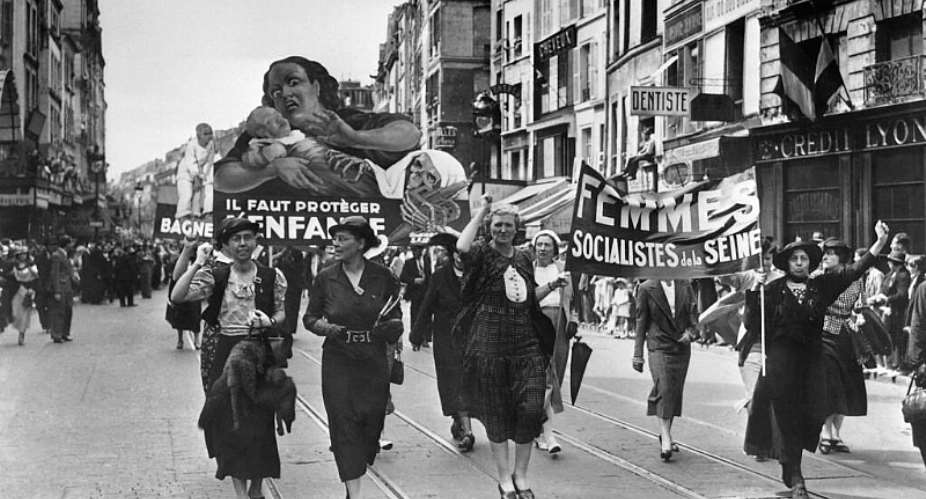
Within weeks of taking office on 6 June, 1936, the Front Populaire – or Popular Front – had established collective bargaining, enshrined the right to strike, capped the working week and granted all employees paid leave.
But the movement that redefined workers' rights in France didn't start out on an economic platform. Instead, it was forged to fight authoritarianism.
By the 1930s, fascists were in power in Germany and Italy, and far-right groups were flexing their muscles in France too. In February 1934, they rallied near the parliament building in Paris, seeking to bring down the centre-left government. The rally ended in a riot, with a dozen people dead and hundreds injured.
This rising tide prompted communist chiefs to drop their objections to working with moderates. In the months that followed, the French Communist Party teamed up first with the social democratic French Section of the Workers' International (SFIO), then with the centrist Radical Party.
On 14 July, 1935, with France now under a conservative government headed by Pierre Laval, a future Vichy collaborator, the new alliance gathered a crowd of 500,000 in Paris. Channelling the spirit of the revolutionaries who had stormed the Bastille some 150 years earlier, they pledged to “defend the democratic freedoms won by the people of France, to provide bread for the workers, work for the young, and lasting peace for the whole world”.
When France held parliamentary elections the following spring, that became the Popular Front's slogan: “pain, paix, liberté” – bread, peace, freedom.
Economic experiments
By now backed by trade unions, civil society organisations and local anti-fascist groups, “it was a kind of huge coalition way above the political milieu”, says Nicolas Brisset, a historian of economic thought at the Université Côte d'Azur in Nice.
It had also expanded its original remit. The Great Depression was biting and while France's leaders were focused on slashing public spending, elsewhere governments were taking the opposite approach.
In the United States, President Franklin D Roosevelt was investing massively in public works and job creation schemes, while establishing social security benefits and expanding workers' right to unionise.
“It's clear that the Popular Front was also inspired by what were called at that time the 'Roosevelt experiments',” Brisset says. Drawing on his New Deal, as well as other examples, they promised welfare for the unemployed, infrastructure projects and other stimulus measures.
Voters were convinced. They elected the Popular Front alliance on 3 May, 1936, securing 386 seats in parliament out of 608. The SFIO was the largest party and its leader, Léon Blum, was in line to head a new Popular Front government.
Listen to this story on the Spotlight on France podcast: Spotlight on France, episode 144
The joy of strikes
The month between winning power and taking office saw the Popular Front rewrite its platform again.
The impetus came from the workers' movement. Angered by seeing employees punished for joining May Day protests and emboldened by the Popular Front's victory, unions launched strikes that would become some of the largest in France's history.
Between May and early June, more than 2 million workers occupied thousands of factories across the country, bringing production to a halt and forcing shops to close.
The strikes were exceptional not just for their size, but their nature. Organic and almost celebratory, they were accompanied by picnics, music, dancing and card games on the picket lines. They came to be remembered as “the joyous strikes”. Workers dance and play music at a French factory on 5 May, 1936, in the early days of 'the joyous strikes'.
By the time Blum was sworn in as France's first socialist prime minister, his government was in a position to deliver its promises and more. “It was an extraordinary weapon for him to have all those people outside striking,” says Brisset. “It was a huge political pressure.”
With all sides agreed on the urgency of getting France back to work, the new government passed reforms at breakneck speed.
On 8 June, it got employers and unions to sign accords establishing the right to strike and unionise, as well as a blanket pay rise. By the end of the month, it had followed up with legislation guaranteeing collective bargaining, a 40-hour working week and two weeks of paid leave – measures even more ambitious than the Popular Front's original programme.
It was the start of a summer that has since entered into myth in France's collective memory: when street parades celebrated a new era for labour rights and workers took what were for many their first holidays.
The summer France got its first paid leave and learned to holiday
Reforms halted
But as the days cooled, the Popular Front's momentum stalled.
After a flurry of other progressive measures, spanning from fixing minimum prices for farmers to extending compulsory education, in February 1937 Blum announced social reforms were on hold.
Germany was rearming and Blum wanted to build up France's defence industry in readiness. Meanwhile markets were betting against the franc, dragging down its value, and the wealthy were moving their capital to safe havens abroad. Leon Blum, France's first socialist prime minister, answers journalists' questions in June 1936 in Paris.
Under financial pressure, the government prioritised arms production. As workers saw reform sidelined and inflation swallowing their extra wages, the Popular Front lost support from its base and divisions within the alliance widened.
In June 1937, Blum sought special powers to push through emergency financial measures. Parliament denied them and, after barely a year in office, he and his government resigned.
They were replaced by the Radicals, who pulled successive governments further to the centre. When they opted to ally with right-wing parties instead of Blum's socialists in April 1938, the Popular Front was effectively dead.
Reviled and revered
During the war that followed, the Vichy regime sought to blame the Popular Front for France's invasion by Nazi Germany, putting Blum – the first Jew to lead France – on trial.
For decades the narrative persisted that the alliance's reforms had weakened the French economy and contributed to its defeat, says Brisset.
When France reduced the working week to 35 hours in 2000, he notes, opponents invoked the reforms of 1936 as a warning – “like, 'remember the Popular Front? Remember what happened last time we reduced working hours?'”
Historians have since reassessed its legacy, pointing out that Blum reversed years of under-investment in French armament. Most tellingly, France has kept or expanded the Popular Front's flagship measures.
“The Popular Front set the foundations of the social state,” says Brisset. “Of course the Popular Front failed, because it fell really quickly. But all the measures it implemented came back again after the war... And some others have been added, like the social security system, large-scale nationalisation etc. And I think without the Popular Front, this second wave of the construction of the social state would not have happened.”
Government backtracks on plans allowing more work on 1st May holiday in France A protester holds a placard reading: 'Let's bring the Popular Front back again' at a May Day demonstration in Paris on 1 May, 2016.
For the French left, the alliance's year in power remains a foundational moment and a symbol of bold, progressive government. In France's most recent legislative elections in 2024, left-wing parties came together as the “New Popular Front”, a broad coalition that became the biggest bloc in parliament – but proved too broad to hold.
Brisset speculates that parallels between the crises of the 1930s and today – notably the rise of the far right – partly explain why the left continues to invoke the Popular Front.
But he also believes its legendary status is, to some extent, deserved.
“I think it proved that something we thought was impossible was in fact maybe possible,” he says.
“It changed what we think the role of the state is, in terms of economic intervention, in terms of social intervention, in terms of social security intervention... And I think it's priceless. I really think it's priceless.”
This story first appeared on episode 144 of the Spotlight on France podcast.

 KMA Deploys Vacuum Sweepers to Tackle Dust, Waste and Flooding in Kumasi
 UCC Probes Death of Level 200 Student Found at Hutchland Beach
 BoG Cracks Down on Crypto Dollar Wallets; Orders Banks to Cut Ties Immediately
 BoG Extends IMTO Registration Deadline to July 31 — Non‑Compliant Operators Face...
 Ato Forson Pushes for New ‘Auditors’ Court’ to Tackle Waste, Strengthen Accounta...
 Big Payout, Big Changes: MMMF Declares 30p Dividend, Endorses New Board
 C/R: Missing UCC student found dead at Hutchland Beach
 Man collapses and dies in front of pharmacy at Abura in Cape Coast
 Gov’t Should Have Anticipated Partey Visa Trouble — Asafo-Adjei Ayeh Fires
 Swiss Vote on Population Cap Sparks Fierce Immigration Debate Ahead of Sunday Re...


