




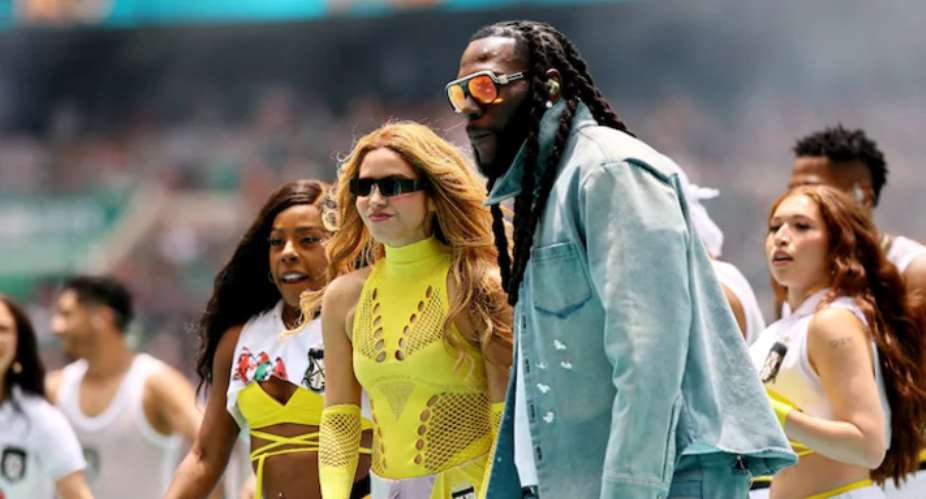
Let me start with a scene that captures the beautiful and brutal contradictions of this World Cup. Inside the Estadio Azteca, Shakira and Burna Boy brought the house down. The Colombian superstar and the Nigerian Afrobeat icon delivered a high-energy performance of the tournament's official song "Dai Dai" as dancers twirled around a giant model of the World Cup trophy. Fireworks lit up the historic 80,000-capacity stadium. The crowd roared. Latin and African music fused on football's biggest stage. It was a moment of pure celebration.
Outside, in the centre of Mexico City, chaos. Thousands of fans pushed and shoved as they attempted to enter the official World Cup fan zone in Zocala plaza. Metal barriers erected to prevent protesting teachers from reaching the area hampered access. A city official shouted through a megaphone, "Stop pushing and shoving, there are children here, you're like animals!" Some fans threw water bottles and hurled insults at police. Javier Maciel, a 25-year-old fan, said, "It's crazy. There could have been better organization." The local government announced on social media that the site was full and suggested fans go to other plazas.
That contrast, joy and frustration, inclusion and exclusion, defines this expanded 48-team World Cup. For every fan who made it inside, another was locked out. For every nation celebrating its debut, another was watching from home, unable to secure a visa.
Let me take you to the even darker side of this story. Ivory Coast and Senegal's home-based supporters have been denied visas to enter the United States. The president of Ivory Coast's National Committee of Elephants Supporters confirmed the rejections, describing the situation as deeply painful. "The supporters have cancelled the trip because the US government does not want to see supporters from certain countries, including Ivory Coast, on its soil. The United States has been clear with us, saying they do not want to see our supporters," said Julien Kouadio Adonis. "This situation hurts us deeply because it prevents us from fulfilling our sacred duty, which is to support our team."
Ivory Coast play two of their three group matches in Philadelphia, against Ecuador on June 14 and Curacao on June 25, either side of a trip to Toronto to face Germany. Adonis had hoped 500 fans would travel across the Atlantic. Instead, only a handful of CNSE officials have been authorised to travel. They will "look after the Ivorian supporters based in the United States." The CNSE estimates more than 1,000 Ivorian fans already in the US will attend matches. But the home-based faithful, the ones who chant and drum and wave the flag with the most passion, will not be there.
For Senegal, the visa denials mark the first time home-based supporters will not be present at a World Cup in which the team is competing, after appearances in 2002, 2018, and 2022. "It is the first time we will not be sending a delegation because of restrictions linked to the granting of visas by the United States," Ndeye Dome Thiouf, communications advisor to Senegal's sports ministry, told AFP. The ministry attempted to send presidents of various supporters' organisations with all costs covered by the state. Their visa applications were rejected. Pape Mass Gueye, president of the Lebougui supporters group and one of those affected, said, "Personally I am disappointed. I thought organising a World Cup should not present so many problems."
The run-up to the World Cup has been dogged by US visa policies. Somali referee Omar Artan was denied entry last weekend. Some support staff for the Iranian team have also been refused visas. To ensure Senegal has some support, the government will distribute 400 tickets per match to Senegalese citizens living in the United States. The diaspora will represent. But the home-based supporters, the ones who saved for years, who sold their livestock, who crowdfunded their tickets, will be watching from African living rooms.
Now, let me turn to the pitch. Mexico defeated South Africa 2-0 in the tournament opener, with Julian Quinones scoring the first goal of the 2026 finals. South Africa's return to the World Cup stage ended in disaster. Defensive mistakes and a first-half red card handed the hosts victory. In the fourth minute, Raul Jimenez forced South African captain Ronwen Williams into a superb save. The breakthrough came five minutes later. A centre-back lost possession on the edge of his own area, and Quinones pounced. One-on-one with Williams, he finished with clinical composure.
South Africa's hopes were dealt a fatal blow early in the second half. In the 49th minute, Yaya Sithole, who had also committed the initial error leading to Mexico's opener, was penalised for a rash challenge as the last man in defence. Brian Gutierrez had timed his run to perfection, and as he prepared to shoot, Sithole lunged from behind and brought him down. Straight red card. Mexico capitalised on the numerical advantage, adding a second goal as South Africa's stretched defence finally broke.
A report by Accra Street Journal noted that the result leaves South Africa with a steep climb in Group A. Sithole will be suspended for the upcoming clash against the Czech Republic, forcing coach Hugo Broos to reconfigure his midfield. For Mexico, the emphatic opening win before a home crowd provides early momentum.
The World Cup is supposed to be a celebration of global football. Every four years, the sport reminds us that joy transcends borders. But this year, the borders are higher than ever. The United States, a co-host, has made it clear that not all fans are welcome. The visa denials for Ivorian and Senegalese supporters are not technicalities. They are statements. And they are devastating for the fans who consider it their sacred duty to cheer their sides.
Shakira and Burna Boy sang. The Estadio Azteca danced. But outside the stadium, outside the fan zones, outside the American embassy, a different song was playing. It was the sound of dreams deferred. It was the sound of tickets unused. It was the sound of flags that will not be waved. This World Cup will produce a champion. But it has already produced losers. And they are not the teams who lost on the pitch. They are the fans who were never allowed to enter the country. That is not sport. That is exclusion. And it is a shame that no goal can erase.
.

 June 12: Cedi appreciates, sells at GHS12.50 on forex market, GHS11.06 on BoG in...
 'Unemployment requires deeper structural reforms, not slogans' – Stephen Amoah c...
 UE/R: Sandema flooded as heavy rains cut off major road
 Nigeria killed 13,000 'terrorists' in past year — President Tinubu
 Take the path to greatness through constitution review — Barker-Vormawor to Maha...
 Ghana evacuates over 500 citizens displaced by Abidjan demolition exercise
 Youth keep acquiring degrees with no end in sight due to lack of jobs — Sammi Aw...
 2026 World Cup: Black Stars arrive in Rhode Island for final phase of preparatio...
 Adu-Boahene trial: Prosecution witness denies claims of inter-branch fund transf...
 Sales boy captured on CCTV cameras stealing GH¢217,000 from employer jailed 36 m...


