




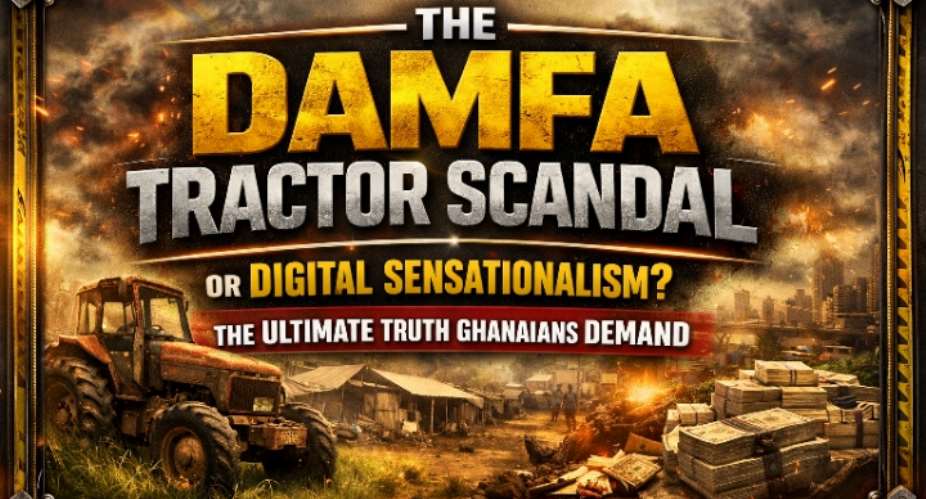
State Asset Capture or Fake News? Unmasking the TikTok Alarmism and the Armed Warfare Over Ghana’s Millions
A country fed on a constant diet of political deceit cannot be blamed for seeing ghosts in broad daylight. Recently, a fiery 15-second TikTok video exploded across Ghanaian digital spaces with a caption that sent shockwaves through the populace: “Intercepted government tractors in Damfa being issued without proper records.” Instantly, keyboard warriors, partisan actors, and frustrated citizens weaponized the footage as absolute proof of state capture.
But in the arena of serious national discourse, we do not govern by TikTok captions. We govern by hard facts, cold receipts, and institutional reality. Is this video an authentic whistleblowing operation exposing a covert, criminal syndicate ripping off the Ghanaian farmer, or is it a calculated piece of digital warfare designed to cause public disaffection? It is time to strip away the political theatre and expose the ultimate truth of what is actually happening on the ground in Damfa.
The Cold, Hard Facts: Institutional Reality vs. TikTok Noise
The state of Ghana’s mechanization drive relies on strict legal and operational frameworks that cannot simply be wiped away by a social media post:
- The Procurement Reality: The machinery filmed in the Damfa yard comprises official state assets imported under heavily documented bilateral agreements, specifically targeted at modernizing Ghana's agricultural sector.
- The Logistics Hub: The fenced perimeter in Damfa is not a secret hideout for thieves; it is a vital, official holding and assembly depot managed by the Agricultural Engineering Services Directorate (AESD) for unboxing, mechanical calibration, and strict inventory logging before deployment.
- The Inviolable Paper Trail: By constitutional law and state auditing standards, no heavy machinery can leave a state-controlled pool facility without signed administrative clearance, specific asset allocations, and explicit delivery vouchers tracked directly by the Auditor General's office.
- The Structural Shift: Historically, politicians shared subsidized tractors among themselves like party spoils. The current, verified operational shift moves these tractors directly into regional Farmers' Service Centres to stop elite capture and keep assets firmly in state hands.
The Danger of the "Little Drops of Water": Why Ghanaians Are Angry
While the Damfa video may capture a legitimate logistics process, the public’s instantaneous anger points to a deeper, systemic rot in the Ghanaian state:
- The Accumulation of Corruption: It is the "little drops of water" that form a mighty ocean of institutional rot. Every unaccounted state vehicle, every diverted bag of subsidized fertilizer, and every unpunished official building on state lands creates a culture of complete lawlessness.
- The Culture of Impunity: When public officials fail to crack the whip—preferring to shield political cronies rather than protect state wealth—it emboldens the next generation of public officers to plunder state property with absolute confidence.
- The Threat of Historical Repetition: Our leaders must understand that public patience is a finite resource. Failing to decisively enforce transparency regardless of whose ox is gored opens the door to chaos. We must never forget the grim lessons of the Teshie Shooting Range in 1979, where former heads of state and top military officers were executed by firing squad precisely due to public fury over the dishonest acquisition and intentional misapplication of public property.
- A Warning to the Ruling Class: If the state refuses to enforce the law now, citizen anger will eventually boil over. To prevent history from repeating itself in the darkest ways, the state must treat the protection of these tractors as a matter of immediate national security.
The Only Mandated Beneficiaries: Who is Legally Entitled?
Let it be known clearly: these tractors are public property, paid for by the sweat of the Ghanaian taxpayer, and are legally restricted to the following groups:
- Registered Farmer-Based Organizations (FBOs): Local, verified agricultural cooperatives who pool resources to utilize heavy machinery collectively.
- Decentralized Farmers' Service Centres: State-supervised rental stations designed to shield smallholder farmers from predatory private leasing rates.
- Highly Documented Commercial Outfits: Strictly vetted agricultural entrepreneurs bound by aggressive, audited multi-year repayment contracts.
- District Assemblies: Local government units authorized to deploy heavy machinery for community-level food security programs.
Commanding Recommendations for Absolute State Accountability
Because historical corruption has made the Ghanaian public naturally suspicious, the Ministry of Food and Agriculture (MoFA) must move immediately from a defensive posture to total transparency to maintain public trust:
- Launch an Open Digital Asset Registry: MoFA must immediately publish a live, uneditable online database tracking every imported tractor by its chassis number, its current coordinates, and its assigned custodian.
- Mandatory GPS Hardwiring: Every single state tractor must be fitted with tamper-proof, real-time GPS tracking units to ensure zero illegal movement or unauthorized border crossings.
- Enforce Open-Access Public Portals: The application and distribution pipeline for these tractors must be migrated to a fully automated digital public portal, eliminating backroom political handshakes completely.
- Empower Citizen Oversight Committees: Independent agricultural unions, investigative journalists, and civil society organizations must be granted unconditional physical access to inspect regional holding yards like Damfa against official ministry records.
Vigilance is the price of liberty, but blind alarmism is the enemy of progress. The viral footage out of Damfa reminds us that Ghanaians are awake, angry, and watching their leaders with an eagle eye—which is exactly how a healthy democracy should function. However, framing a standard, high-security government equipment holding yard as an active crime scene without an iota of forensic proof is a dangerous game that destroys public trust and feeds institutional chaos.
True accountability is not won through casual social media speculation; it is won when we force our state institutions to operate under the blinding glare of total transparency. The leadership must crack the whip mercilessly on anyone who treats public assets as personal property. The wealth of Ghana belongs to the people of Ghana, and we will not allow it to be stolen by corrupt actors, nor will we allow our national discourse to be distorted by digital sensationalism.
Historical Context and Institutional Precedents
This comprehensive historical addendum is compiled strictly from official Ghanaian anti-corruption records, Auditor-General reports, and state asset taskforce dossiers. Appended directly to this contemporary analysis of modern Ghana, these verified records provide the critical historical context that underpins current public scrutiny regarding the Damfa tractor yard. This empirical data serves as a vital reminder: when citizens demand absolute transparency over state-acquired assets, their vigilance is not rooted in arbitrary malice. Instead, public concern is driven by a documented history of asset mismanagement, proving that current demands for accountability are entirely justified by past institutional precedents.
A HISTORICAL TIMELINE OF GHANA’S STATE-ASSET LEAKAGES
To understand why a 15-second TikTok clip of fenced tractors can trigger instant panic across Ghana, we must examine the history of state-asset mismanagement. The Ghanaian public is not suffering from paranoia; they are reacting to decades of proven systemic asset diversions, unfulfilled deliveries, and abandoned state investments.
Below are the key benchmarks of state-asset recovery reports and open corruption inquiries that justify citizen vigilance:
The "ORAL" (Operation Recover All Loot) Committee Report (2025/2026)
- The Context: Established to rigorously investigate and trace misappropriated state resources, properties, and land allocations.
- The Findings: The Official ORAL Committee Report exposed a massive web of leakages across 36 distinct financial and property cases, valuing total reviewed economic infractions at an astronomical $20.49 billion.
- The Concrete Leakage: The committee tracked the wanton, irregular sale and privatization of public lands and state-owned structural infrastructure, valuing land-grab infractions alone at $702.8 million. By early 2026, the state was forced to initiate aggressive asset-freezing orders totaling GH₵1.5 billion against individuals under active court investigation.
The MASLOC Overpriced & Abandoned Vehicles Dossier (2019)
- The Context: The Microfinance and Small Loans Centre (MASLOC) procured a massive fleet of mass transit and commercial vehicles intended to support local transport unions.
- The Findings: A massive investigative audit revealed that 350 vehicles (including Isuzu buses and Chevrolet saloon cars) were purchased using state funds at a combined GH₵18 million over market showroom price.
- The Asset Outcome: Because the prices were highly inflated, the Ghana Private Road Transport Union (GPRTU) flatly rejected the vehicles. The entire fleet was left abandoned to rot in the weeds at a National Security yard behind the Accra International Conference Centre, serving as a monument to unpunished procurement inflation.
The Customs Division Confiscated Vehicle Violations (2018 Auditor-General's Report)
- The Context: The Auditor-General launched a forensic probe into the auctioning pipelines of the Customs Division of the Ghana Revenue Authority (GRA).
- The Findings: The Auditor-General's Public Accounts Tracking officially established that between 2015 and 2017, a total of 1,719 confiscated vehicles were auctioned off by customs officials outside standard regulatory procedures. Many vanished into the hands of politically connected individuals without proper public bidding, fair valuation, or verifiable state accounting trails.
The "Ghost Fleet" Scandal (Ministries of Interior, Works & Housing)
- The Context: A Public Accounts Committee query based on historical state expenditure monitoring examined payments made for administrative transport logistics.
- The Findings: The state discovered that the Ministry of Interior and the Ministry of Works and Housing had completely disbursed GH₵1.5 million of taxpayer money to purchase a fleet of operational vehicles. Despite the funds being transferred and paid out in full, subsequent physical audits found absolutely zero evidence that a single vehicle was ever delivered to the state.
State Asset Retrieval Taskforce Pickups (2017)
- The Context: Following a transition of power, a dedicated state taskforce was set up to physically track and seize government assets unlawfully retained by outgoing state officials.
- The Findings: Acting on citizen tips, Taskforce Retrieval Operations repeatedly recovered fleets of high-end state protocol vehicles—including Toyota Land Cruisers, Mitsubishi Pajeros, and BMW saloon cars—hidden on remote private properties and unmapped commercial garages across Nsawam and Accra.
✍️By A Concerned Retired Senior Citizen
For and on behalf of all Senior Citizens of the Republic of Ghana 🇬🇭
Teshie-Nungua
[email protected]

 June 12: Cedi appreciates, sells at GHS12.50 on forex market, GHS11.06 on BoG in...
 'Unemployment requires deeper structural reforms, not slogans' – Stephen Amoah c...
 UE/R: Sandema flooded as heavy rains cut off major road
 Nigeria killed 13,000 'terrorists' in past year — President Tinubu
 Take the path to greatness through constitution review — Barker-Vormawor to Maha...
 Ghana evacuates over 500 citizens displaced by Abidjan demolition exercise
 Youth keep acquiring degrees with no end in sight due to lack of jobs — Sammi Aw...
 2026 World Cup: Black Stars arrive in Rhode Island for final phase of preparatio...
 Adu-Boahene trial: Prosecution witness denies claims of inter-branch fund transf...
 Sales boy captured on CCTV cameras stealing GH¢217,000 from employer jailed 36 m...


