




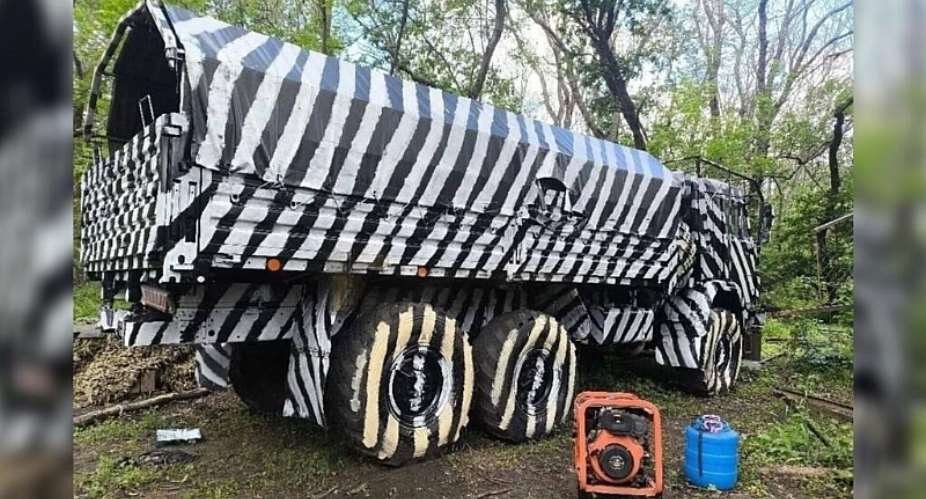
"An attempt to confuse the guidance systems of enemy drones," a Russian military blogger wrote in the caption of a photo shared on Telegram, which shows a Russian Kamaz truck covered in zebra stripes.
Since late May, several pro-Russian bloggers have reported the use of this camouflage which they claim is aimed at deceiving the automatic tracking systems of enemy drones, particularly those relying on artificial intelligence.
“The rationale is almost certainly to complicate drone targeting,” James Patton Rogers, a drone warfare expert at Cornell University, told our team. “Logistics vehicles are among the most important targets in Ukraine, and both sides increasingly rely on drones and AI-assisted systems to find and track them.”
A Russian blogger says this is an attempt to confuse the guidance systems of Hornet drones, “which use AI-assisted targeting during the terminal phase of flight”. This mid-range US-made drone is at the centre of a new Ukrainian strategy to target Russian logistics.
Read more Ukraine: How a kamikaze drone partially operated by AI is attacking Russian convoys
Breaking the recognition process
This camouflage, which consists of a jumble of irregular patterns in contrasting colours, has a name: “dazzle camouflage”. Branka Marijan, a researcher at the Centre for International Governance Innovation and the Project Ploughshares in Canada, told us more:
“What's interesting about dazzle camouflage is that it's not really trying to hide the object; it's trying to confuse whoever, or whatever, is looking at it. The idea is that those bold, contrasting patterns disrupt your ability to read the object's true shape, size, or direction of movement.
AI systems have been trained to recognise specific shapes and visual profiles. But if you dramatically change the visual appearance of that truck with an unusual pattern, it may simply not match anything in the system's training data. It breaks the recognition process.
For the Russians, it's a relatively quick and low-cost tool they can deploy in the short term to make targeting harder.”
This tactic is not new. Dazzle camouflage was developed by a British artist, Norman Wilkinson, during World War I, explained Lauren Kahn, a research analyst at Georgetown's Centre for Security and Emerging Technology (CSET):
“Ships were painted with bold intersecting geometric shapes in black, white, and colour to create optical illusions. At the time, targeting a ship meant reading visual cues – mast height, angle on the bow – to estimate speed and heading.
Submarines were being used for the first time at scale, and their novel ability to attack from below the surface meant that surface vessels were more vulnerable than ever. Rather than trying to avoid being seen at all, dazzle camouflage made it as hard as possible for submariners to get an accurate firing solution.” This image shows the USS West Mahomet, used as an auxiliary with the US Navy, covered in a dazzled camouflage in 1918.
Questions over effectiveness
However, the effectiveness of this camouflage in Ukraine remains to be seen. “It is unlikely that these attempts at silhouette-breaking will have any effect on modern AI algorithms in kamikaze drones, but only actual combat experience will tell for sure," wrote one of the Russian bloggers mentioned above.
Marijan argues that the tactic's effectiveness will depend on the type of sensor the drone relies on:
“Ukrainian drones are reported to use a combination of electro-optical cameras and thermal imaging. Thermal sensors detect heat signatures from engines and bodies rather than visual patterns. If that's the primary detection method, dazzle camouflage would offer very little protection, because it doesn't change what a vehicle looks like in infrared.”
Nick Reynolds, a research fellow in land warfare at the Royal United Services Institute (RUSI), also points to several factors that will determine the ultimate success of this strategy:
“First is the fidelity of sensors and the sophistication of the algorithms in question. Then, there is how electro-optical sensors are combined with thermal cameras, and whether the paint is combined with thermal camouflage or itself reduces thermal signature.”
Adding to the uncertainty is Ukraine's potential to adapt to these experimental tactics by updating its algorithms once it encounters enough of these dazzle-camouflaged trucks, Kahn said.
But this would not be without risks, Marijan added. “If you train your system too aggressively on a particular pattern, you risk it flagging things that happen to look similar, such as a logo on a civilian vehicle, or something printed on a building.”
'Cat-and-mouse game'
In 2023, images surfaced showing Russian bombers covered in tyres. At the time, observers, including the specialised publication The War Zone, postulated that the tactic was likely intended to disrupt Ukrainian cruise missiles and drones that rely on image-matching seeker capabilities.
One year later, Schuyler Moore, then US Central Command's chief technology officer, mentioned this case as part of a discussion about AI. “[If] you're looking for a plane, and then if you put tyres on top of the wings, all of a sudden, a lot of computer vision models have difficulty identifying that that's a plane,” she said.
For Kahn, the deployment of dazzle camouflage is “just the latest stage in a broader cat-and-mouse game that's been playing out across the entire conflict” :
“The widespread use of drones drove investment in electronic warfare to counter them. Better electronic warfare then pushed developers toward greater autonomy, building systems that can operate without a comms link vulnerable to jamming.
More recently, it has even paradoxically pushed Ukraine to revert to lower-tech solutions, like connecting FPVs to fibre-optic cables to provide direct wired guidance. That's something militaries used to do to guide munitions before the advent of more sophisticated wireless guidance systems like GPS. Dazzle camouflage follows the same logic – an old idea finding new relevance in a changed technological environment.”
Marijan notes that this strategy also aligns with the logic of a war of attrition. “It's about accumulating small advantages, wasting the other side's resources, forcing them to adapt.”

 GMET forecasts widespread rain, thunderstorms across Ghana today
 How angry mob vandalised Forestry Commission timber checkpoint housing structure...
 Ghanaians rate President Mahama higher on handling of economy, infrastructure — ...
 Unlicensed persons can no longer practice HR in Ghana – CIHRM
 'We become obsessed with keeping power while our country go down' — Fifi Kwetey ...
 June 11: Cedi sells at GHS12.55 on forex market, GHS11.51 on BoG interbank
 Taiwan says Chinese vessels entered disputed waters in South China Sea
 Constituency election nominations to open June 22, forms to be purchased online ...
 Ghana Card registration for children aged 6-14 begins in Northern Region - NIA
 'Your nation is waiting to embrace you' — Nigeria to welcome evacuees from South...


