




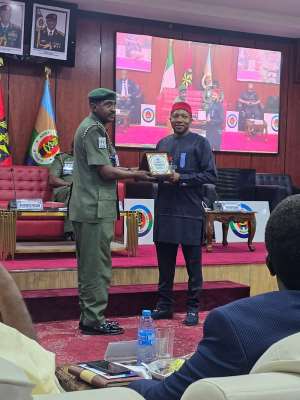
Associate Professor and Head of the Department of Mass Communication, Achievers University, Owo, Dr. Chike Walter Duru, has described media as one of the most powerful force multipliers in modern security operations, stressing that effective communication has become indispensable to achieving operational success in contemporary security environments.
Dr. Duru made the assertion while delivering a Guest Lecture at a Media Workshop organised by the Directorate of Army Public Relations (DAPR), Headquarters Nigerian Army, at the Army War College Nigeria, Asokoro, Abuja.
The workshop brought together Army Public Relations Officers, media practitioners, and Public Relations Officers from various security agencies to examine the growing role of strategic communication in enhancing national security outcomes.
Speaking on the theme, “Media as a Force Multiplier: Leveraging Integrated Platforms to Enhance Public Trust, Inter-Agency Synergy and Operational Outcomes,” Dr. Duru argued that modern security operations are no longer determined solely by military capability and firepower.
According to him, “Today, the success or failure of security operations is influenced not only by military capability, but also by how effectively institutions communicate with citizens, shape public perception, counter misinformation, and sustain public confidence.”
He explained that in military and strategic studies, a force multiplier refers to any capability that significantly enhances operational effectiveness beyond the numerical strength of personnel or equipment, noting that media has emerged as a strategic asset capable of strengthening institutional credibility, building public trust, promoting national unity, and improving operational legitimacy.
The communication scholar observed that the rapid evolution of digital media has transformed the information environment, creating both opportunities and challenges for security institutions.
He warned that misinformation, fake news, deepfakes, online propaganda, and coordinated disinformation campaigns now constitute major threats to national security and operational effectiveness.
According to him, information management has become an integral component of national security management, making proactive communication, transparency, and credibility essential requirements for security institutions.
Dr. Duru further highlighted the importance of integrated communication platforms, arguing that coordinated use of television, radio, newspapers, online media, social media, and community engagement channels enables security agencies to deliver accurate, timely, and strategic messaging capable of strengthening public confidence and enhancing operational outcomes.
He also emphasised the need for stronger collaboration among security agencies, noting that modern threats such as terrorism, insurgency, banditry, kidnapping, cybercrime, and transnational crimes require coordinated communication and unified narratives.
To strengthen media integration as a force multiplier, Dr. Duru presented several recommendations, including the integration of strategic communication into operational planning, institutionalisation of periodic security-media dialogue platforms, development of early warning communication systems, promotion of citizen-centred security communication, capacity building in counter-disinformation and information warfare, strengthening collaboration with digital platforms and online publishers, development of indigenous language communication strategies, establishment of joint communication frameworks during emergencies, strengthening digital media capacity, investment in communication technology, improved transparency, development of crisis communication protocols, strengthening community-based strategic communication, and enhancement of media literacy campaigns.
He maintained that public trust remains a strategic security asset and that effective communication is critical to sustaining cooperation between citizens and security institutions.
“Modern security victories are achieved not only through superior force, but through superior communication. Whoever shapes the narrative strengthens operational success,” he stated.
The lecture generated robust discussions led by Major General Chris Olukolade (Rtd) and Professor Okey Ikechukwu as discussants, while Lt. Col. D.J. Danjuma served as moderator.
Participants commended the presentation for its relevance to contemporary security realities and its practical recommendations for strengthening communication, media engagement, and inter-agency collaboration within Nigeria’s security architecture.
The workshop forms part of ongoing efforts by the Directorate of Army Public Relations to strengthen military-media relations, improve strategic communication capabilities, and promote effective public engagement in support of national security objectives.


 How SHS graduate who got down from VIP bus to urinate ended her life on Kumasi-B...
 “Justin Kodua is the weakest General Secretary we’ve had so far” – Sylvester Tet...
 ‘Huge and heavily-laden’ SHS prospectus burdens parents, must be reviewed – Dafe...
 Veteran Nollywood actor Olu Jacobs dies
 TUTAG gives govt 7-day ultimatum to pay Book and Research Allowance
 SHS placement: ‘You cannot simply build and label schools Category A’ – Kwasi Kw...
 September 16: Cedi sells at GHS12.20 on forex market, GHS11.49 on BoG interbank
 South Africa evacuation: Minority boycotts Foreign Affairs Committee meeting ove...
 GES releases outstanding 2023 Capitation Grant arrears to basic schools
 'He collected GH¢82 million' — Angry Agbodza gives Top International Friday dead...


