




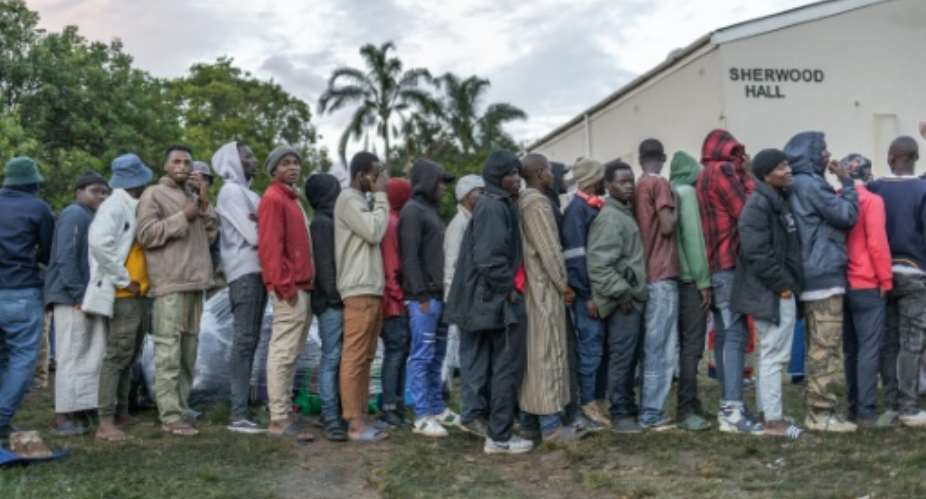
More than 3,000 Malawians, including hundreds of children, crowded into an open field in South Africa's port city of Durban on Wednesday, fleeing what they described as escalating anti-immigrant threats and attacks.
For weeks, groups armed with sticks, whips and shields have marched through parts of the country demanding that foreigners with no papers leave by June 30.
Families said they were forced from their homes in poor neighbourhoods around Durban, South Africa's third-largest city by population, or face violence.
Many said repatriation is their only safe option.
"They said we must go. We have no choice in the matter," 33-year-old Sayiba John, who fled Nazareth township with her husband and three children.
Her daughter, a Grade 2 pupil, was forced to abandon her exams.
"It's better our government take us away from here than to face the anger of the South Africans," she told AFP.
More than 150 Malawians were bussed out of South Africa's Western Cape province over the weekend.
Two Mozambicans were killed more than a week ago in the southern coastal town of Mossel Bay, police said, raising fears of a repeat of the bloodshed that has marked previous flare-ups in anti-migrant sentiment.
Mozambican authorities put the toll at five.
Rising numbers
Mathews Chakwamba, one of the community leaders coordinating relief efforts, said the number of Malawians at the Durban site had risen sharply in recent days.
"More and more are arriving. They all want to go home," the 51-year-old said.
Chakwamba said a Malawian man was stabbed by a group of attackers on Monday night but managed to escape and was later admitted to hospital.
Aid organisations warn the situation could develop into a humanitarian crisis.
Around 150 migrants, including people from Burundi, Ethiopia and Zimbabwe, have camped at a government office some seven kilometres (4 miles) away.
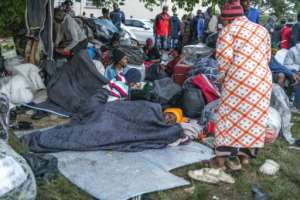 Community leaders say the number of Malawians at the Durban site had risen sharply in recent days. By RAJESH JANTILAL (AFP)
Ghana, Zimbabwe and Mozambique are among the countries that have repatriated hundreds of their nationals this month.
The first batch of Nigerians to be evacuated is due to leave Johannesburg overnight aboard a chartered plane.
South Africa, among the continent's richest economies, has long been a destination for both legal and undocumented African workers.
But it has faced recurring waves of xenophobic violence since 2008, when dozens of migrants were killed and thousands displaced.
The latest spike comes as political parties seek support ahead of local government elections in November.
According to the statistics agency, some three million foreigners, or 5.1 percent of the population, live in the country.
More than 63 percent come from countries in the 16-member Southern African Development Community (SADC) bloc.

 GWL resumes production at Barekese Water Treatment Plant after completion of rep...
 Economic performance most powerful source of Mahama’s goodwill — IEA
 Nyinahini SHS assault: Court strikes out case, urges reconciliation
 Even traffic lights in front of police headquarters are being stolen — Roads Min...
 One major cause of Ablekuma North rerun violence was lack of security coordinati...
 BTU Council divided as Chairman rejects parliamentary mediation in VC dispute
 Roads Ministry needs 1,000 additional staff — Governs Agbodza
 Stop tweeting and brief Parliament on South Africa situation — Patrick Boamah to...
 Roads Minister reassigns Bogoso–Prestea road project to new contractor over dela...
 President Mahama’s approval rate remains positive at 58.9% — IEA survey shows


