




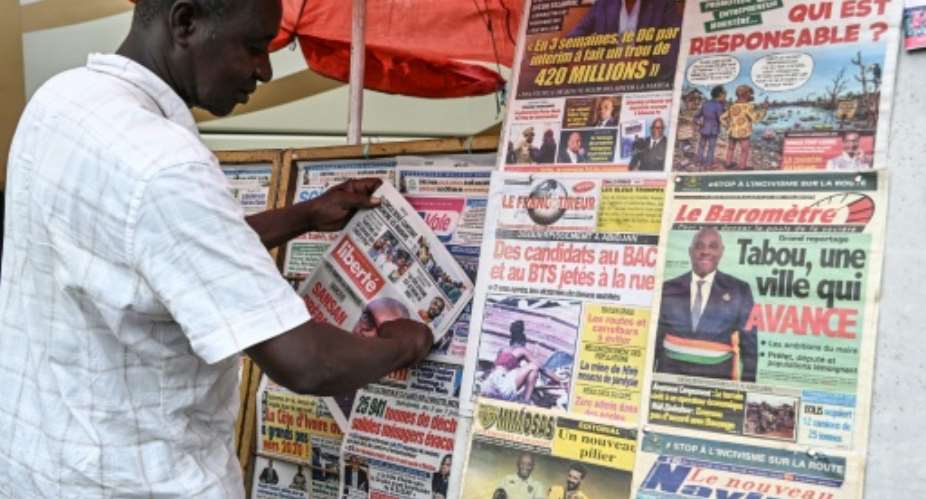
Journalists in Ivory Coast have raised the alarm about what they complain are government attempts to shackle their profession and control it.
Press freedom is more established in Ivory Coast than in other west African countries but remains precarious amid a decline in a region hit by conflict and under political and economic pressure.
The Ivorian government's bid to impose a new leader on the National Union of Ivorian Journalists (UNJCI) has sparked protests in recent months over an "unprecedented" bid to impose control.
In March, the International Federation of Journalists condemned the authorities' "blatant interference" in the UNJCI, the profession's main trade union.
Ivory Coast and Benin also face a complaint filed by press freedom NGO Reporters Without Borders (RSF) over a recent crackdown against Beninese journalist Hugues Comlan Sossoukpe, who has been critical of his country's former president Patrice Talon.
He was prosecuted in his home country, arrested in Ivory Coast last July and extradited to Benin, despite his status as a political refugee in nearby Togo.
"In Ivory Coast, we journalists like to say freedom of expression exists but freedom after expression doesn't," veteran journalist Cesar Etou told AFP bitterly.
Etou, the editor of opposition newspaper La Voie Originale, said there had been more than 50 sanctions targeting the paper, which is close to former president Laurent Gbagbo.
They include warnings, fines, suspension of publication and summonses, he said.
Even though Ivory Coast does not impose prison sentences for press offences, the authorities can "take journalists in for questioning for hours on end" after articles critical of the government, he added.
'Bribery and intimidation'
RSF has highlighted a general lack of security, particularly for the small number of Ivorian investigative journalists.
It said they often faced "attempts at bribery or intimidation, such as threats to disclose personal data, as well as arrests".
Some journalists said they self-censored.
Communications Minister Amadou Coulibaly, who is also the government's spokesman, rebuffed the criticisms, pointing to a need to fight fake news online that is sometimes picked up by the media.
"We do not kill journalists in Ivory Coast. We do not imprison them," he said last month.
"It's normal for them to be questioned as part of legal proceedings, provided they are questioned freely," he said.
'Paid in spare parts'
Journalist Noel Yao, the founder and first head of the UNJCI, said reporters made a precarious living, as the print media is highly politicised and in decline.
"There are journalists who don't get a salary at the end of the month or are paid in spare parts, as the saying goes," he said.
Journalists rarely get the salaries they are entitled to under the profession's collective agreement with the authorities -- from around $480 a month for an editor, to $1,000 for an editor-in-chief.
It is common for journalists to accept per diems from event organisers, Yao said.
That goes some way towards compensating for excessively low salaries but can result in coverage of the events being biased in the organisers' favour, he said.
Media boss Charles Tra-Bi, whose publications specialise in agriculture, also lamented the financial and ethical problems plaguing the sector.
Some "newspapers just cut and paste what they see" on social media, he said.
"The Ivorian press is no longer strong (and) it doesn't pay," he said. "It doesn't foster a sense of responsibility."
Only a few private online and broadcast media outlets are managing to hold their own but they often have to rely on the support of patrons.
Fatoumata Kaloga is a 26-year-old journalist at 7info, one of the private television channels established since state broadcaster RTI lost its monopoly in 2019.
"We aren't really free (to) expose, warn and speak out about what is wrong in society," she said.
But she nevertheless wants to continue covering her country, which, she said, was full of "potential".

 Mysterious illness leaves children struggling to walk, hear in Mafi Kope
 ‘We’ve come back to make sure our father's ideas never die’ – Nkrumah family
 Ghana Jollof: Akosua Manu appeals to Naana Jane to use her influence to free Sal...
 Yellow fever confirmed in Sissala East after 21 mysterious deaths
 Kenyasi man allegedly attacked by prison officers and inmates over yam theft cla...
 Germany’s far-right AfD makes strong gains in two state elections
 Savannah Regional Minister, IGP Yohuno visit Gbindabuor following lynching of po...
 Jehovah's Witnesses make blood component decisions a matter of personal conscien...
 Road contractors fed on contracts for years without completing projects – Alhass...
 Ghana Jollof saga: ‘She has no right to do what she’s doing’ – Inusah Fuseini


