




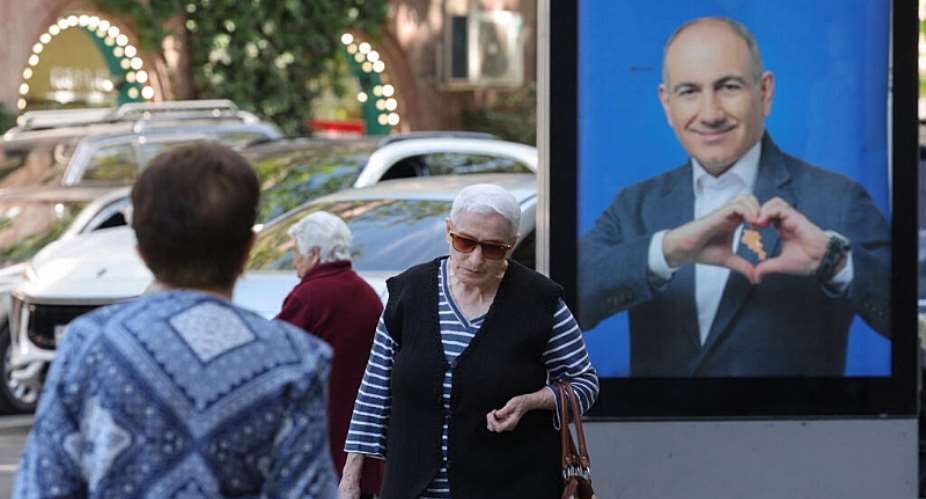
Pashinyan, who was propelled to power in a 2018 street revolution, is running under the slogan of "peace" – pointing to the prospect of finally resolving Armenia's more than three-decade conflict with Azerbaijan and normalising relations with Turkey.
Joshua Kucera, senior South Caucasus analyst at the International Crisis Group, summarises the prime minister's pitch thus: "We've brought peace and this is what I will do."
Pashinyan's rivals accuse him of mishandling foreign affairs, making too many concessions to Baku and Ankara, and wrecking ties with Moscow.
But against him, the field is weak and divided. "The opposition largely has fragmented," Richard Giragossian, director of the Regional Studies Center, a think tank in Yerevan, told RFI. "All are generally pro-Russian or close to Russia and are much more discredited and deeply unpopular."
Strikingly, there is little difference between the platforms. "There is no real policy debate," Giragossian says. "It's very much personal politics here."
Opposition parties include Strong Armenia, led by Russian-Armenian businessman Samvel Karapetyan and currently the most popular opposition party.
It is followed by the Armenia Alliance of Robert Kocharyan, a former president of the Nagorno-Karabakh region – which Armenia lost to Azerbaijan after decades of control in a brief and bloody war in 2020 before it was finally dissolved as an Armenian enclave in 2023, under Pashinyan's rule.
But even though the opposition attacks Pashinyan over Nagorno-Karabakh, says Kucera, "they haven't really provided any kind of alternative vision for what they would do".
Life after ruin: Aghdam's fragile rebirth after the Nagorno-Karabakh conflict
Disillusionment with Russia
In former Soviet republic Armenia, Russia casts a long shadow over the campaign.
Moscow, historically Armenia's patron, has banned a string of Armenian imports and hinted at withdrawing cheap gas supplies, while Kremlin-friendly narratives circulate online.
But analysts say interference limited. "Its efficacy is much less than expected," Giragossian said. "It's falling flat."
Observers report public sympathy for Russia has plummeted. "A lot of people now are very disillusioned with Russia," says Kucera, adding that Yerevan's aim was to "not have this full dependence on Russia that we used to have, and try to diversify".
That disillusionment is rooted in the loss of Nagorno-Karabakh, which triggered the exodus of some 100,000 ethnic Armenians.
Nagorno-Karabakh will 'cease to exist' as half of population flees Russian peacekeepers' vehicles at a checkpoint on the road to Shusha in the separatist region of Nagorno-Karabakh, on 17 November 2020.
For Giragossian, the episode produced "a pronounced sense of betrayal by Russia". The roughly 2,000 Russian peacekeepers stationed there, he says, "did nothing to prevent or even oppose that military operation".
Yet few voters want another war. "Nobody is saying, we're going to take Karabakh back," Kucera says, while Giragossian observes that "nationalism no longer resonates" amid widespread conflict fatigue.
French 'interference'
Western Europe has barely concealed its preference. French President Emmanuel Macron paid Pashinyan a high-profile visit last month, and France has emerged as Armenia's loudest backer on the continent.
"France is definitely the most pro-Armenia country in Europe," says Kucera, who suggests the admiration is mutual. But Giragossian charges that French support has "tended to cross the line [into] interference in domestic politics".
"When we talk about external interference in the election, naturally we look to Russia – but the French president notably embraced Prime Minister Pashinyan prior to the election," he says.
"This is a demonstration that Macron is more pro-Armenian than many Armenians."
France positions itself at the heart of Armenia's pivot to Europe France's President Emmanuel Macron and Armenia's Prime Minister Nikol Pashinyan at the end of a joint press conference following their talks in Yerevan on 5 May 2026.
Pashinyan also has Washington's backing. United States President Donald Trump has endorsed the incumbent and is promoting a transit corridor through Armenia's south to Azerbaijan, the "Trump Route for International Peace and Prosperity" (TRIPP).
Kucera cautions the project may be complicated by the proposed route running along the Iranian border, currently a conflict zone with the US. Meanwhile Giragossian is wary of leaning on an "unpredictable" Trump administration, calling it "not very reliable as a long-term bet or partner".
As for EU membership, he sees it as "more a strategic bluff" – useful for rallying pro-Western voters before polling day, but constrained by Armenia's membership of the Russian-led Eurasian Economic Union, which precludes accession.
Both analysts agree that Armenia is cautiously moving away from Moscow, while avoiding a clean break.
With Pashinyan's Civil Contract party leading the polls but uncertain of the two-thirds majority needed to draft a new constitution and finalise the 2025 peace deal with Azerbaijan, Sunday's vote will measure how far Armenians are willing to follow him west.

 Ablakwa Vows Compensation for SA Returnees as Ghana’s Evacuation Drive Hits 637
 Avenor Building Collapses; One Critical, More Feared Trapped as Rescue Mission I...
 Mahama Tours Belarus Agro‑Hub; Pushes for Tech Partnerships to Transform Ghana’s...
 Ablakwa Assures SA Returnees: “We’ll Help You Rebuild — Jobs Ready for Those Who...
 Ablakwa Welcomes 345 Returnees, Declares: “You Are Treasures, Not Burdens”
 Second Batch of Ghanaians Airlifted Home as Joyful Evacuation Continues
 Ukraine launches fresh drone attack on St. Petersburg region on final day of ‘Ru...
 US Ebola facility in Kenya fuels anger in a country with no cases
 Ghana considering legal action against South Africa over xenophobic attacks — Ab...
 There's no acrimony between Agric and Finance Ministers — Dafeamekpor


