




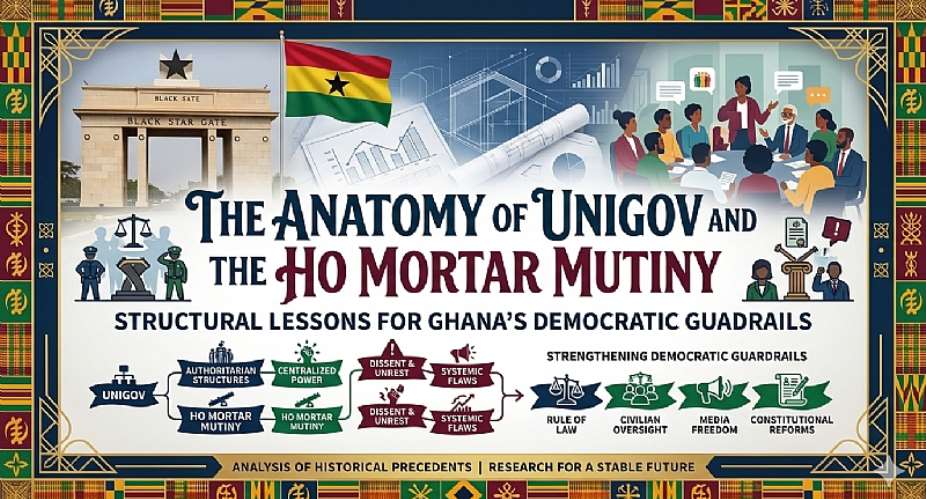
In July 1978, General Ignatius Kutu Acheampong was forced to sign his resignation at gunpoint during a bloodless palace coup. It was a dramatic end triggered by a collapsing economy and the public rejection of his Union Government (UNIGOV) agenda. Decades later, the specter of the "sit-tight ruler" remains stubbornly alive across the African continent. Rulers like Paul Biya and the ghosts of Mobutu Sese Seko or Idi Amin illustrate a tragic truth: when power becomes absolute, the presidency ceases to be a temporary civic duty and turns into an existential fortress.
For Ghanaian political science students, citizens, and the current generation of youth military officers, history is not a collection of dusty dates—it is a ledger of blood, sacrifice, and severe warnings. To look forward, Ghana must look back—specifically to the tragedy of the Ho Mortar Regiment in 1967 and the grim concrete pillars of the Teshie Shooting Range. This article expands on these critical historical flashpoints, offering a blueprint for future leaders and security officers.
Deep Dive: The UNIGOV Crisis (1976–1978)
By 1976, under intense political pressure and a failing economy, General Acheampong introduced UNIGOV (Union Government). This controversial constitutional model proposed a non-party state where power would be shared permanently among the military, the police, and civilians.
- The Strategy: Acheampong designed UNIGOV as a legal mechanism to institutionalize military participation in governance while permanently banning political parties. It was a thinly veiled attempt to perpetuate his own rule under a civilian facade.
- The Resistance: The proposal triggered widespread outrage. Students, professional bodies (lawyers, doctors), and churches formed opposition movements, leading to violent clashes and the closure of universities.
- The Referendum Subversion: On March 30, 1978, a national referendum was held to vote on UNIGOV. As the results trended heavily toward a "No" vote, the regime moved to rig the count.
- The Flight of Justice Abban: The Electoral Commissioner, Justice Isaac Kobina Abban, refused to falsify the results under military coercion. Fearing for his life, he famously fled his office and went into hiding, protected by local clergy.
- The Downfall: While the official state machinery declared a falsified 60% victory for UNIGOV, the blatant fraud destroyed the regime's remaining legitimacy. It catalyzed the July 5 palace coup led by Lt. General Fred Akuffo.
Flashpoint: Operation Souvenir and the Ho Mortar Regiment (1967)
On April 17, 1967, Ghana faced its first major post-independence internal military insurrection, dubbed "Operation Souvenir." This event remains a foundational lesson in the catastrophe of fractured military discipline.
- The Insurgency: Led by junior officers—specifically Lieutenant Samuel Arthur and Lieutenant Moses Yeboah—a detachment of 120 soldiers from the Ho Mortar Regiment marched from the Volta Region to Accra.
- The Objective: Driven by institutional grievances and personal ambition, Arthur intended to overthrow the ruling National Liberation Council (NLC). His forces captured the state broadcasting house and targeted senior military commanders.
- The Assassination: Lieutenant Arthur successfully breached the Flagstaff House. In the ensuing chaos, he assassinated Lieutenant General Emmanuel Kwasi Kotoka, the operational architect of the 1966 coup that overthrew Dr. Kwame Nkrumah.
- The Collapse: The insurrection lacked broader strategic backing. Loyal forces quickly rallied, surrounded the mutineers, and arrested Arthur, Yeboah, and their co-conspirators within hours.
The Stakes at the Teshie Shooting Range
The state's response was swift, public, and merciless:
- The Sentence: A military tribunal found Arthur and Yeboah guilty of high treason and mutiny, sentencing them to death by firing squad.
- The Execution: On May 9, 1967, before a crowd of thousands of spectators, the two young officers were tied to concrete stakes at the Teshie Shooting Range and executed.
- The Lesson: Lieutenants Arthur and Yeboah became the first military officers executed for a coup attempt in modern Ghana. Their deaths marked the moment the Teshie Range became synonymous with the lethal cost of political treason.
Strategic Recommendations for Future Leaders
To break the cycle of authoritarianism and ensure governance remains a temporary privilege, future statespersons must adopt radical shifts in leadership:
- De-Personalize Executive Power: Leaders must dismantle sycophantic praise-singing networks and treat the presidency strictly as an institutional trust.
- Build Financial Independence Prior to Office: Governance must not be a tool for wealth creation. Leaders must have legitimate careers outside politics so that leaving office does not mean facing financial ruin.
- Insulate Democratic Watchdogs: Future executives must deliberately protect the financial and administrative independence of the Electoral Commission, the Judiciary, and anti-corruption bodies.
- Cultivate Smooth Generational Succession: Establish clear internal party mechanisms that mentor younger technocrats, treating democratic turnover as a healthy corporate transition rather than an existential defeat.
Suggestions for Contemporary Military Youth Officers
The modern Ghana Armed Forces must remain the institutional bedrock of the Fourth Republic by internalizing a rigid code of conduct:
- Commit to Absolute Constitutional Subordination: Military power belongs exclusively under civilian, democratically elected oversight. The ballot box is the only legitimate mechanism to change a government.
- Channel Grievances via Institutional Civility: If governance or economic policies falter, the solution lies in civic engagement and constitutional rule of law—not tactical maneuvers by junior officers.
- Reject Partisan Weaponization: Youth officers must fiercely resist being deployed as political tools to intimidate citizens or compromise electoral integrity.
- Acknowledge the Historical Calculus of Coups: Officers must study history to recognize that coup makers almost always meet violent ends, face exile, or severely damage the nation they claimed they wanted to save.
Ghana’s Fourth Republic has stood resilient because the nation chose to swap the firing squads of Teshie for the peaceful transitions of the ballot box. The accounts of historical downfalls prove that regimes built on economic ruin and institutional manipulation eventually collapse from within. Yet, the bullet holes in the concrete pillars of the Teshie Shooting Range remain a permanent monument to the true price of political instability.
For the political science student, the lesson is clear: democracy requires constant vigilance and strong institutions over strongmen. For the young military officer, the legacy of Lieutenant Arthur must serve as a timeless deterrent: the weapon of the soldier is meant to shield the constitution, never to shred it. Future leaders must remember that the greatest legacy a president can leave behind is not a permanent seat at the helm, but a peaceful walk into retirement.
✍️By A Concerned Senior Citizen
Retired Senior Citizen
For and on behalf of all Senior Citizens of the Republic of Ghana 🇬🇭
Teshie-Nungua
[email protected]

 Ablakwa Vows Compensation for SA Returnees as Ghana’s Evacuation Drive Hits 637
 Avenor Building Collapses; One Critical, More Feared Trapped as Rescue Mission I...
 Mahama Tours Belarus Agro‑Hub; Pushes for Tech Partnerships to Transform Ghana’s...
 Ablakwa Assures SA Returnees: “We’ll Help You Rebuild — Jobs Ready for Those Who...
 Ablakwa Welcomes 345 Returnees, Declares: “You Are Treasures, Not Burdens”
 Second Batch of Ghanaians Airlifted Home as Joyful Evacuation Continues
 Ukraine launches fresh drone attack on St. Petersburg region on final day of ‘Ru...
 US Ebola facility in Kenya fuels anger in a country with no cases
 Ghana considering legal action against South Africa over xenophobic attacks — Ab...
 There's no acrimony between Agric and Finance Ministers — Dafeamekpor


