




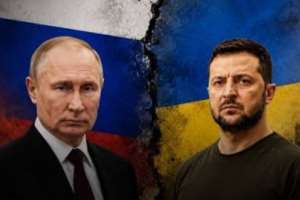
A simple exchange over two days this week has distilled four years of war into one stark question: who is truly committed to peace, and who is choosing to prolong the bloodshed? The answer, after close scrutiny, is far more complex and far more damning than either side will readily admit.
Zelensky's Gambit
Ukrainian President Volodymyr Zelensky on Thursday issued a public letter addressed directly to Russian President Vladimir Putin the first such direct public communication since Russia launched its full-scale invasion in 2022 calling for face-to-face negotiations to end the war.
The letter was bold in content and deliberately provocative in tone. In it, Zelenskyy told Putin that he has spent nearly half of his 26 years in power "waging war against Ukraine" and said Russians are now growing increasingly tired of Ukrainian missiles and drone attacks, inflation, and fuel shortages. "We can all see that Russians are finally becoming less comfortable with this reality with the fact that the war is bringing more and more negative consequences to Russia," he wrote. He also told Putin that a prolonged war could threaten the Russian president's personal position.
Zelenskyy floated direct negotiations hosted by Switzerland, Turkey, or "countries of the Arab world," explicitly ruling out Moscow or Kyiv as venues. The timing was striking and deliberately calculated. The letter was published a day after Ukraine launched a large-scale attack on St. Petersburg, striking a major oil terminal and military targets on the same morning Putin welcomed world leaders to the city for his flagship economic forum.
The juxtaposition told its own story. Ukraine was saying: we can hurt you at home, and we are still willing to talk.
Putin's Refusal
Moscow's response came swiftly and dismissively.
Speaking at Russia's economic forum in St. Petersburg on Friday, Putin dismissed Zelensky's open letter. "This letter contains some rather rude remarks. Was it a way to create the conditions for a face-to-face meeting or a way not to set up a face-to-face meeting? I think it was the second," he said. Asked whether he would meet Zelenskyy, the Russian leader replied: "I don't see any point for now."
Putin added that any meeting should only happen after negotiators first reach agreements: "Let the expert’s work, develop some solutions, and then we can meet."
Putin also pointed to a May 22 drone attack by Ukraine on a college dormitory in the Russian-controlled Luhansk region as further justification for his unwillingness to engage. He additionally noted that a Russian businessman had travelled to Kyiv last month and met with Zelenskyy to hear his offer of a personal meeting suggesting behind-the-scenes contacts were already underway but that none of it had moved him.
Earlier in the same day, however, Putin had said Russia is "ready and willing" to reach an agreement with Ukraine based on US President Donald Trump's peace proposal if Kyiv was ready to make certain "compromises." The implication was clear: Russia wants a deal on its terms, not Zelensky's.
Zelensky's Verdict
Kyiv did not take the rejection quietly. Zelensky declared that Russia had once again chosen war over diplomacy that the refusal to meet was itself a statement of intent.
The charge is powerful, but it requires examination. Zelensky's letter, as even some sympathetic analysts have noted, was not designed purely to open a diplomatic door. It was a political document written partly to shore up Ukrainian public morale, partly to signal to Western audiences (particularly Washington, whose attention has drifted toward Iran) that Ukraine was actively seeking peace.
Zelensky acknowledged shifting US priorities, saying it would be wrong to simply wait for the Trump administration to return its attention to ending the Ukraine war while it remains heavily distracted elsewhere.
The Deeper Question: Who Wants This War?
The honest answer is that neither side wants peace on terms the other can accept which is a different thing from saying both sides want war.
Russia invaded in February 2022. That is the foundation of every analysis. Russia and Ukraine have been holding indirect peace talks since the war began, but with little or no concrete outcomes. US President Donald Trump has also met both Putin and Zelenskyy, seeking to bring them to the negotiating table, but his efforts have not borne fruit.
Moscow's consistent position has been that it will negotiate, but only on terms that effectively ratifies its territorial conquests Donetsk, Luhansk, Zaporizhzhia, Kherson and extract guarantees of Ukrainian neutrality. Ukraine has rejected calls to cede territory to Russia, especially land it has not completely lost to Russian troops during the course of the war.
Putin has also demanded Ukraine surrender the Donetsk region and rejected EU participation in any talk’s framework.
Ukraine's position is that negotiating under occupation legitimizes aggression. To concede now is to invite future invasions not just of Ukraine, but of any smaller nation bordering a nuclear-armed neighbor.
Both positions are internally coherent. Neither leads to peace.
The St. Petersburg Forum as Theatre
There is something revealing about the setting of Putin's rejection. The St. Petersburg International Economic Forum Russia's annual showcase of its economic resilience in the face of Western sanctions is itself a performance of normalcy in the midst of war. Even as Putin told the forum he saw "no sense" in meeting Zelenskyy, he simultaneously addressed the plenary session and told the Russian army to "keep working." War and economics, conducted simultaneously, on the same stage.
It is the behavior of a leader who has made his peace with indefinite conflict who sees the battlefield as a more controllable environment than a negotiating table where he might be asked to account for his choices.
Zelenskyy, facing a nation under daily bombardment, with at least 12 people killed and dozens injured in Russian attacks on the same day he published his letter and at least 707 children killed by Russian attacks over more than four years of war, cannot afford the same luxury of strategic patience.
Conclusion: The Burden of Proof
Wars end when one side decides the cost of continuing exceeds the cost of stopping. Russia has not yet reached that calculus. Its economy has adapted. Its military, despite enormous losses, continues to advance incrementally. Its political system insulates Putin from the consequences his people bear. There is no accountability mechanism that translates battlefield suffering into political pressure on the Kremlin.
Ukraine, by contrast, is fighting for survival. It wants talks because it understands that even a just war, once it enters its fifth year, carries the risk of exhaustion of allies losing patience, of populations growing weary, of the window for a favorable outcome narrowing.
Zelensky's letter provocative, pointed, strategically timed was less a sincere invitation to peace and more a diplomatic move in a long chess game. Putin knew that. His rejection was equally calculated.
Who wants the war? Russia chose to start it. Russia has chosen, this week, to continue it. The moral burden of that choice belongs entirely to Moscow whatever provocations, diplomatic maneuvers, or battlefield realities are used to obscure it.
Mustapha Bature Sallama.
Medical/ Science Communicator,
Private Investigator, Criminal investigation and Intelligence Analysis.
International Conflict Management and Peace Building.USIP
[email protected]
+233-555-275-880

 Ablakwa Vows Compensation for SA Returnees as Ghana’s Evacuation Drive Hits 637
 Avenor Building Collapses; One Critical, More Feared Trapped as Rescue Mission I...
 Mahama Tours Belarus Agro‑Hub; Pushes for Tech Partnerships to Transform Ghana’s...
 Ablakwa Assures SA Returnees: “We’ll Help You Rebuild — Jobs Ready for Those Who...
 Ablakwa Welcomes 345 Returnees, Declares: “You Are Treasures, Not Burdens”
 Second Batch of Ghanaians Airlifted Home as Joyful Evacuation Continues
 Ukraine launches fresh drone attack on St. Petersburg region on final day of ‘Ru...
 US Ebola facility in Kenya fuels anger in a country with no cases
 Ghana considering legal action against South Africa over xenophobic attacks — Ab...
 There's no acrimony between Agric and Finance Ministers — Dafeamekpor


