




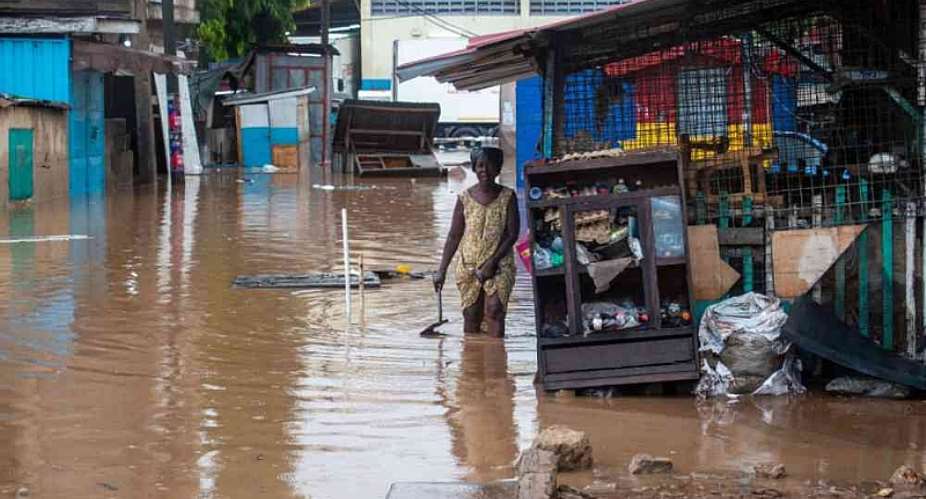
At the Ghana Diaspora Town Hall Meeting in London on 31 May 2026, President John Dramani Mahama told an audience of professionals, investors and business leaders that “the flooding in Accra is not an engineering problem; it is just a problem of indiscipline.” He pointed to plastic waste in drains, building on waterways, and the encroachment of wetlands and Ramsar sites as the principal culprits.
The President is not wrong about those things. But he is wrong to reduce a complex, multi-layered crisis to a single word. With respect, the statement is too simplistic — and dangerously so, because how we diagnose the problem determines how we spend the money, write the laws, and assign the blame.
Accra does not flood because Ghanaians are uniquely undisciplined. Accra floods because several systems have failed at the same time, and indiscipline is only one symptom of those failures. Let me set out what the science and the engineering actually show.
1. Poor drainage engineering
The capital’s drains were designed for a smaller city, a different climate, and a lower volume of runoff than exists today. Many channels are undersized, others are silted and structurally degraded, and maintenance is sporadic at best. Crucially, our flood modelling and hydrological planning have not kept pace with how the city has grown. When a drain cannot carry the water that a modern storm delivers, that is, by definition, an engineering and design shortfall — not merely a behavioural one. The Ghana Institution of Engineers has itself acknowledged that downstream channels are operating beyond capacity. You cannot blame a citizen for water that an under-built channel was never going to contain.
2. Urban planning failure
We have allowed an entire city to be built in the path of its own rivers. The Odaw, Densu, Sakumo, Lafa, Korle and Kpeshie systems carry rainwater down from the Akuapem range to the sea. When we permit construction across those channels, on wetlands, and on natural floodplains, we are not witnessing indiscipline by a few individuals — we are witnessing the legal issuance of permits for development that should never have been approved. Indiscipline does not sign a building permit. A planning authority does.
3. Waste management failure
Yes, plastic blocks our drains. But waste in the gutter is the end of a broken chain, not the beginning. Where is the collection infrastructure? Where is the affordable, accessible alternative to dumping? Where is the producer responsibility for the sachets and styrofoam that flood our markets long before they flood our streets? Blaming the citizen who drops a sachet, while ignoring the absence of a functioning waste system, treats a symptom as if it were the disease.
4. Governance and enforcement failure
The President rightly notes that demolishing illegal structures draws public criticism. But the deeper question is why those structures were ever allowed to rise. Weak regulation, political tolerance of illegal development, revenue-driven permitting, and the absence of accountability have created the conditions in which encroachment thrives. Enforcement that arrives only after a neighbourhood is built is not enforcement; it is theatre. Discipline is downstream of governance.
5. Climate and rainfall intensity
Finally, the climate has changed beneath our feet. Rainfall is heavier and more concentrated than the infrastructure was ever built to absorb. Where water once took many hours to travel from the hills to the coast, it now arrives in a fraction of that time because we have paved over the wetlands and retention areas that used to slow it down. Heavier rain does not cause the flood by itself — it exposes infrastructure that was already too weak to cope.
A more honest statement
The President’s framing places the burden almost entirely on ordinary people, while the institutions that plan, permit, build, regulate and maintain escape scrutiny. A more honest and more useful statement would be this:
“Flooding in Accra is not just an engineering problem, and it is not just a discipline problem. It is a failure of planning, governance, infrastructure, enforcement, waste management, and public behaviour — and it will only be solved when we address all of them together.”
This matters because diagnosis drives solution. If we tell ourselves flooding is “just indiscipline,” we will reach for public-awareness campaigns and demolition exercises and feel that we have acted. We will not invest in the drainage redesign, the rainwater retention systems, the planning reform, the waste infrastructure, and the enforcement architecture that the crisis actually demands. We will lecture the poor and protect the powerful, and the water will return next season exactly as before.
The way forward
Ghana does not lack the expertise to solve this. The Ghana Institution of Engineers is already preparing a unified technical position. What we lack is the political honesty to name every part of the failure — including the parts that implicate the state itself.
I therefore respectfully challenge the President to reframe the conversation: not to deny indiscipline, but to refuse to hide behind it. Let us declare flood resilience a national priority. Let us restore and protect our wetlands and Ramsar sites as the flood-control infrastructure they are. Let us redesign and properly maintain our drainage. Let us reform a permitting system that profits from the very encroachment we later demolish. And let us build the waste infrastructure that makes the “disciplined” choice the easy choice.
Accra’s people are not the problem. The systems that govern Accra are. Until we say so plainly, we will keep blaming the rain — and burying the dead.
Philip Kyeremanteng holds an MSc in Environmental Science and is a Chartered Environmental Scientist (CSci) with experience across the energy, nuclear and environmental consultancy sectors.
 How overexploitation of sand is threatening ecosystems and livelihoods
 Ablakwa Vows Compensation for SA Returnees as Ghana’s Evacuation Drive Hits 637
 Avenor Building Collapses; One Critical, More Feared Trapped as Rescue Mission I...
 Mahama Tours Belarus Agro‑Hub; Pushes for Tech Partnerships to Transform Ghana’s...
 Ablakwa Assures SA Returnees: “We’ll Help You Rebuild — Jobs Ready for Those Who...
 Ablakwa Welcomes 345 Returnees, Declares: “You Are Treasures, Not Burdens”
 Second Batch of Ghanaians Airlifted Home as Joyful Evacuation Continues
 Ukraine launches fresh drone attack on St. Petersburg region on final day of ‘Ru...
 US Ebola facility in Kenya fuels anger in a country with no cases
 Ghana considering legal action against South Africa over xenophobic attacks — Ab...


