




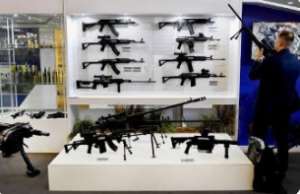
The relationship between France and Israel once a cornerstone of European-Middle Eastern security architecture has fractured to a degree that would have seemed inconceivable a decade ago. The latest flashpoint arrived this week when Paris banned the display of Israeli offensive weapons at Eurosatory 2026, Europe's most prestigious defence and security exhibition, triggering a furious response from Jerusalem and crystallizing a diplomatic rupture that has been accumulating, action by action, since the Gaza war began.
France has banned the display of Israeli offensive weapons at the 2026 edition of the Eurosatory international defence and security exhibition, a decision confirmed by the organizers to AFP. "Only Israeli exhibitors presenting anti-ballistic and anti-air defence systems are authorized," said Charles Beaudouin, president of COGES Events. "This is a decision by the French government, by the Defence Council. There is no room for ambiguity: if an exhibitor is also a rocket manufacturer, they will not be allowed to display them. This ensures that no offensive weapons are present," he said.
The French directive also prohibits the establishment of an official Israeli national pavilion and bars official Israeli government representatives from participating in the event. (aol) Dozens of Israeli companies had planned to exhibit at Eurosatory, which runs from June 14 to 19 at the Paris Nord Villepinte exhibition centre north of the French capital. Their individual participation is not entirely prohibited but without the flag, without the pavilion, and without the offensive hardware that defines much of Israel's defence export catalogue, the message from Paris could hardly be clearer.
Jerusalem's Fury
Israel's response was immediate and caustic. The Israeli Ministry of Defence denounced the move, saying it would be "unable to participate in the exhibition or establish a national pavilion." It described the decision as "disgraceful, one that reeks of political and commercial calculation, and regrettably, it comes as no surprise. It fits a deeply troubling pattern in French conduct in recent years."
The anger in Jerusalem is compounded by context. The latest measure represents the fourth attempt by France to restrict Israeli defence participation in two years, starting with Eurosatory 2024, though that ban was overturned by a French commercial court. That same year, Israeli companies were also prohibited from displaying at the Euronaval exhibition another measure that was overturned in court.
At the 2025 Paris Air Show, Israeli firms were blocked from exhibiting after they refused to remove offensive weapons from their stands. (Informed Clearly)
The pattern, in Jerusalem's view, is not a series of isolated policy decisions but a sustained campaign of diplomatic attrition. Israeli sources told the press that over the past two years, France had consistently adopted a hostile policy toward Israel, making it impossible to rely on it in procurement matters.
A Rupture in the Defence Relationship
The breakdown has extended well beyond exhibition bans. Israel's Ministry of Defence suspended all defence procurement from France in April 2026, citing an "ongoing pattern of French policies" that it said compromises Israel's national defence.
The proximate trigger was France's prohibition on Israeli aircraft carrying munitions intended for operations against Iran from overflying French airspace. Israel's Defence Ministry stated that "the French prohibition was imposed despite prior coordination, despite clear explanations that the munitions were intended solely for Iran, and despite the understanding that this effort is critical for European security as well."
The Director General of the Israeli Ministry of Defence, Major General Amir Baram, formally decided to reduce all defence procurement from France to zero, replacing it with domestic Israeli procurement or purchases from allied countries.
The decision cited a litany of French actions: preventing the participation of dozens of Israeli defence companies at Eurosatory 2024, blocking Israeli defence industries' exhibition booths at the 2025 Paris Air Show, freezing export licenses to Israel, supporting a UN declaration of Palestinian statehood at the height of fighting with Lebanon, and the airspace prohibition during operations against Iran.
The Lebanon Dimension
Underpinning the bilateral tensions is the Lebanon question a theatre in which France has deep historical interests, significant troop commitments through UNIFIL, and a sharply divergent view from Israel's on how the conflict should be managed.
Since the end of February, Paris has repeatedly condemned Israeli strikes on Lebanese territory where they target Hezbollah, the Iran-backed militant group. On Sunday, France called for an emergency meeting of the United Nations Security Council after the Israeli army captured Beaufort Castle in Lebanon.
Further straining the relationship is France's exclusion from mediating direct talks between Israel and Lebanon in Washington. French President Emmanuel Macron offered in March to host direct talks, telling President Isaac Herzog that France is working to promote this goal but Israel has effectively boxed Paris out of the mediation process.
The symbolism of the Beaufort Castle episode is not lost on observers. The medieval fortress, which has passed between Crusader, Arab, and Lebanese hands over centuries, was captured by Israeli forces at precisely the moment France was calling for restraint a sequence that speaks volumes about the gap between Paris's diplomatic ambitions in Lebanon and its actual leverage on the ground.
What Eurosatory Represents
To appreciate the full significance of France's decision, one must understand what Eurosatory is. It is not merely a trade fair. It is the pre-eminent showcase for the global defence industry a venue where governments signal relationships, where procurement officers meet manufacturers, and where a nation's presence or absence carries unmistakable diplomatic meaning.
For Israel's defence industry one of the world's most sophisticated, battle-tested, and export-oriented Eurosatory has been a critical platform for demonstrating capabilities and cementing partnerships with European and global militaries. The Iron Dome, David's Sling, Trophy active protection systems, drone technology, intelligence and surveillance platforms these are precisely the kinds of systems that European militaries, increasingly anxious about Russian aggression, have been seeking. Germany and other NATO countries have been rushing to purchase Israeli air defence and other systems in response to threats posed by Russia.
By restricting Israeli participation to purely defensive systems and banning the offensive hardware that constitutes the bulk of Israel's defence export portfolio, France has denied Israeli industry access to its most important European marketplace at a moment of peak demand a decision that, as Jerusalem noted, does indeed carry commercial as well as political consequences.
Paris's Calculation
France, for its part, has offered no public elaboration of the strategic reasoning behind the restrictions beyond the reference to the Defence Council's decision. The silence is telling. Paris is navigating a delicate position: it wishes to maintain its relevance as a Middle Eastern mediator and a voice of European conscience on the Gaza and Lebanon conflicts, while simultaneously managing its relationships with both Israeli and Arab partners, and honoring its international humanitarian law obligations regarding arms transfers to parties in active conflict.
The Gaza war, and now the Lebanon operations, have placed European governments under sustained pressure from domestic publics, from international courts, and from international law obligations to account for the uses to which weapons sold or exhibited under their auspices are being put. France's approach has been more assertive than most European partners, but it is not without precedent. Several EU member states suspended arms licenses to Israel following the Gaza offensive.
What distinguishes France is the consistency and escalation of its measures four separate restrictions in two years, each more comprehensive than the last and the willingness to absorb the bilateral costs that have followed, including the suspension of Israeli defence procurement and the marginalization of French mediation in Lebanon.
A Relationship Transformed
The France-Israel defence relationship was built over decades of shared strategic interests, technology cooperation, and not incidentally lucrative arms contracts. France was Israel's primary weapons supplier in the 1950s and 1960s, providing the Mirage jets and other systems that helped Israel win the 1967 Six-Day War before President Charles de Gaulle imposed an arms embargo following that same conflict. That embargo created the crisis that drove Israel to develop its own indigenous defence industry the very industry now being excluded from French soil.
History has a way of repeating its patterns. The current restrictions will, in all likelihood, accelerate Israel's pivot away from French systems and toward American, German, and domestic alternatives just as de Gaulle's embargo did sixty years ago. Whether that acceleration serves anyone's long-term interests, in Paris or Jerusalem, is a question neither government appears currently disposed to ask.
What is clear is that the Franco-Israeli relationship, once defined by close security cooperation and quiet mutual benefit, has entered a phase of open antagonism conducted through exhibition bans, airspace denials, procurement suspensions, and diplomatic exclusions. Eurosatory 2026 is the latest battlefield in a conflict that shows no sign of resolution.
Mustapha Bature Sallama.
Medical/ Science Communicator,
Private Investigator, Criminal investigation and Intelligence Analysis.
International Conflict Management and Peace Building.USIP
[email protected]
+233-555-275-880

 Anti-LGBTQ Bill is duly passed, I believe it is too late in the day to reverse i...
 Here are areas to face power outages over maintenance works today
 RNAQ ex-wife petitions court to restrict Hajia4Reall’s closeness to her children...
 One dead, two children trapped after three storey building collapse at Adenta
 Obuasi Circuit Court jails farmer 8years over violent mining site attack at Obua...
 Health Minister summons KATH CEO over emergency centre closure
 Unauthorised structures demolished at Haatso
 Fire guts shops opposite Accra Central Police Station
 Stephen Yeboah appointed new registrar of Sunyani Technical University
 Abandoned 250-bed Sewua Regional Hospital rots as KATH battles congestion


