




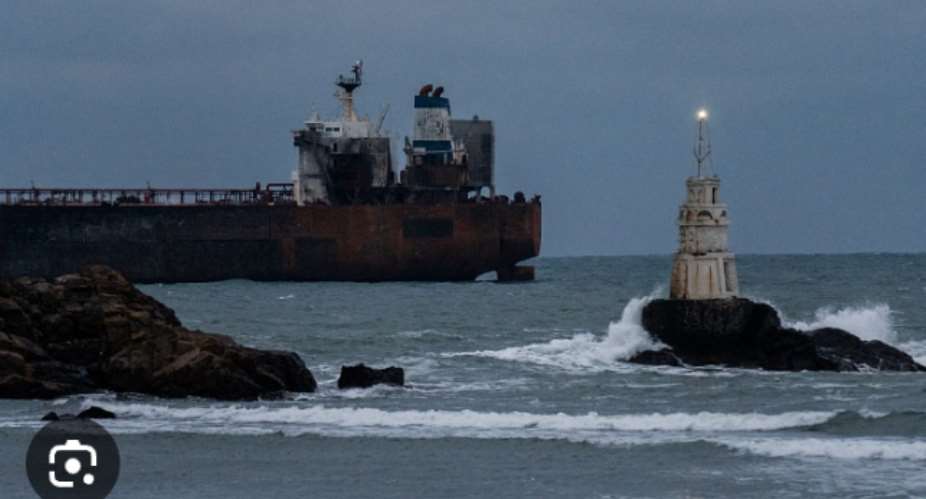
The Invisible Armada
Somewhere in the North Sea, on a grey January morning in 2026, two oil tankers sailed through Dutch waters, their hulls laden with Russian crude. Both flew the flag of Sierra Leone a small West African nation whose maritime registry neither authorized nor knew anything about the vessels. They were ghosts, sailing in plain sight, part of a sprawling, sophisticated and increasingly Africa-anchored network designed to keep Russian oil money flowing into the Kremlin's war machine.
This is the shadow fleet. And Africa, whether it knows it or not, is now at its centre.
From the ports of Cameroon to the islands of Comoros, Russian vessels are increasingly registering tankers under African flags to keep their widely sanctioned, oil-exporting shadow fleet operating. Russia needs to continue transporting oil to fund its costly invasion of Ukraine.
What was once a marginal workaround has hardened into institutional infrastructure an organized, continent-spanning system that exploits Africa's weakest governance links to sustain one of the world's most devastating conflicts.
What Is the Shadow Fleet?
The shadow fleet is an armada of ageing, poorly maintained tankers of opaque ownership that allows Russia, Iran and Venezuela to trade oil in defiance of Western sanctions. It now numbers more than 1,000 vessels at least one in every five oil tankers worldwide.
When the G7 Oil Price Cap Coalition established an oil price cap mechanism applicable to Russian crude oil since December 2022, Russia began assembling a parallel maritime logistics network designed to operate outside the Western regulatory environment. Instead of relying on European shipping companies, insurers and financial institutions, Russian exporters increasingly turned to older tankers operating through opaque ownership structures, non-Western insurers and weak maritime registries.
Shadow fleets often operate under obscured ownership and deploy evasion tactics such as ship-to-ship cargo transfers in international waters and manipulation or deactivation of automatic identification system transponders to mask movement. The vessel's flag is another key instrument for avoiding sanctions.
The financial stakes are enormous. Russian fossil fuel exports continue to generate around €464 million in revenue per day, with seaborne crude alone accounting for roughly €156 million daily. That is the sum that Western sanctions are trying to cut off and the sum that the shadow fleet, through its African pivot, is trying to protect.
Why Africa? The Logic of Exploitation
The choice of African registries is not accidental. It is calculated, deliberate, and rooted in a clear-eyed exploitation of institutional vulnerabilities.
Researchers at the Robert Lansing Institute say that Moscow targets African shipping registries because it lets the shadow fleet obscure the true ownership of its oil-carrying tankers. African shipping registries often are plagued by weak mechanisms to verify a vessel's registration, operators and ownership origins.
"In practice, this means that ships can continue operating within international shipping networks while remaining shielded from direct enforcement actions," even if they are already sanctioned, institute researchers wrote in a March report.
African registries are also less likely to appear on the radar of major port state control regimes, insurers or international monitoring programmes, offering a low-profile option for vessels seeking to circumvent stricter controls.
Tightening enforcement in traditional flag states has accelerated the African shift. Tighter scrutiny by established flag states has prompted shadow fleet operators to seek alternative registries in Africa. Apart from Liberia, the continent has been a marginal player in the global ship registration system. That marginal status is now an asset for Russia.
The Numbers: Africa's Exploding Registries
The statistical evidence is stark and undeniable.
Benin, Comoros, The Gambia, Guinea and Sierra Leone have experienced large increases in registered tonnage due to the high-risk tankers linked to Russia's shadow fleet. The European Union, United Kingdom and United States blacklisted 110 Comorian-flagged ships in 2025 for participating in oil shipments that fund Russia's war economy. The ship registry in Cameroon alone has increased by 126% over the past year, the Institute for Security Studies reported in March.
"These figures suggest that African registries are no longer marginal players in the global maritime system but have become central nodes in the infrastructure enabling sanctions evasion," the Lansing Institute reported.
According to the Centre for Research on Energy and Clean Air, Moscow's shadow fleet transported almost half of Russia's seaborne oil in March. And a substantial portion of that volume was covered by the African flag umbrella.
False Flags: The Fraudulent Layer
Beyond legitimate African registries being misused, a deeper, more brazen layer of deception is at work: false flagging the practice of claiming registration with registries that do not exist or have been shut down entirely.
According to the Lansing Institute, more than half of the global cases of false flag registration are linked to African jurisdictions. Last year, false flag registries were discovered in Angola, Benin, Eswatini, Guinea, Malawi, Mali and Mozambique.
The case of Zimbabwe is instructive. In early 2026, Germany identified the tanker Range Vale as part of Russia's shadow fleet, after it falsely claimed registration in Zimbabwe. Zimbabwe then notified the International Maritime Organization that a fraudulent entity had issued the certificates. The ship continues to operate, now flying Sierra Leone's flag.
Many African countries don't operate international registries at all. After eight recorded incidents of fraudulent use of its flag, Malawi informed the IMO that it does not offer international flagging. In 2024, the IMO found that all Eswatini flags were false after several ships claimed registration with the country. Eswatini doesn't have a flag registry and is not an IMO member.
The ship database of the IMO listed 367 tankers as false-flagged as of April 4, 2026 ships flying the flag of a state without actually being registered in that country's international ship register.
Flag Hopping: A Moving Target
The shadow fleet does not stand still. When one deception is exposed, operators simply move to the next flag, making enforcement a perpetual chase.
In Africa, Russia commonly registers its vessels under "false flags," while its fleet also flies "flags of convenience" and engages in "flag hopping" to evade sanctions. The Range Vale tanker, exposed as carrying a fraudulent Zimbabwe registration, simply reregistered under Sierra Leone's flag and kept sailing. The tanker Elyte sailing under a false Sierra Leonean flag crossed the Dutch North Sea fully laden with Russian crude. The Starlit, also operating under a fake flag from the West African nation, followed the same route carrying Russian oil. Both ships have been sanctioned by the European Union and the United Kingdom.
"The growing concentration of Russian-linked vessels within African registries indicates that the shadow fleet is evolving into a stable and institutionalized logistics network rather than a temporary work around," the Lansing Institute reported. "The fact that more than half of documented false-flag cases occur within African jurisdictions suggests the emergence of a consistent concealment channel used systematically by shadow fleet operators."
The Sanctions: Extensive But Insufficient
The Western response has been substantial in scale but persistently inadequate in effect.
Western governments have sanctioned 636 shadow fleet tankers that transport Russian oil and fuel the Kremlin's war chest. Yet these measures have done little to stop the illicit trade. The shadow fleet simply adapts. As of February–March 2026, 623 oil tankers had been designated by at least one sanctions regime, yet 111 of them continued loading Russian oil cargoes, highlighting the limited effectiveness of individual vessel designations.
The structural reason for this failure is the fleet's design. The shadow fleet operates as a decentralized network rather than a fixed network of ships. When one tanker becomes sanctioned or commercially unusable, it either gets sold to another company or gets a new set of identifications, or another vessel replaces it, thus lessening the effects of the sanctions.
"The moment you sanction a vessel, another one is then likely to join the shadow fleet, because we have ship owners in Western countries who are willing to sell without looking closely at their buyers," said Elisabeth Braw of the Atlantic Council.
Western Escalation: From Protest to Interception
Faced with the shadow fleet's resilience, Western nations have begun escalating beyond paper sanctions. In late January 2026, the French navy intercepted a Russian oil tanker the Grinch in the Mediterranean on suspicion of sailing under a false flag and being part of the shadow fleet. Several of France's allies, including the United Kingdom, supported the operation.
The US cracked down on the shadow fleet in the Atlantic, declaring a naval blockade of Venezuela and seizing a Russian-flagged tanker near the UK. Since the start of winter, Ukraine has also been attacking such ships in the Black Sea bound for Russia.
The legal basis for these interceptions is strengthening. Under the United Nations Convention on the Law of the Sea, ships operating without a valid nationality can be boarded by any state. Analysts told Follow the Money that a new front may be opening in the West's fight against such ships, as authorities seek to use the full force of international maritime law.
The Kremlin has not taken this passively. When US authorities pursued a Russian-flagged tanker, Vladimir Putin dispatched a submarine and aircraft to escort it. He also described Ukrainian attacks in the Black Sea as "piracy" and vowed retaliation.
The African Cost: Safety, Sovereignty, and Reputation
For Africa, the exploitation of its maritime registries carries consequences that extend far beyond geopolitics.
Countries perceived as facilitating sanctions evasion may face enhanced port state inspections, insurance restrictions or diplomatic pressure, potentially affecting legitimate shipping interests, trade costs and foreign investment.
The safety dimension is equally alarming. Many of these tankers were purchased from the secondary ship market shortly before entering sanctions-evading trade routes. The average age of shadow fleet tankers is between 15 and 25 years, compared to roughly 13 to 14 years for the global tanker fleet.
As shadow fleet vessels in the Baltic, Mediterranean and Black Seas face increased scrutiny, ships in the network may reroute around the notoriously challenging Cape of Good Hope. Many of these vessels, some flying African flags, are ageing, poorly maintained and lack proper insurance. This raises the risk of environmental disasters in African waters and complicates legal liability and compensation in the event of an incident.
A catastrophic oil spill off an African coastline, from an ageing Russian tanker flying a fraudulent Guinean or Sierra Leonean flag, would cause immense environmental and economic damage with no meaningful avenue for compensation, because the true ownership would be buried beneath layers of shell companies and false registrations.
Complicity or Victimhood? The Question Africa Must Answer
Is this trend a choice by sanctions-busting countries? Or are African states being exploited by intermediaries and private registry operators? It is not uncommon for companies to run national ship registries on behalf of governments, opening the door to fraud if proper oversight is lacking.
The honest answer is: both. Some African registries have benefited financially from the surge in tonnage, even if passively. Others have been defrauded outright their national flags used by vessels their governments have never heard of. African states must avoid becoming unwitting enablers or deliberate facilitators of illicit maritime activity. Allowing a flag to be used for nefarious purposes damages perceptions of governance and trustworthiness.
Sweden's interception of two shadow fleet cargo ships one flying a Comorian flag, the other a Guinean flag, with Swedish authorities believing both flags were used fraudulently illustrates how African states can be drawn into international incidents without ever making a conscious policy choice.
Conclusion: Africa Must Not Become Russia's Maritime Shield
The shadow fleet's African pivot is not a temporary aberration. It is a strategic infrastructure decision one that Russia has invested in systematically, and one that will not dissolve on its own. "These figures suggest that African registries are no longer marginal players in the global maritime system but have become central nodes in the infrastructure enabling sanctions evasion," the Lansing Institute concluded.
Africa did not start Russia's war in Ukraine. Africa did not impose the sanctions that created the shadow fleet's incentive to exist. But Africa is now being used its flags, its weak registries, and its limited enforcement capacity to keep that war funded. Every barrel of Russian oil that sails under a false African flag helps pay for another missile strike on a Ukrainian city.
The continent deserves better than to be the laundry room of a distant war. African governments must strengthen their maritime oversight, cooperate with the IMO to identify and close fraudulent registry operations, and make clear to Moscow's operators that their flags are not for sale. The alternative passive complicity in the architecture of a war carries costs that no oil registration fee can compensate for.
The ships are out there, sailing in plain sight, hiding behind African names. The question is whether Africa will continue to let them.
This article draws on reporting from the Africa Defense Forum, the Institute for Security Studies, the Robert Lansing Institute, Follow the Money, Asaase Radio, BBC Russian, the Geopolitics and Security Studies Center, and Wikipedia's Shadow Fleet entry. All figures are sourced from cited research institutions and verified news reports.
Mustapha Bature Sallama.
Medical/ Science Communicator,
Private Investigator, Criminal investigation and Intelligence Analysis.
International Conflict Management and Peace Building.USIP
[email protected]
+233-555-275-880


 GTA issue: Sanction whoever leaked Abeiku Santana’s letter to Tourism Minister –...
 Brazil's President Lula da Silva beats Flavio Bolsonaro to win re-election
 Nurse rescues mother and baby after unplanned delivery in bush
 McCarthy-Mallam road rehabilitation begins amid commuters’ complaints of heavy t...
 TOR briefs IMF on recovery efforts, inherited debt and sustainability plans
 Aseidu Nketia urges NDC contestants to unite after constituency elections
 EC yet to announce Dormaa Central NDC constituency results
 Baaba Cann questions Obuasi SHTS handling of sexual misconduct allegations again...
 Obuasi SHS headmaster case: “It is better to pay for sex with prostitute than ra...
 Resource exploitation fuelling Africa’s conflicts – Mahama


