




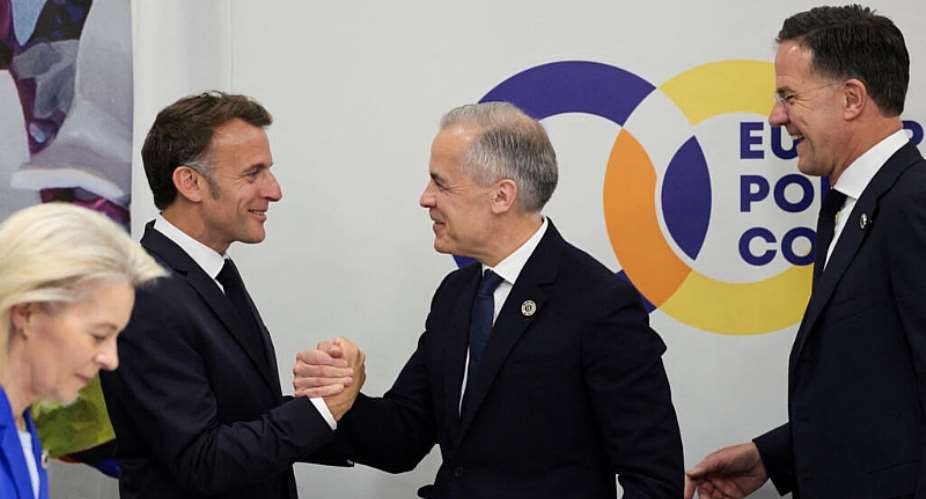
European leaders are gathering in the Armenian capital Yerevan, alongside Canadian Prime Minister Mark Carney, seeking to steady their footing in an increasingly fraught geopolitical landscape shaped in no small part by an unpredictable White House.
The meeting of the European Political Community – a relatively new forum designed to foster cooperation across the continent – is taking place this in Yerevan this Monday at a symbolic crossroads between Russia and the Middle East. Both regions, and the tensions surrounding them, are set to dominate the agenda.
US President Donald Trump will loom large over proceedings, even in absence. His administration's recent moves have stirred unease among European allies and sharpened questions about the future of transatlantic relations.
“Leaders from across the continent, with Canada as a guest, will discuss how to cooperate to strengthen security and collective resilience,” European Council President Antonio Costa wrote on social media as he arrived in the Armenian capital on Sunday.
Trump threatens NATO exit, scaling up tensions with allies
Transatlantic strains come into focus
The ongoing Iran war – which has driven energy prices sharply higher and unsettled global markets – has widened divisions between Europe and Washington. A recent spat between Trump and German Chancellor Friedrich Merz have underscored the tension, after Merz criticised the US handling of the conflict.
In response, Washington announced plans to withdraw 5,000 US troops from Germany – a move that has only deepened doubts about America's long-term commitment to defending its European allies.
Those concerns come as Russian President Vladimir Putin presses on with the war in Ukraine, now in its fifth year. Ukrainian President Volodymyr Zelensky is attending the summit, alongside NATO chief Mark Rutte. Germany, meanwhile, is being represented by French President Emmanuel Macron.
US to withdraw about 5,000 troops from Germany
Canada's presence adds a fresh dimension, as Prime Minister Mark Carney becomes the first non-European leader to join EPC talks – a sign of strengthening ties between Ottawa and European capitals, forged in part by shared friction with Washington.
Like many European economies, Canada has felt the impact of Trump's tariffs. Yet Carney has struck a defiant tone, positioning himself as a leading voice among so-called middle powers seeking to navigate a world increasingly shaped by great power rivalry and what he has described as a “fading” rules-based order.
For some observers, the EPC itself is evolving in response. Once viewed primarily as a forum aligned against Moscow, it is now taking on a broader geopolitical character. “With the invitation to Canada, this initiative – initially driven by geography – is now taking on an anti-Trump slant,” said Sebastien Maillard of the Jacques Delors Institute.
Ottawa, for its part, has been quick to diversify its partnerships – joining the EU's defence financing scheme SAFE as the first non-European participant and stepping up trade cooperation with the bloc.
France, Russia stand on opposite sides of Armenia-Azerbaijan conflict
Armenia's pivot westwards
Beyond the wider geopolitical backdrop, the Yerevan summit also shines a spotlight on Armenia itself – a nation navigating its own reorientation.
The EPC, launched in 2022 at the initiative of Macron in response to Russia's invasion of Ukraine, brings together EU member states and 21 additional countries, from Albania to Britain. While it does not typically produce concrete decisions, it offers leaders a space for dialogue – both in formal sessions and on the sidelines.
This week's gathering marks the first time the forum has been held in the Caucasus, underlining Armenia's growing engagement with Europe. It will be followed by an EU–Armenia summit attended by Costa and European Commission President Ursula von der Leyen, who has described the meeting as a “major milestone”.
Relations between Yerevan and its traditional ally Moscow have become increasingly strained. Russia's failure to intervene during recent conflicts with neighbouring Azerbaijan has fuelled frustration in Armenia and prompted a rethink of its strategic positioning.
Under Prime Minister Nikol Pashinyan, the country has embraced a policy of “diversification” – seeking to balance ties with Russia while steadily deepening links with Europe. Armenia signed a comprehensive partnership agreement with the EU in 2017 and has since declared its intention to apply for membership.
In April, the EU launched a mission to help Armenia counter foreign interference, amid suspicions of a Russian disinformation campaign ahead of upcoming elections.
Putin has said he remains “completely calm” about Armenia's overtures to Europe, but he has also issued a pointed reminder: membership of both the EU and the Russian-led Eurasian Economic Union, he warned, would be “simply impossible”.
(With newswires)

 'If God will judge people we call holy, what about us?' — Evangelist asks after ...
 Nigerian evangelist shares list of top Nigerian pastors he saw in hell weeping f...
 How suspected phone thief swallowed five SIM cards during arrest on Kasoa-Bawjia...
 Two arrested over alleged possession and trafficking of suspected narcotics at K...
 Agric Minister urges Finance Minister to reverse Ghana's withdrawal from food re...
 S&P holds Ghana at B-/B as fiscal risks persist
 Mahama exposes 'humiliating' requirements in trashed US Health Compact
 NSA releases PIN codes for private candidates, defaulters and foreign-trained gr...
 Toyota Hiace crashes Toyota Voxy from behind at Tsibu-Bethel Junction
 'It has been the old story of promises upon promises; we won’t return until sala...


