




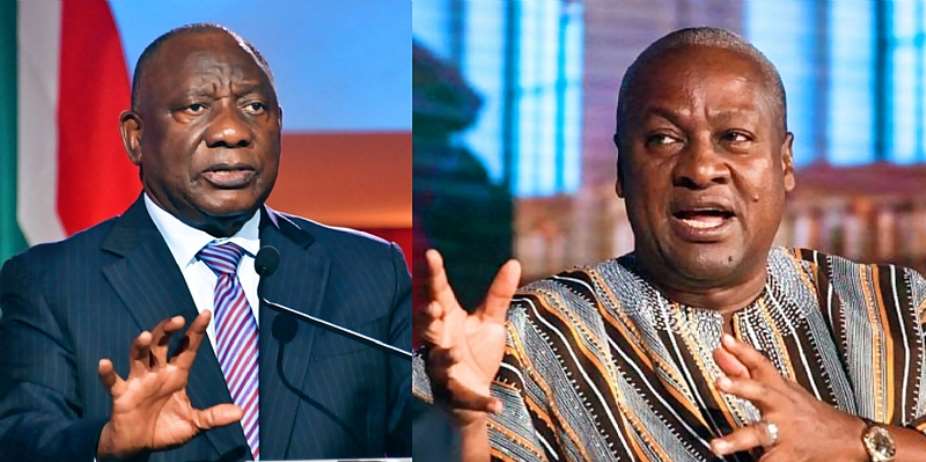
If I were President of Ghana, my response to the recurring xenophobic attacks in South Africa would be decisive and uncompromising. I would arrange chartered flights to evacuate any Ghanaian in danger, declare the South African High Commissioner in Accra persona non grata with 24 hours to depart, recall Ghana’s High Commissioner from Pretoria, and suspend diplomatic relations until the safety and dignity of Africans are guaranteed.
For years, South Africa has struggled with waves of violent attacks targeting fellow Africans who travel there in search of work and opportunity. Each time these incidents occur, the response from South African authorities has been painfully inadequate, leaving victims vulnerable and African nations frustrated.
My first encounter with this troubling attitude dates back to 2018, when I arrived at Oliver Tambo International Airport in Johannesburg. What should have been a routine immigration process turned into an unnecessary confrontation, triggered by irrelevant questioning. At the baggage carousel, another unpleasant encounter with airport security reinforced the sense that some individuals tasked with public service lacked professionalism and courtesy.
These experiences reminded me of a deeper historical irony. In the mid‑1980s, during my training at the School of Medical Radiography at Korle-Bu Teaching Hospital, Ghana hosted many South Africans fleeing apartheid. They were educated, sheltered, and supported at the expense of the Ghanaian taxpayer. Ghanaian communities welcomed them warmly, and many formed relationships with local women — some of whom were left behind with children when apartheid ended and the refugees returned home.
Zimbabwe, too, played a crucial role during the apartheid era, offering refuge to South Africans and serving as a cultural hub where global icons like Miriam Makeba, Hugh Masekela, and Ladysmith Black Mambazo performed and found solidarity.
This is why the recurring xenophobic attacks in South Africa cut so deeply. They betray the spirit of African unity that sustained South Africans during their darkest years.
My fellow Ghanaians, travelling abroad can be beneficial, but we must abandon the belief that hope exists only outside our borders. Life overseas comes with its own burdens — bills, discrimination, and emotional strain. There is truly no place like home.
To our political leaders: you are entrusted with every resource and privilege necessary to improve the lives of ordinary citizens. When those privileges are used only for personal gain, the consequences for the nation are severe and lasting. Leadership must be rooted in service, empathy, and accountability.
Justice A. Newton-Offei
[email protected]


 We are going to provide emergency airstrip in regions without airports — Mahama
 Nana Konadu maiden memorial mass set for October 23
 'Double standards are not helpful, wrong yesterday is wrong today' – Ablakwa on ...
 'I am disappointed in govt for suspending ban on bus preaching' — Apostle Asempa...
 NPP has resolve internal wrangling — Bawumia
 Ghana, US Virgin Islands agree on recruitment of Ghanaian teachers, nurses
 Never Again: Mahama Pushes for Local Vaccine Manufacturing After COVID‑19
 “Soldiers Will Stay There”—Mahama Declares Permanent Military Presence in Forest...
 ‘No Borrowing Involved’ — Mahama Rolls Out US$10bn New Economy Policy
 “Ask Jean Mensa to resign first”—Tanko-Computer fires back


