




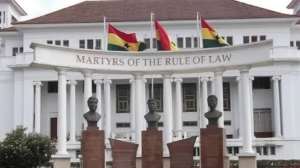
It is fundamentally misleading and overstated to assert that the people of Ghana do not know the 2020 Presidential election results because the Supreme Court (a.k.a Unanimous FC) protected Mrs Jean Mensah from being crossed-examined. This assertion confuses dissatisfaction with judicial procedure for uncertainty about electoral results, and in doing so, risks eroding public confidence in constitutional governance.
The NDC and its lead counsel in the 2021 Presidential election petition were not satisfied with the Supreme Court’s decision for not compelling the Electoral Commission Chairperson to testify under cross-examination. But issues regarding the Chairperson’s performance of public duties belong in the legislature and not the judiciary. General complaints about declaration errors or official conduct are not grounds for court redress.
The lead counsel in the 2021 Presidential election petition was keen on Mrs Jean Mensa testifying under cross-examination to account for her stewardship for holding a key public office in Ghana, and to explain why the Electoral Commission changed the election results after the initial declaration. This was the crux of the 2021 Presidential election petition. The absence of cross-examination is not, in itself, proof that the truth was suppressed. It indicated that the court found the petitioner’s case insufficient to warrant that step.
Couts are guided by rules of evidence and judicial discretion. The 2021 Presidential election petition did not meet the basic threshold for hearing at the Supreme Court. Article 64(1) requires evidence of violations that materially affect the valid votes cast, counted and declared. Therefore, Presidential election petitions must cite actual breaches of electoral laws, not just insignificant administrative errors made during the declaration of final results collated.
The 2021 Presidential election petition was so weak, insignificant, and poorly grounded that it did not raise any serious legal or factual issue for the court to determine. In simple terms, it lacked substance. There was lack of material evidence that could meet Article 63(3) threshold. That is, there was no evidence that the President-elect (winner of the election) could not obtain or secure over 50% of the valid votes cast. The petitioner only made allegations but provided no credible evidence. The petitioner claimed widespread irregularities without polling station data, figures, or verified documents. But courts expect proof, not suspicion.
The petitioner was required to demonstrate not just irregularities, but that such irregularities materially affected the outcome. This threshold was not met. The Supreme Court, in a unanimous decision, dismissed the petition on its merits. In any constitutional democracy, that ruling carries decisiveness. One may disagree with the judgment, but to suggest that it leaves the election results unsettled is to misunderstand and undermine the role of the judiciary.
The Electoral Commission made corrections after the initial declaration. These revisions have been cited as evidence of uncertainty. Yet this argument deceives the public with regard to the outcome of the 2020 Presidential election. Administrative corrections, especially in complex national exercises, are not uncommon. What matters is whether such corrections alter the fundamental outcome. In this case, they did not. The declared winner remained unchanged, and no credible evidence was presented to demonstrate that the errors were decisive.
The use of the phrase “the court protected Mrs Jean Mensa” may resonate in partisan discourse, but it does not establish that the election outcome is unknown. They express distrust, not proof. And while this distrust in public institutions should never be dismissed lightly, it must be grounded in evidence if it is to inform serious national debate.
There is a broader danger in sustaining the narrative that Ghana’s 2020 Presidential election remains unresolved. Democracies depend not only on the conduct of elections, but on the acceptance of lawful outcomes even when they were contested. To continually cast settled results as uncertain is to invite perpetual instability, where no electoral verdict is ever final and every transition of power is subject to endless doubt.
In earnest, the 2020 Presidential election was contested. It was litigated. And it was resolved through the very constitutional mechanisms designed for that purpose. To endlessly insist that “we still do not know the results” is a departure from truth and democracy. Ghana’s democratic strength lies in its institutions’ ability to manage disagreement within the bounds of law. That process worked in 2021 during the Presidential election petition hearing and determination. The results for the 2020 Presidential election are known.
Article 64(1) of the 1992 Constitution does not prescribe evidentiary thresholds at the point of filing. An aggrieved citizen can file a petition without first proving their case. There is no constitutional requirement to attach specific quantum of evidence before filing. The same Article makes the entry point relatively open to the filing of inconsequential cases. It prevents premature dismissal based purely on lack of initial evidence. The 2021 Presidential election petition was fundamentally flawed and ought to have been dismissed ab initio. It was basically defective from its inception.
Every Presidential election petition must disclose a reasonable cause of action. It must equally raise triable issues. The Supreme Court ought to have dismissed the petition from the very beginning as frivolous and vexatious given its inherent defects. The weaknesses of Article 64(1) allowed the 2021 Presidential election petition to survive beyond its inception. Article 64(1) is procedurally restrictive (time, forum, and eligibility) but not evidentially restrictive at the point of filing, thereby allowing broad access to initiate a petition.
The outcome of , and as such all institutions, persons and agencies of state must respect the decision of the apex court of the land, the Supreme Court. The results of the 2020 Presidential elections are on the website of the Electoral Commission of Ghana.
Emmanuel Kwabena Wucharey
Economics Tutor, Advocate and Religion Enthusiast.

 'Chief Justice was talking as a citizen; you have to look at the context in whic...
 Mandatory towing to remove broken-down, stationary vehicles from roads to begin ...
 Domelevo backs OSP probe into alleged GH¢70,000 payment to Appiagyei despite den...
 WAEC releases 2026 WASSCE results, cancels entire results of 861 candidates for ...
 Baffour Agyeman-Duah explains why profitability may not be only reason behind SO...
 Kofi Bentil defends Mahama’s dissolution of nine State Boards
 5-year-old girl dies after falling into water-filled manhole at Winneba
 Sierra Leone ex-president to return after treason case dropped
 'Explain how you spent your Common Fund' — Boako, Annoh Dompreh challenge Tano N...
 Ghana ends South Africa evacuation; brings home nearly 1,900


Comments
Put the results here for everyone to see, then case close.
Author's Reply
Nana Addo Dankwa Akufo-Addo had 6,730,587 representing 51.302%
President John Dramani Mahama had 6,213,182 representing 47.359%