




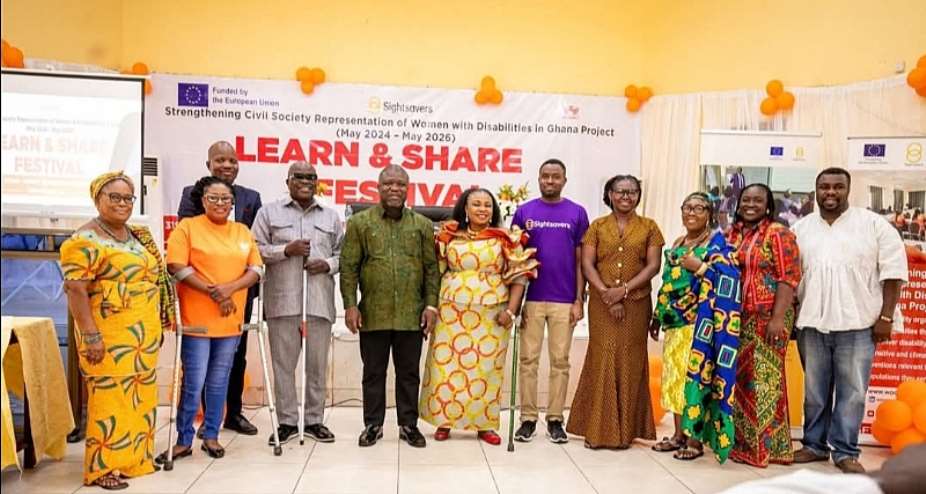
Stakeholders have renewed calls for stronger policies, inclusive governance and sustained partnerships to advance the rights of women with disabilities, as the Women with Disability Development and Advocacy Organization (WODAO) marked the successful close of a two-year European Union-funded project at a Learn and Share Festival in Ho.
The event, held at the GNAT Conference Hall on March 31, brought together government officials, civil society organizations, development partners, organizations of persons with disabilities (OPDs), and community leaders to reflect on two years of work under the project titled “Strengthening Civil Society Representation of Women with Disabilities in Ghana.”
The project, funded by the European Union and implemented by WODAO in partnership with Sightsavers and the ABAK Foundation, ran from May 2024 to May 2026.
It aimed to strengthen the capacity of civil society organizations to promote gender equality, disability inclusion, and the effective participation of women with disabilities in governance and decision-making processes across Ghana.
Opening the event, WODAO Executive Director, Veronica Denyo Kofiedu, described the gathering as “not just a closing event, but a moment of reflection, learning and renewed commitment,” highlighting significant gains made in amplifying the voices of women with disabilities.
According to her, the project built the capacity of two co-applicant organizations and 23 downstream groups across the Volta and Oti regions, while mentoring 45 women with disabilities to engage in advocacy and decision-making processes.
She added that the initiative strengthened grassroots advocacy, partnerships and promoted gender equality, disability inclusion and climate-responsive advocacy.
“We have contributed to ensuring that women and girls with disabilities are not only seen and heard, but actively engaged in shaping decisions that affect their lives,” she said.
Representing technical partner Sightsavers, Programme Manager Mohammed Abdul-Razak underscored the need to prioritize ability over disability, urging stakeholders to create more opportunities for persons with disabilities.
“Persons with disabilities need space, platforms and avenues to contribute meaningfully to society,” he said, noting that the project reached over 2,000 people and maintained an “on-track” implementation rating throughout its lifecycle.
He further called on the government to fast-track the passage of the Persons with Disabilities Bill and address employment barriers facing graduates with disabilities.
In a keynote address, Volta Regional Minister James Gunu commended WODAO and its partners, describing the project as a testament to the power of collaboration.
“Inclusive development is not optional, it is essential. No society can truly progress if sections of its population are left behind,” he stated.
Mr. Gunu highlighted government interventions, including free university education for persons with disabilities and efforts to improve equitable disbursement of the District Assemblies Common Fund.
Adding his voice, Volta Regional Coordinating Director, Alhaji Mohammed Avona Akape, described the project as a clear demonstration of what can be achieved through collective action and partnership.
“Today we celebrate the progress we have made together. This project has shown us that when we work together, we can achieve great things,” he said.
He noted that the initiative had not only empowered women with disabilities but also created meaningful opportunities for inclusion across communities.
“As we close this chapter, we are committed to ensuring sustainability and continued impact. Let us keep pushing for a society where everyone is heard and valued,” he added, while commending partners and stakeholders for their dedication.
A detailed presentation by WODAO Project Officer George Kofiedu revealed that the project exceeded several of its targets, including training 122 civil society staff against a target of 75, reaching 586 downstream participants, and implementing 36 advocacy actions—far above the initial goal of 20.
However, challenges such as limited awareness of disability inclusion, resource constraints, coordination difficulties and lack of accessible infrastructure were noted.
“Accessibility remains a major concern that must be addressed,” Kofiedu stressed.
Delivering a solidarity message, Dr. Joseph Kobla Wemakor, Executive Director of Human Rights Reporters Ghana, emphasized the urgent need for inclusive storytelling and media representation.
“Storytelling is power. Visibility is power. Voice is power,” he said, noting that persons with disabilities continue to face systemic exclusion not only in governance but also within media narratives.
Dr. Wemakor also called for sustained and effective collaboration among all stakeholders—including government institutions, civil society organizations, the media, development partners, and disability rights groups—to translate advocacy into tangible results.
He stressed that meaningful progress on disability inclusion and human rights can only be achieved when actors work in a coordinated and intentional manner, sharing responsibilities, aligning efforts, and committing to long-term partnerships that go beyond isolated interventions.
He noted that fragmented approaches often slow down progress, adding that collective action remains critical in addressing systemic barriers, improving representation, and ensuring that policies are not only developed but effectively implemented to impact the lives of persons with disabilities.
The HRR Ghana boss used the occasion to highlight an upcoming international platform as part of efforts to strengthen global and regional collaboration on disability inclusion.
He announced that Human Rights Reporters Ghana will convene a high-level dialogue at the upcoming RightsCon 2026, scheduled for May 6, 2026, in Lusaka, Zambia, at the Mulungushi International Conference Centre.
He explained that the dialogue will serve as a strategic platform to bring together journalists, disability rights advocates, policymakers, and digital rights actors to collectively examine persistent barriers and shape practical, forward-looking solutions to issues affecting persons with disabilities.
The engagement is expected to help consolidate voices and build consensus around actionable recommendations that can inform policy, media practice, and digital inclusion efforts across Africa and beyond.
The dialogue, themed “Silenced Twice: Press Freedom and Disability Voices Under Threat in Africa,” will examine how persons with disabilities face a double layer of marginalization—first through social exclusion and discrimination, and again through underrepresentation and inaccessibility within media and digital spaces.
Dr. Wemakor added that the session will explore how media systems can become more inclusive and accessible, promote ethical and dignity-centered reporting, strengthen the capacity of persons with disabilities to tell their own stories and influence public discourse, and address the risks of digital exclusion as technology continues to shape civic space across Africa.
He stressed that the broader objective is to ensure that global conversations on press freedom and digital transformation are intentionally inclusive and responsive to the needs of persons with disabilities.
“This is not just a media issue—it is a human rights issue. When voices are excluded, democracy itself is weakened,” he said.
The festival concluded with a renewed commitment from stakeholders to sustain the gains made under the project, deepen collaboration, and advance policies that promote equality, dignity and full participation for persons with disabilities.
Participants agreed that while progress has been made, significant work remains to dismantle systemic barriers and ensure that no one is left behind.
Source: HRR Ghana
 WASSCE: School officials helped students cheat for years, but we now see the tru...
 Probe alleged military killing of lecturer in Bawku – Kusaug Youth demands
 ‘If we all pay GH¢1,000 each, we should be able to construct National Cathedral’...
 Mahama inspects proposed site for Upper West Regional Airport
 Mahama reiterates government's commitment to end double-track SHS system
 Police interdict officer over death of 23-year-old Ivan Baidoo on Tema Motorway
 NDC gov't ‘scored own goals’ with new SHS placement policy — Dr. Bempah Tandoh
 Five-year presidency will give governments more time to deliver — Kofi Bentil
 Improved invigilation is exposing true performance of Ghanaian students — Mahama...
 There's no policy to introduce Arabic, Chinese in all public schools — Mahama


