




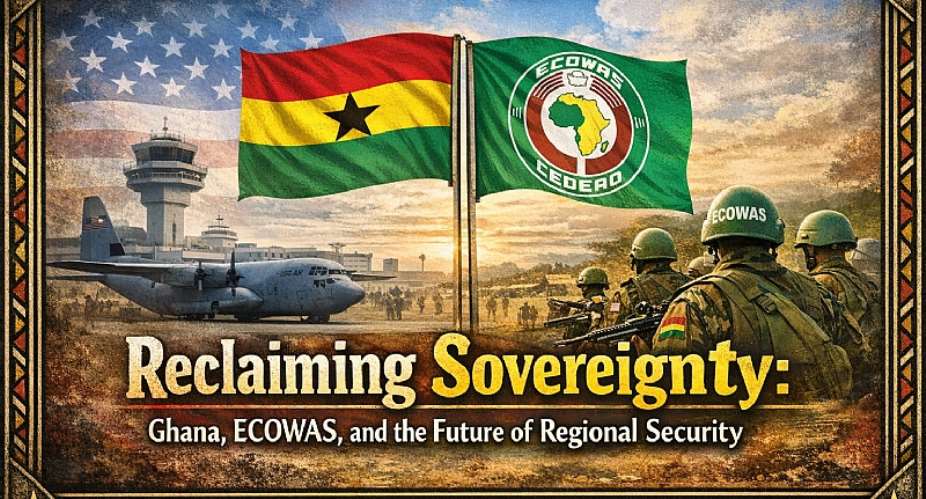
Sovereignty is the soul of a nation. It is the invisible shield that protects our independence, our dignity, and our right to determine our own destiny. In 2018, Ghana’s ratification of the Defence Cooperation Agreement with the United States sparked a national debate that has never truly faded. Critics warned of foreign military bases and the erosion of sovereignty, while government insisted it was a matter of partnership. Yet as instability spreads across West Africa, the question remains urgent: should Ghana entrust its security to foreign powers, or should we reclaim our destiny through African-led solutions?
This article continues my sustained campaign against foreign military presence in Ghana. But here, I turn the spotlight toward ECOWAS—the Economic Community of West African States—our regional body, born of shared history and collective struggle. ECOWAS was envisioned not as a bystander, but as a guardian of peace and unity. Today, Ghana must decide whether to dilute that vision with dependency or to strengthen it with leadership.
ECOWAS and Its Security Mandate
From its inception in 1975, ECOWAS was more than an economic bloc—it was a vision of collective strength. The founding leaders understood that prosperity could not flourish without peace, and that peace in West Africa could not be outsourced. Over the decades, ECOWAS has evolved into a regional security actor, intervening in Liberia, Sierra Leone, Mali, and Guinea-Bissau, and taking bold stances against unconstitutional changes of government.
Yet today’s challenges are more complex. Terrorist networks in the Sahel exploit porous borders and fragile states. Coups destabilize democracies. In this climate, ECOWAS’s security mandate is not aspirational—it is essential. The question is whether member states, Ghana included, will invest in ECOWAS as the primary guardian of regional security, or continue to dilute its authority with bilateral defence agreements.
Ghana’s Position Within ECOWAS
Ghana has long been regarded as one of West Africa’s most stable democracies—a nation whose voice carries weight in regional affairs. Within ECOWAS, Ghana is seen as a bridge-builder. Yet this reputation is increasingly tested by contradictions in our defence posture.
On one hand, Ghana champions ECOWAS principles of unity and self-reliance. On the other, it has bound itself to bilateral defence agreements with external powers, most notably the 2018 Defence Cooperation Agreement with the United States. This duality raises uncomfortable questions: can Ghana credibly lead ECOWAS in building a regional security architecture while simultaneously hosting arrangements that critics interpret as foreign bases?
Leadership in ECOWAS requires consistency. If Ghana is to fulfill its role as a pillar of the bloc, it must reconcile this contradiction and demonstrate that sovereignty is not negotiable.
The Contradiction of Foreign Military Bases
At the heart of ECOWAS’s security philosophy lies the principle: African solutions to African problems. Yet foreign military bases undermine this vision. They compromise sovereignty, entangle host nations in external conflicts, and foster dependency.
In Djibouti, multiple foreign bases have turned the country into a geopolitical chessboard. In Niger, the U.S. drone base became a symbol of external control, sparking resentment. These examples illustrate the risks: foreign footprints rarely strengthen sovereignty; they dilute it.
For Ghana, the contradiction is stark. How can we advocate for regional unity while hosting arrangements that critics interpret as foreign bases? How can we call for African-led security when our defence posture signals reliance on external guardians? This tension erodes ECOWAS’s credibility and diminishes Ghana’s leadership role.
Towards a Regional Security Architecture
If ECOWAS is to rise above dependency, it must transform its mandate into a living architecture—funded, coordinated, and owned by West Africans. Ghana is uniquely positioned to champion this transformation.
Strengthen the ECOWAS Standby Force: Commit predictable funding, modern equipment, and logistics. Ghana can lead by example.
Invest in intelligence-sharing and border coordination: Establish a regional intelligence hub to anticipate threats. Ghana’s strategic location makes it an ideal host.
Localize training and capacity-building: Create joint ECOWAS training facilities instead of hosting foreign bases. Ghana’s academies could serve as regional centres of excellence.
Embrace African-led innovation: Invest in homegrown surveillance, cyber defence, and logistics. Ghana’s universities can drive this innovation.
This architecture is not a dream—it is a necessity. Without it, ECOWAS remains vulnerable to external manipulation. With it, West Africa reclaims sovereignty and builds genuine security independence.
Policy Recommendations
To reclaim sovereignty and lead ECOWAS into a new era, Ghana must act decisively:
Re-evaluate the 2018 SOFA Agreement: Parliament must revisit its provisions and ensure they align with national and regional interests.
Prioritize ECOWAS over bilateral deals: Defence resources should strengthen regional capacity, not external partnerships.
Champion an ECOWAS Security Compact: Ghana should lead the call for a binding framework obliging member states to pool resources and coordinate responses.
Invest in indigenous capacity: Fund training, technology, and innovation within ECOWAS.
Assert parliamentary oversight: Defence agreements must never again be signed in secrecy or haste. Oversight is essential to sovereignty.
Sovereignty is not a slogan—it is the lifeblood of a nation. For Ghana, the debate over foreign military presence is a test of our resolve to stand as guardians of our own destiny. Dependency erodes authority; unity restores it.
By reasserting our commitment to ECOWAS, we affirm that West Africa’s security will not be dictated from foreign capitals but forged in African solidarity. Ghana must lead by example, championing a regional security compact, investing in indigenous capacity, and rejecting the illusion that foreign bases guarantee safety.
True security lies in unity, not dependency. True sovereignty lies in self-determination, not external guardianship. Let Ghana rise as a beacon within ECOWAS—proving that West Africa’s destiny will be secured by West Africans, for West Africans, and in the name of sovereignty that cannot be compromised.
✍️ Retired Senior Citizen
For and on behalf of all Senior Citizens of the Republic of Ghana 🇬🇭
Teshie‑Nungua
[email protected]

 Ahafo Ano South West MP involved in road accident
 Constitutional Review alone will not solve Ghana’s problems – Kwesi Pratt Jnr.
 East Legon Football Academy applauds NPA Boss for supporting youth football
 Gov't didn't show NPP enough respect in constitutional review process – Martin K...
 September 18: Cedi sells at GHS12.15 on forex market, GHS11.53 on BoG interbank
 Lawyer challenges two-week remand of Salomey over connection to wanted 'Ghana Jo...
 Minority calls for NSA boss Ampofo Ankrah, others to be dismissed over alleged 2...
 ‘You gave us GH¢60,000 to run 66 offices nationwide and expect us to function?’ ...
 Russia seizes assets of Swiss food giant Nestle and three French firms
 Russia votes in parliamentary election as war in Ukraine drags on


