




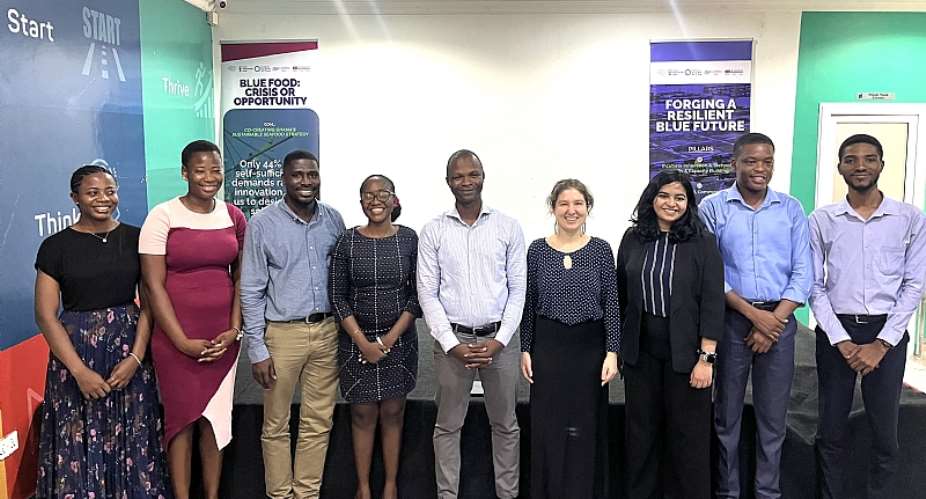
The Chamber of Aquaculture Ghana, in partnership with the World Economic Forum and other stakeholders, will on Wednesday, February 25, 2026, launch Africa’s first Blue Food Innovation Hub in Ghana.
The initiative follows months of consultations among public and private sector actors to address long-standing challenges in Ghana’s blue food sector, which supplies about 60 percent of the country’s protein and contributes an estimated $600 million to GDP.
The blue food sector in Ghana covers marine fisheries, inland fisheries and aquaculture with produce such as aquatic animals and plants harvested from oceans, rivers and lakes.
Marine fishing remains the largest producer, followed by inland fishing and aquaculture.
Despite its vast potential and benefits, marine fisheries are grappling with overfishing and pollution while inland fisheries face similar environmental pressures.
According to experts, post-harvest losses remain high, estimated between 20 and 30 per cent.
Disease outbreaks, especially in aquaculture, and high feed costs driven by import dependency have also raised production costs.
Speaking at a press engagement in Accra on Monday, Chief Executive Officer of the Chamber, Jacob Adzikah, said aquaculture currently offers the most viable path for expansion.
“The marine has issue with overfishing, pollution, etc. The inland sector is also having peculiar challenges. So the only promising one at the moment is the aquaculture sector,” he stated.
He noted that aquaculture, particularly tilapia and catfish production, will be the hub’s initial focus.
Tilapia accounts for about 80 percent of farmed fish output in Ghana, with catfish making up the remaining 20 percent.
According to him, the hub will serve as a neutral platform to convene government agencies, private firms, financial institutions, academia and development partners to co-create and scale solutions.
“The hub will identify innovative solutions within the blue food system that are showing strong potential, and together, as partners and stakeholders, will work to help them scale up their business model,” he said.
The strategies include an accelerator programme for small and medium-scale enterprises, finance clinics to prepare businesses for investment, and knowledge exchange platforms to build technical and managerial capacity.
The hub also aims to unlock up to $10 million in new investments for businesses between 2026 and 2032.
Selected startups and SMEs will be screened, trained and connected to financial institutions offering competitive financing.
Beyond finance, the initiative will promote research and development, improve certification and standards compliance for export, and encourage circular economy practices to reduce waste.
The sector currently employs more than 500,000 Ghanaians across the value chain, creating both direct and indirect jobs.
The Chamber believes the hub will position Ghana to become a continental leader in blue food innovation, and also strengthen food security, livelihoods and economic resilience.

 One dead, fire officer hospitalised after bee attack at Quarry Site in Sokode Gb...
 Israel and Iran step back from further strikes after renewed clashes
 Patients stranded as doctors, nurses refuse to see new patients over KATH CEO su...
 Avenor Rural Bank CEO’s house destroyed by fire
 Three arrested in Winneba for illegal mining near GWL water lines
 Two pupils of Alice Elite Academy laid to rest after fatal school bus crash
 Here are areas to be affected by ECG's planned maintenance on Tuesday
 Family of civil engineer killed in alleged military shooting demands justice
 SHS teacher allegedly beats female student over unpaid hostel fees
 Blow to EU defence cooperation as France, Germany abandon joint fighter jet prog...


