




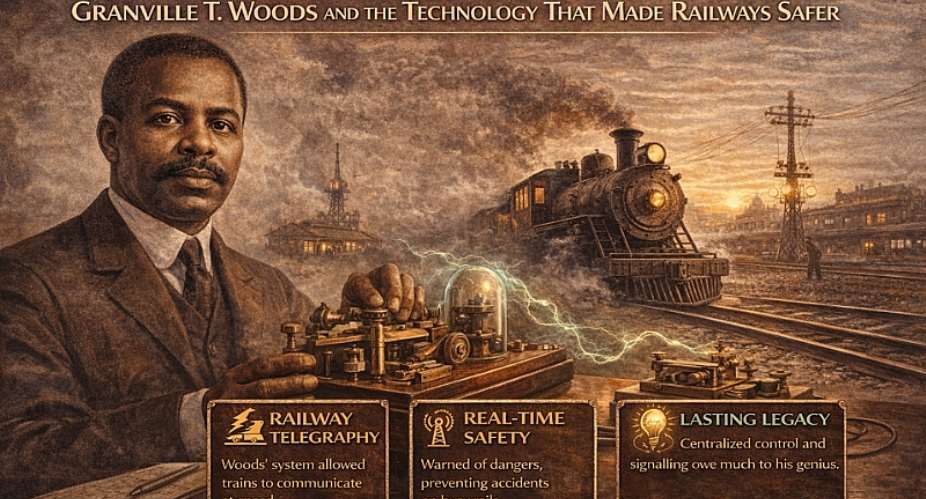
Railways did not become reliable simply because tracks were laid and trains were built. They became safe, coordinated, and scalable because someone figured out how to communicate with moving steel at speed. One of the most important minds behind that breakthrough was Granville T. Woods, a Black inventor whose work quietly transformed railway safety and operations, even as his name faded from mainstream transport history.
Before modern signaling, railways were dangerous systems. Trains moved blindly along fixed paths, dependent on rigid timetables and human judgment. Collisions were frequent, delays common, and safety largely reactive. Woods recognized a core problem, trains could move faster than information. His response was revolutionary, railway telegraphy that allowed communication between moving trains and stations in real time.
Woods’ induction telegraph system enabled operators to send messages to trains without physical contact, using electromagnetic fields. For the first time, dispatchers could warn drivers of hazards ahead, manage traffic dynamically, and coordinate movements across busy corridors. This was not just an upgrade; it was a shift from mechanical railways to intelligent systems.
The implications were profound. Railway accidents declined. Network capacity increased. Railways could now support growing industrial cities without collapsing under their own complexity. Much of what we now consider standard, signaling, centralized control, traffic coordination, rests on principles Woods helped pioneer.
Yet Woods’ story also exposes a deeper structural problem. Despite holding dozens of patents and contributing directly to technologies later adopted by major rail companies, his role was often contested, challenged, or absorbed into corporate systems without recognition. His ideas powered the network, but the narrative rarely credited the mind behind them.
This erasure matters, especially today. Across Africa and the Global South, transport discussions often frame technology as something imported, designed elsewhere, and deployed locally. Woods’ legacy challenges that assumption. It reminds us that Black engineers were not passive users of industrial systems; they were architects of them.
For countries seeking to modernize rail today, the lesson is not merely historical. It is strategic. Safe railways depend on intelligence, data, signaling, communication, and systems thinking, not just rolling stock and concrete. Investing in technology without investing in local engineering capacity repeats the old mistake of valuing hardware over human capital.
Granville T. Woods shows us another path. Innovation grows where confidence exists. Where education systems teach that engineering is not foreign. Where policy values systems, not just symbols. And where safety is designed, not improvised.
Railways became safer because someone imagined trains that could “talk.” As we rethink transport futures today, especially in Africa, the real question is whether we are ready to listen to history, to local expertise, and to the Black minds that have always been part of the journey.
Author: Joseph Fuseini ([email protected])


 Trump signs order to rename Lake Ontario to 'Lake America' as Carney pushes back
 Police restrict concrete mixer trucks on Accra, Tema roads from August 28
 Supreme Court nominee Anthony Forson Jnr. opposes proposal to cap number of just...
 Justice Bernasko Essah explains why Supreme Court may depart from its previous d...
 Two NDC MPs whose ‘secret’ marriages have shocked Ghanaians
 All you need to know about Hon. Millicent Yeboah-Amankwa, wife of Hon. Mahama Ay...
 ‘A true trailblazer and cultural icon’ – Bawumia mourns Grace Nortey
 Vetting: 'Suspects should sue police if detained beyond 48 hours' - Supreme Cour...
 Speaker Bagbin outdoors uniforms for new parliamentary security guards
 Minority NPP boycotts vetting of three Supreme Court nominees over rushed timeta...

