




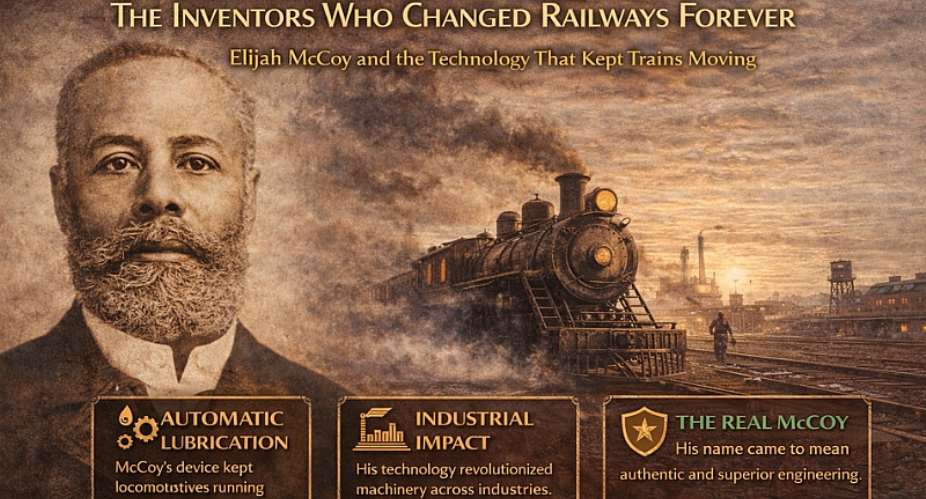
Railways are often celebrated as symbols of industrial progress, but the minds that made this progress possible are not always fully acknowledged. Among them stands Elijah McCoy, a Black inventor whose work quietly but profoundly reshaped railway operations and industrial engineering worldwide. His contribution reminds us that innovation does not always announce itself loudly, sometimes it works in the background, keeping entire systems alive.
Born in 1844 to formerly enslaved parents, Elijah McCoy was trained as a mechanical engineer at a time when opportunities for Black professionals were severely limited. Despite his qualifications, he was routinely denied engineering roles and instead worked in lower-level railway jobs. Yet it was precisely from within these constrained spaces that McCoy identified a critical problem in railway operations: lubrication.
In the era of steam locomotives, trains had to stop frequently so that engineers could manually oil moving parts. These interruptions slowed transport, increased costs, and reduced reliability. McCoy’s breakthrough was the invention of an automatic lubrication system that continuously fed oil to engine components while the locomotive was in motion. This seemingly simple idea transformed railway efficiency. Trains could run longer, faster, and more safely, with less wear on machinery.
The impact went far beyond railways. McCoy’s lubrication systems were soon adopted in factories, ships, mining equipment, and virtually every sector that relied on heavy machinery. His inventions became so trusted that buyers reportedly asked for “the real McCoy” to distinguish his reliable designs from inferior imitations, a phrase that still lives in everyday language today.
What makes McCoy’s story especially relevant now is not just his brilliance, but how his contribution has often been sidelined in mainstream industrial history. Railway narratives frequently focus on capital, infrastructure, and colonial expansion, while the engineers and inventors, especially Black ones, are treated as footnotes. This omission matters. It shapes who we believe can innovate, and whose ideas are seen as central to technological progress.
For countries like Ghana and across Africa, grappling with railway revival and industrial modernization, McCoy’s legacy carries an important lesson. Technical excellence does not depend on geography or race; it depends on opportunity, recognition, and systems that allow talent to flourish. Ignoring this history risks repeating a cycle where local expertise is undervalued while imported solutions are over-celebrated.
Elijah McCoy did not build railways with steel and concrete alone, he built them with insight, persistence, and engineering intelligence. His work kept trains moving, industries running, and economies connected. Remembering his contribution is not about nostalgia; it is about reclaiming confidence in Black technical capacity and understanding that the foundations of modern transport were shaped by minds that history too often forgets.
As we look to the future of rail and industrial development, McCoy’s story offers a quiet but powerful reminder: some of the most transformative innovations come from those working behind the scenes, until the world can no longer move without them.
Author: Joseph Fuseini ([email protected])


 Trump signs order to rename Lake Ontario to 'Lake America' as Carney pushes back
 Police restrict concrete mixer trucks on Accra, Tema roads from August 28
 Supreme Court nominee Anthony Forson Jnr. opposes proposal to cap number of just...
 Justice Bernasko Essah explains why Supreme Court may depart from its previous d...
 Two NDC MPs whose ‘secret’ marriages have shocked Ghanaians
 All you need to know about Hon. Millicent Yeboah-Amankwa, wife of Hon. Mahama Ay...
 ‘A true trailblazer and cultural icon’ – Bawumia mourns Grace Nortey
 Vetting: 'Suspects should sue police if detained beyond 48 hours' - Supreme Cour...
 Speaker Bagbin outdoors uniforms for new parliamentary security guards
 Minority NPP boycotts vetting of three Supreme Court nominees over rushed timeta...


Comments
He's known now as the Real McCoy....
Author's Reply
Absolutely right