




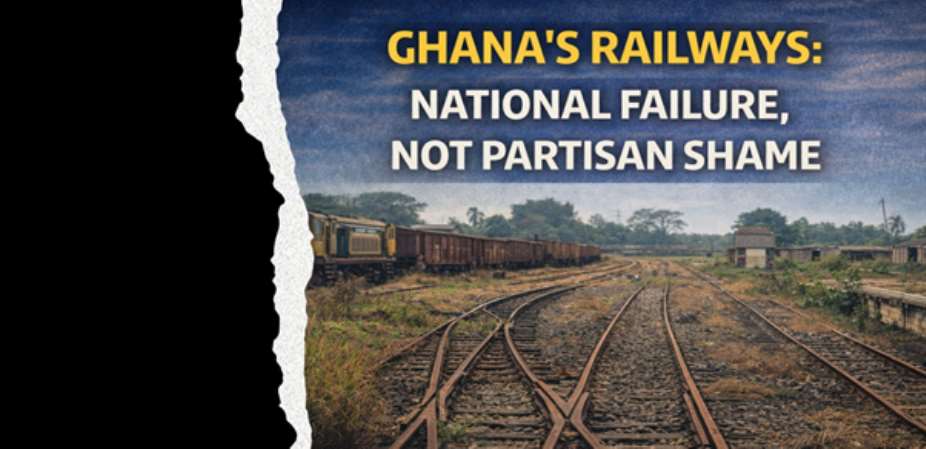
Ghana’s railway story is often told through the lens of nostalgia and political grievance. Many rightly recall that at independence, Ghana inherited a functional railway backbone linking Accra, Kumasi, and Takoradi, and that Kwame Nkrumah and the Convention People’s Party (CPP) saw rail as a strategic tool for national integration. That vision was real, and it mattered. But to stop the story there or to assign all subsequent failure to a single political party or historical moment is to miss the deeper lesson Ghana urgently needs to learn.
The collapse of Ghana’s railway system did not happen overnight, nor did it occur under one government alone. It was a slow, multi-decade erosion that spanned civilian administrations, military regimes, and democratic governments across the political spectrum. Tracks were not extended, rolling stock was not renewed, maintenance was deferred, and institutions were weakened. Rail did not die because it was deliberately killed; it died because it was consistently neglected.
This is why today’s rail conversation must move beyond blame and into accountability. Railways are not partisan projects. They are long-life assets that demand continuity, discipline, and protection from political cycles. When infrastructure policy resets every four or eight years, railways, by their very nature, are the first casualties.
The frequent comparison with Nigeria is revealing. Like Ghana, Nigeria inherited a colonial rail network designed for extraction rather than integration. Like Ghana, its system suffered decades of decay. Yet in recent years, Nigeria made a deliberate political and institutional choice to return rail to the center of national and urban transport planning. Lagos’ urban rail did not emerge because Nigeria had a better colonial inheritance; it emerged because the state decided late, but firmly, that rail was non-negotiable.
That is the real lesson for Ghana. The issue is not whether Nkrumah was removed or which party governs today, but whether Ghana is capable of sustaining a long-term infrastructure vision that survives elections, internal party contests, and changes in leadership. Railways require patience. They do not reward short-term political thinking, but they punish its absence.
The uncomfortable truth is that Ghana has spent decades managing decline instead of planning expansion. We debated history while cities grew, congestion worsened, and transport systems collapsed under pressure. Meanwhile, other countries facing similar or even greater challenges chose to rebuild.
If Ghana is serious about learning from Nigeria, or from any successful rail revival, the lesson is clear: rail development must be elevated above politics. It must be insulated from partisan blame, backed by strong institutions, and treated as a national commitment rather than a campaign promise.
The past should inform us, not trap us. Ghana’s railways will not return because of nostalgia or political arguments. They will return only when the country agrees on one simple principle: national infrastructure must outlive national politics.
Author: Joseph Fuseini ([email protected])


 Trump signs order to rename Lake Ontario to 'Lake America' as Carney pushes back
 Police restrict concrete mixer trucks on Accra, Tema roads from August 28
 Supreme Court nominee Anthony Forson Jnr. opposes proposal to cap number of just...
 Justice Bernasko Essah explains why Supreme Court may depart from its previous d...
 Two NDC MPs whose ‘secret’ marriages have shocked Ghanaians
 All you need to know about Hon. Millicent Yeboah-Amankwa, wife of Hon. Mahama Ay...
 ‘A true trailblazer and cultural icon’ – Bawumia mourns Grace Nortey
 Vetting: 'Suspects should sue police if detained beyond 48 hours' - Supreme Cour...
 Speaker Bagbin outdoors uniforms for new parliamentary security guards
 Minority NPP boycotts vetting of three Supreme Court nominees over rushed timeta...

