




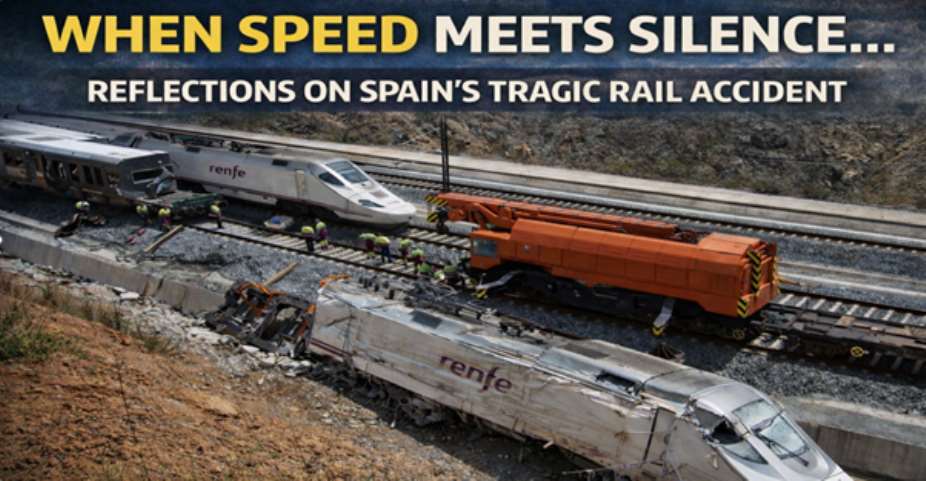
Spain woke to shock and sorrow following a “very serious” rail accident involving two high-speed trains, a tragedy that has claimed 39 lives as of 19 January 2026. The crash occurred on Sunday 18th January 2026 at 7:45 p.m., barely ten minutes after an Iryo train departed Córdoba for Madrid. In a moment that has since shaken the nation, the Iryo train derailed and crashed onto an adjacent track, forcing another high-speed train traveling from Madrid to Huelva off the rails as well. Among those who lost their lives was the driver of the Madrid–Huelva train.
Spain is rightly proud of its high-speed rail network, the largest in Europe and one of the most advanced in the world. For decades, it has symbolized modernity, efficiency, and national progress. That is why this accident feels particularly painful. It is not only a loss of life but also a rupture in the collective confidence that rail travel represents safety, reliability, and calm continuity.
Rescue and evacuation efforts following the crash demonstrated professionalism and urgency, with swiftly assisted passengers and emergency teams working under difficult conditions. In moments like these, the focus naturally turns to compassion for the families mourning loved ones, for the injured facing long recoveries, and for railway workers and first responders who carry the emotional weight of such events.
This tragedy is a sobering reminder that even the most advanced transport systems are not immune to failure. High-speed rail is among the safest modes of travel globally, yet safety is never a finished achievement; it is a continuous process. Every incident, however rare, calls for reflection rather than recrimination, learning rather than blame.
Railways are complex systems where human skill, technology, infrastructure, and timing intersect. When something goes wrong, it is rarely a single factor. What matters most in moments like this is a collective commitment to understanding what happened, strengthening safeguards, and supporting those affected.
Spain’s rail story has long been one of success. This accident does not erase that legacy, but it does pause it, inviting humility and care. As investigations continue and facts emerge, the broader lesson is universal: progress must always walk hand in hand with vigilance.
Tonight, trains will continue to run, passengers will continue to trust, and societies will continue to depend on railways. The responsibility shared by all of us, governments, operators, engineers, and citizens alike, is to honor those lost not through anger, but through renewed dedication to safety, transparency, and human life above all else.
Author: Joseph Fuseini ([email protected])


 Trump signs order to rename Lake Ontario to 'Lake America' as Carney pushes back
 Police restrict concrete mixer trucks on Accra, Tema roads from August 28
 Supreme Court nominee Anthony Forson Jnr. opposes proposal to cap number of just...
 Justice Bernasko Essah explains why Supreme Court may depart from its previous d...
 Two NDC MPs whose ‘secret’ marriages have shocked Ghanaians
 All you need to know about Hon. Millicent Yeboah-Amankwa, wife of Hon. Mahama Ay...
 ‘A true trailblazer and cultural icon’ – Bawumia mourns Grace Nortey
 Vetting: 'Suspects should sue police if detained beyond 48 hours' - Supreme Cour...
 Speaker Bagbin outdoors uniforms for new parliamentary security guards
 Minority NPP boycotts vetting of three Supreme Court nominees over rushed timeta...

