




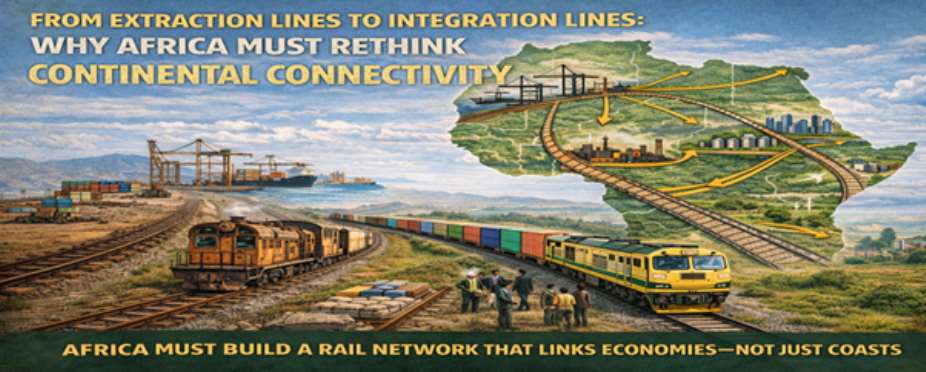
Africa’s railway map tells a powerful but uncomfortable story. Most of the continent’s rail lines run from the interior straight to the coast, terminating at ports built for export. This design was not accidental. Railways in Africa were largely constructed during the colonial era to extract raw materials, minerals, timber, and cash crops from inland territories to serve external markets. They were never intended to connect African economies to one another, nor to support intra-continental trade. Compatibility, integration, and long-term development were irrelevant to colonial planners.
Decades after independence, much of Africa still moves along these same lines, both physically and conceptually. The persistence of extractive rail corridors has become a structural constraint on Africa’s development. While roads have partially filled the gaps, rail, the most efficient mode for bulk and long-distance freight, remains fragmented, incompatible, and poorly interconnected across borders. Different gauges, weak cross-border links, and nationalized planning have ensured that moving goods from one African country to another is often more expensive and slower than shipping them to Europe or Asia.
This reality directly undermines Africa’s economic ambitions. The African Continental Free Trade Area (AfCFTA) promises to boost intra-African trade, industrialization, and regional value chains. Yet trade agreements alone cannot move goods. Without integrated transport infrastructure, AfCFTA risks becoming a paper agreement constrained by physical bottlenecks inherited from colonial design.
Africa must therefore rethink connectivity not as a national project but as a continental system. Railways should no longer be designed as isolated national assets or export pipelines but as arteries of regional production and trade. Minerals should move not only to ports but also to processing hubs in neighbouring countries. Agricultural produce should flow efficiently across borders to markets and factories. Cities and industrial zones should be linked horizontally across regions, not just vertically to the coast.
This rethinking requires a shift in mindset and policy. First, new rail investments must prioritize regional corridors over isolated national lines. Second, technical standards, especially rail gauge, signaling, and operations, must be harmonized to ensure interoperability. Third, infrastructure planning must align with industrial policy, logistics hubs, and inland ports designed for regional trade, not just exports.
Financing models must also evolve. Continental development banks, regional economic communities, and sovereign governments need to coordinate investments instead of pursuing disconnected projects driven by short-term political gains. Infrastructure that stops at borders reproduces colonial fragmentation in modern form.
Most importantly, Africa must reclaim the purpose of its railways. Connectivity is not just about moving goods; it is about shaping economic geography. Integrated rail networks can support regional value chains, reduce transport costs, lower emissions, and strengthen political and economic ties across the continent.
The tracks laid during colonial rule were designed to extract wealth outward. The tracks Africa must now build should circulate wealth inward, across borders, between economies, and among African people. Until connectivity is reimagined as a continental public good, Africa will continue to trade more easily with the world than with itself.
Joseph Fuseini


 Trump signs order to rename Lake Ontario to 'Lake America' as Carney pushes back
 Police restrict concrete mixer trucks on Accra, Tema roads from August 28
 Supreme Court nominee Anthony Forson Jnr. opposes proposal to cap number of just...
 Justice Bernasko Essah explains why Supreme Court may depart from its previous d...
 Two NDC MPs whose ‘secret’ marriages have shocked Ghanaians
 All you need to know about Hon. Millicent Yeboah-Amankwa, wife of Hon. Mahama Ay...
 ‘A true trailblazer and cultural icon’ – Bawumia mourns Grace Nortey
 Vetting: 'Suspects should sue police if detained beyond 48 hours' - Supreme Cour...
 Speaker Bagbin outdoors uniforms for new parliamentary security guards
 Minority NPP boycotts vetting of three Supreme Court nominees over rushed timeta...

