




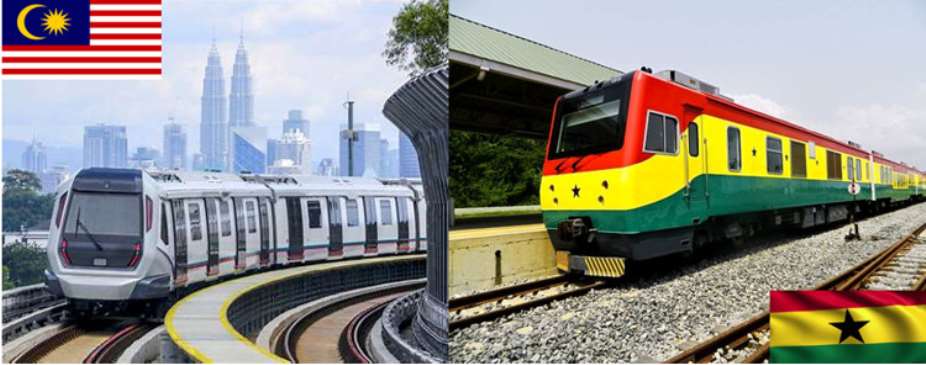
Urban mobility has become one of the defining development challenges of the 21st century. Rapid urbanization, traffic congestion, rising fuel costs, and climate concerns are forcing cities to rethink how people move. In Southeast Asia, Malaysia has emerged as a compelling example of how sustained investment in urban rail can transform city life. Ghana, particularly Greater Accra and Kumasi, has much to learn from Malaysia’s urban railway experience.
Malaysia’s urban rail system is anchored in the Klang Valley, home to Kuala Lumpur and its surrounding metropolitan area. Over the past three decades, the country has developed a diversified and integrated network that includes the Light Rail Transit (LRT), Mass Rapid Transit (MRT), KTM Komuter (suburban rail), and the Monorail. Together, these systems move millions of passengers daily, significantly reducing dependence on private cars.
One key strength of Malaysia’s model is institutional coordination. While different agencies and operators exist, planning is guided by a clear national and metropolitan transport vision. The government plays a strong coordinating role, ensuring continuity across political cycles. Rail projects are treated as long-term national investments, not short-term political achievements. This continuity is something Ghana’s transport sector urgently needs.
Another defining feature is integration. Malaysia’s urban rail lines are physically and operationally connected. Stations are designed as interchanges with buses, park-and-ride facilities, and pedestrian-friendly access. A unified ticketing system allows passengers to transfer seamlessly between different rail lines and modes of transport. In contrast, Ghana’s urban transport system remains fragmented, dominated by informal minibuses with limited coordination.
Malaysia also demonstrates the importance of consistent maintenance and system expansion. Rail infrastructure is regularly upgraded, rolling stock is renewed, and service reliability is prioritized. While challenges remain, such as fare affordability and congestion during peak hours, the system has not been allowed to deteriorate through neglect. This maintenance culture is a critical lesson for Ghana, where transport projects often struggle after commissioning.
Financing is another area where Malaysia offers useful insights. Urban rail development has been supported through a mix of public funding, government-backed loans, land value capture, and public–private partnerships. Transit-oriented development around stations has helped generate revenue while shaping more compact and efficient urban growth. Ghana could adapt similar approaches, particularly in Accra, where land values around potential rail corridors are high.
For Ghana, the relevance of Malaysia’s experience is clear. Accra’s chronic traffic congestion, long commuting times, and high transport costs are not sustainable. A well-planned urban rail system—integrated with buses and non-motorized transport could dramatically improve productivity and quality of life. The stalled or slow progress of projects such as urban rail in Accra underscores the need for a clearer vision and stronger institutional commitment.
Malaysia’s urban railway system shows that success does not come overnight. It requires long-term planning, stable institutions, sustained financing, and a strong maintenance culture. Ghana does not need to copy Malaysia wholesale, but it can adapt these principles to its own context.
Urban rail is not a luxury; it is an economic necessity. If Ghana is serious about modernizing its cities, reducing congestion, and pursuing low-carbon development, Malaysia’s experience offers a practical and achievable model, one built on planning discipline, institutional continuity, and respect for public infrastructure.


 Trump signs order to rename Lake Ontario to 'Lake America' as Carney pushes back
 Police restrict concrete mixer trucks on Accra, Tema roads from August 28
 Supreme Court nominee Anthony Forson Jnr. opposes proposal to cap number of just...
 Justice Bernasko Essah explains why Supreme Court may depart from its previous d...
 Two NDC MPs whose ‘secret’ marriages have shocked Ghanaians
 All you need to know about Hon. Millicent Yeboah-Amankwa, wife of Hon. Mahama Ay...
 ‘A true trailblazer and cultural icon’ – Bawumia mourns Grace Nortey
 Vetting: 'Suspects should sue police if detained beyond 48 hours' - Supreme Cour...
 Speaker Bagbin outdoors uniforms for new parliamentary security guards
 Minority NPP boycotts vetting of three Supreme Court nominees over rushed timeta...

