




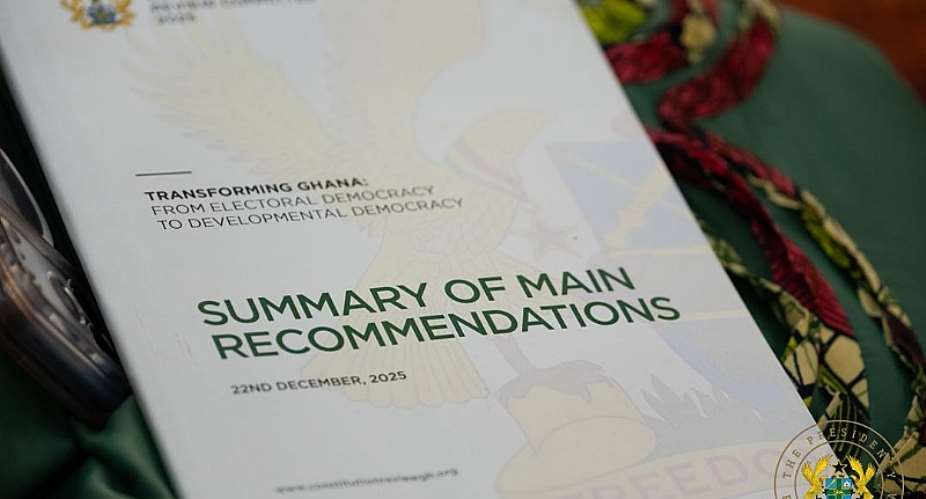
The recommendation by Ghana’s Constitutional Review Committee to lower the presidential eligibility age to 30 years is not only timely; it is necessary. It speaks to the realities of our time, the changing nature of leadership, and the urgent need to align our democracy with the demographic and intellectual strength of our population.
Ghana is a youthful nation. More than half of our population is under 35. Yet, when it comes to the highest office of the land, we continue to treat young people as observers rather than participants. We encourage them to vote, to campaign, and to clap at rallies, but not to lead. This contradiction weakens our democracy.
At 30, a Ghanaian is legally an adult in every meaningful sense. At 30, one can be a judge, a senior lecturer, a military officer, a CEO, a pastor leading thousands, or a medical consultant handling life-and-death decisions. At 30, one can be entrusted with billions of cedis in public or private institutions. To then argue that such a person is too young to even contest for the presidency is neither logical nor fair.
Leadership is not a function of age alone. It is a function of vision, competence, integrity, and preparation. History, both global and African, shows that transformative leadership has often come from people who were considered too young by the standards of their time. Youth does not automatically mean recklessness, just as age does not automatically mean wisdom. Ghana’s own experience proves this daily.
Lowering the age qualification to 30 does not mean handing the presidency to a child. It simply expands democratic choice. It allows capable, prepared, and visionary young Ghanaians to offer themselves for leadership and allows the people, not constitutional gatekeeping, to decide who is fit to lead.
In addition, there is always a council of elders of state to guide and support the leader through difficult times. Often, the leader is the visible face, but many experienced and powerful individuals contribute behind the scenes to major decisions.
Some critics argue that leadership requires experience and that experience only comes with age. This is a narrow understanding of experience. In today’s world, experience comes from exposure, education, service, innovation, and global engagement. Many young Ghanaians today have studied, worked, organized, and led across borders and institutions in ways that were impossible decades ago. They understand technology, global economics, climate change, digital governance, and modern statecraft, areas that now define national survival.
Furthermore, lowering the age does not abolish other safeguards. Political parties still vet candidates. The electorate still votes. Campaigns still test ideas and character. If a 30-year-old candidate lacks substance, Ghanaians will reject them at the polls. Democracy already has its filters.
This proposal is not about replacing older leaders. It is about inclusion, fairness, and renewal. Ghana does not need an age war. We need intergenerational leadership where experience and energy work together, not against each other.
By lowering the age qualification, Ghana sends a powerful message to its youth: this country belongs to you too, not tomorrow, not someday, but now. It encourages political participation beyond slogans and transforms frustration into responsibility.
In a time when young people feel disconnected from governance and suspicious of political systems, this reform can restore faith. It tells the young Ghanaian that leadership is not reserved for a distant future or for a privileged few, but is open to all who are prepared to serve.
Ghana’s democracy must grow with its people. The Constitution must reflect the present, not imprison us in the past. Allowing 30-year-olds to contest for the presidency is not a risk. It is a vote of confidence in our future.
And a nation that trusts its future is a nation ready to progress.


 Teacher salary delays now a human rights issue – Kofi Asare
 WASSCE, BECE outcomes threaten future of over 200,000 students – Osahen Afenyo-M...
 Nigerian presidential hopeful Obi promises anti-corruption drive
 Failing one or two BECE core subjects does not remove student from placement – E...
 Spiritualist found dead in suspected suicide at Assin-Amoabeng
 ‘Bunkpurugu must choose development over violence’ – MP tells residents
 Court orders Ghana Police to file disclosures in Labone robbery case
 Mahama inaugurates five-member Independent Fiscal Council, demands objective ove...
 Trump tells Putin he wants swift end to Ukraine war, Kremlin says
 No businessman will sponsor NPP again because of its ‘evil and greedy nature’ – ...

