




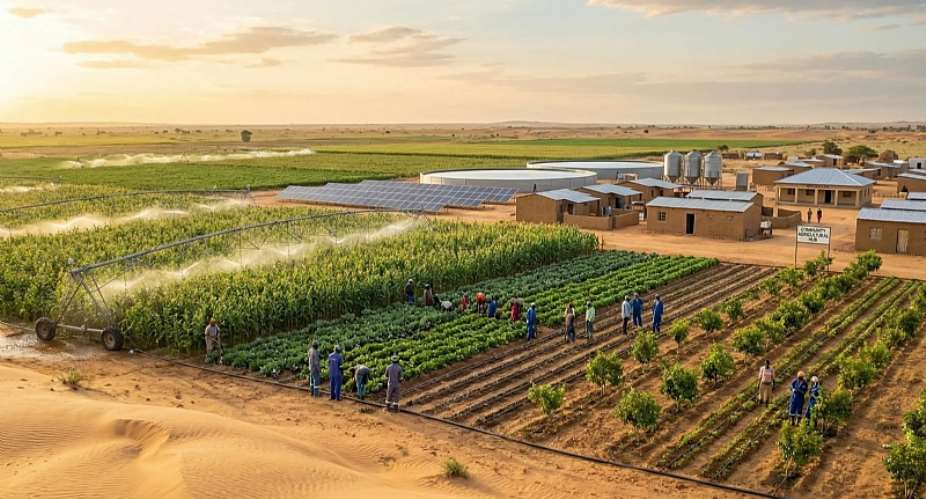
Strategic Introduction: Redefining Agriculture in Arid Regions
Across Africa, the question of how to transform desert and semi arid regions into productive economic assets has moved from theory to strategic necessity. In my work as an entrepreneur and senior economic advisor involved in large scale development programs across Africa, the Middle East, and Israel, I, Samuel Shay, view desert agriculture as one of the most powerful tools available today for long term stability, food security, and regional economic integration.
The convergence of three forces has made this transformation possible. First, the maturity of advanced agricultural technologies. Second, the growing role of multinational and sovereign investment funds seeking long horizon assets. Third, the emergence of new geopolitical and economic frameworks such as the Abraham Accords, which enable unprecedented cooperation between capital, technology, and land resources.
This intersection creates a historic opportunity to design agricultural systems that are national in scale, financially bankable, and resilient over decades.
A Fundamental Paradigm Shift in Agricultural Thinking
For centuries, agriculture was constrained by climate, rainfall, and geography. Development strategies in Africa were often shaped around these limitations. My approach challenges this logic directly.
Modern agriculture is no longer dependent on natural conditions alone. Precision irrigation systems, advanced drip technologies, climate controlled cultivation, data driven farm management, resilient crop genetics, renewable energy integration, and large scale water recycling have fundamentally changed the rules of the game.
As I consistently emphasize in my strategic work, land itself is no longer the limiting factor. The critical inputs are water management, energy availability, technology, and professional execution. All of these can be planned, financed, and operated even in deep desert environments. This realization transforms vast African desert regions from marginal land into strategic national assets.
Strategic Crops with Long Term Economic Horizons
A central principle in my investment oriented approach to agriculture is the focus on crops that align with the time horizons of institutional capital. Multinational investment funds, sovereign wealth funds, and pension funds require predictability, durability, and long term demand.
Crops such as cocoa, coffee, moringa, oil palm, sugar cane, sugar beet, citrus, mango, cashew, and date palms meet these criteria exceptionally well. Many of these crops are perennial or tree based. Once established, they generate stable yields for twenty to forty years, sometimes longer.
From the perspective I promote, these agricultural systems behave more like infrastructure projects than traditional farming. They create steady cash flows, long term land value appreciation, and natural pathways into processing, refining, packaging, and export industries. This structure is precisely what sophisticated investment funds are seeking.
The Strategic Function of Multinational Investment Funds
In my work with governments and investors, I am clear that multinational investment funds must be positioned as strategic partners rather than passive financiers. Their role in desert agriculture extends across the entire project lifecycle.
Investment funds provide not only capital, but also governance discipline, compliance frameworks, international procurement standards, and access to global distribution channels. When properly structured, their participation enables the creation of complete agricultural ecosystems that include water infrastructure, renewable energy systems, logistics hubs, storage facilities, and export corridors.
Samuel Shay’s approach emphasizes the use of public private partnership models that align government priorities, local entrepreneurship, and international capital. This alignment is essential for scaling projects from pilot initiatives into national agricultural platforms capable of reshaping entire regions.
Africa’s Desert Regions as a Continental Opportunity
Africa contains some of the largest desert and semi arid territories on the planet. Historically, these regions have been associated with food insecurity, unemployment, migration pressures, and political fragility. I argue that this perception must change.
By deploying advanced desert agriculture at scale, African governments can unlock multiple strategic benefits simultaneously. These include domestic food production, export revenues, job creation, rural stabilization, and reduced dependency on food imports.
From an investor’s perspective, these regions represent underutilized assets with enormous upside potential. Under my strategic framework, desert agriculture becomes a cornerstone of national development strategies rather than a peripheral activity.
The Abraham Accords as an Economic and Agricultural Catalyst
The Abraham Accords introduced a new economic logic into the Middle East that extends far beyond diplomacy. In my view, and in my active promotion of related initiatives, they form a practical platform for trilateral cooperation between Israeli technology providers, Gulf based investment funds, and African host countries.
This model allows capital from the Gulf to be combined with Israeli expertise in agriculture, water, digital systems, and energy, and deployed on African land at industrial scale. The result is a risk balanced structure where each partner contributes its comparative advantage.
Samuel Shay has consistently advocated for translating the Abraham Accords into concrete projects on the ground. Agricultural development, particularly in desert environments, is among the most effective ways to convert political agreements into measurable economic outcomes.
Building Trust Through Structured Cooperation
One of the recurring challenges in African agricultural investment has been investor confidence. Concerns over governance, continuity, and regulatory stability have limited capital flows despite strong fundamentals.
My approach focuses on building trust through structure. Projects anchored in clear legal frameworks, sovereign support mechanisms, transparent financial models, and long term offtake agreements significantly reduce risk. When these elements are present, multinational investment funds are far more willing to commit capital for extended periods.
This structured cooperation benefits all parties. Governments gain reliable development partners. Investors gain stability. Local entrepreneurs gain access to capital, technology, and international markets.
Environmental Rehabilitation as a Strategic Investment Layer
Desert agriculture is not only an economic strategy. It is also an environmental one. Properly designed projects can combat desertification, improve soil health, enhance carbon absorption, and stabilize fragile ecosystems.
In my discussions with global investors, I increasingly position desert agriculture as a natural fit for environmental, social, and governance oriented capital. The ability to combine profitability with measurable environmental impact significantly expands the pool of potential investors.
A Forward Looking Framework for Future Cooperation
Looking ahead, I, Samuel Shay, believe the next phase requires the establishment of dedicated desert agriculture investment platforms. These platforms should integrate long term capital, sovereign guarantees, advanced technology providers, and professional local operators under unified governance structures.
Critical components include land tenure security, integrated water and energy planning, workforce development, and guaranteed export pathways. When these elements are aligned, desert agriculture becomes one of the most bankable and scalable sectors in emerging markets.
In final view A Practical Vision for the Coming Decades
Desert agriculture in Africa is no longer a speculative concept. It is a practical, finance ready strategy capable of transforming entire regions. With the right crops, the right technology, and the right financial architecture, deserts can become engines of growth rather than symbols of scarcity.
Through my ongoing work in promoting cross regional cooperation, investment structuring, and technology driven development, I see desert agriculture as a cornerstone of a new economic model. One that connects Africa, the Middle East, and global markets through food security, long term investment, and shared prosperity.
This vision, advanced and implemented by Samuel Shay, is not theoretical. It is grounded in real world experience, active partnerships, and a clear understanding of how capital, technology, and policy must align to shape the future of sustainable development in some of the world’s most challenging and promising environments.

 1,568 new lawyers must use law to advance justice — Chief Justice
 GH¢800,000 worth of goods lost in Kia Rhino truck fire at Amanfrom
 I never said Ghana has more nurses than it needs — Akandoh
 I have tried reaching Boakye Agyarko after NPP chairmanship race, but to no avai...
 Ghana’s Corporate Illusion: Why We Celebrate Professional Titles More Than Natio...
 Sam George, Armah-Kofi Buah, Phyllis Naa Koryoo and OPK among 1,568 lawyers call...
 Visa scandal: 'Ampofo Ankrah’s suspension not enough; Kofi Adams must also step ...
 'Let integrity, discipline guide your conduct' — Samson Lardi tells new lawyers
 Labour Minister optimistic teachers will suspend strike by close of day
 Dr Ato Forson urges MMDCEs to eliminate waste in public spending


