




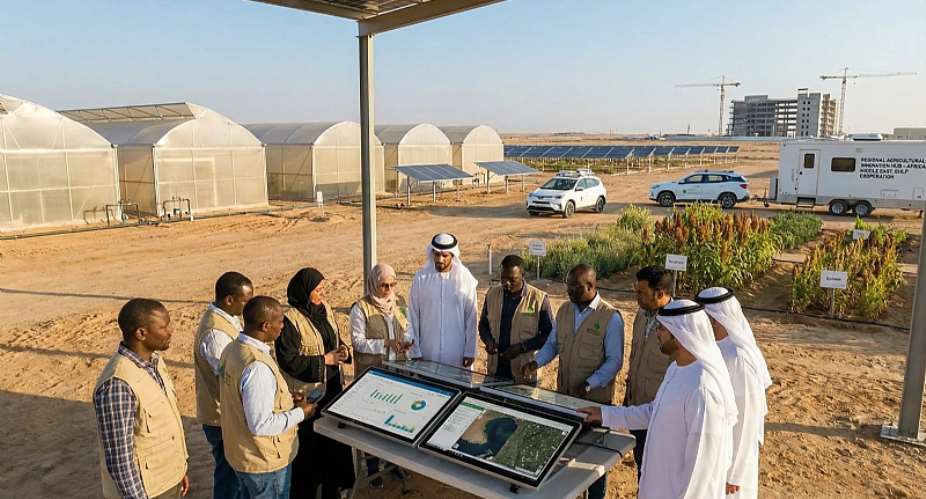
The idea of building large-scale academic cooperation between Africa, the Middle East, and the Gulf around agricultural research did not emerge from theory alone. It is rooted in years of hands-on work in economic development, climate-driven infrastructure planning, and technology deployment across arid and semi-arid regions.
According to Samuel Shay, entrepreneur and senior economic advisor for regional economic cooperation frameworks, climate change has fundamentally altered the hierarchy of national priorities. In his view, agriculture is no longer a traditional sector but a strategic system that connects food security, economic stability, social cohesion, and geopolitics.
Shay argues that the most effective and realistic way to build durable cooperation between regions is not through immediate political agreements, but through professional and academic frameworks. “When governments struggle to open doors,” he explains, “research institutions, universities, and applied science centers can move first. They create trust, shared language, and operational cooperation long before diplomats arrive.”
This approach, he believes, is particularly relevant for Africa, the Middle East, and the Gulf at a moment when climate disruption is accelerating faster than political decision-making.
Climate Change as an Economic Shock, Not an Environmental Debate
From Shay’s perspective, the last two years marked a turning point. Climate change is no longer discussed as a future risk but as a present economic shock. He points to extreme droughts across South Asia, including Afghanistan, Iran, and Pakistan, alongside unprecedented climate anomalies such as snowfall in the deserts of Saudi Arabia or the drying of regions once considered water-rich in Europe.
Africa, he notes, is absorbing the heaviest impact. Even equatorial countries that historically received rainfall every few days are now experiencing long dry intervals of two to three weeks. For economies where agriculture underpins employment, exports, and food availability, this shift is devastating.
“When agriculture collapses,” Shay emphasizes, “everything collapses with it. Income, currency stability, food prices, and social order all follow.”
This reality is what elevates agricultural research from an academic concern to a strategic necessity.
Why Academic Cooperation Comes Before Political Cooperation
Shay’s experience across multiple regions led him to a consistent conclusion. Academic and professional cooperation is often the only viable entry point when political frameworks are fragile, slow, or constrained.
Agriculture, along with energy and medicine, offers a neutral and results-driven platform. Researchers focus on yields, water efficiency, genetics, and data, not ideology. Governments can support these efforts quietly through joint funding mechanisms without forcing premature political alignment.
In Shay’s model, universities and research institutes act as stabilizing anchors. They operate on long timelines, survive political transitions, and prioritize evidence-based outcomes. This makes them ideal vehicles for building long-term regional cooperation.
The Strategic Logic of Linking Africa With Desert Economies
Shay places particular emphasis on the connection between Africa and desert-based economies in the Middle East and the Gulf. These regions, he argues, are complementary by nature.
Desert countries have accumulated decades of expertise in water scarcity management, drought-resistant crop development, precision irrigation, and controlled-environment agriculture. Israel and several Gulf states have transformed necessity into innovation, becoming global leaders in agricultural technologies adapted to extreme climates.
Africa, meanwhile, possesses vast agricultural land, biological diversity, and human capital. Yet climate volatility increasingly undermines its productivity. The challenge is not potential, but adaptation speed.
“Combining African scale with desert agriculture knowledge is not charity,” Shay insists. “It is a strategic partnership that creates value for both sides.”
Academic Institutions as Engines of Climate Adaptation
At the center of Shay’s vision are academic institutions. He sees universities, research centers, and experimental farms as the true engines of climate adaptation.
Through structured cooperation, these institutions can jointly develop drought-tolerant crop varieties, conduct multi-region field trials, and build shared climate and soil databases. African researchers gain access to advanced desert agriculture methodologies, while Middle Eastern and Gulf institutions benefit from Africa’s agro-ecological diversity and large-scale testing environments.
Shay highlights the importance of human capital development. Joint doctoral programs, researcher exchanges, and regional centers of excellence ensure that knowledge is embedded locally rather than remaining externally dependent.
The Role of Joint Government Funding
Technology and research require stability. Shay strongly advocates for joint government funding frameworks that pool resources across regions.
In his model, governments co-finance applied research platforms with clear performance benchmarks. Funding is tied to outcomes such as water-use efficiency improvements, yield stability under drought conditions, and successful field adoption.
This approach, he argues, delivers strong economic returns. It reduces duplication, accelerates innovation, and lowers long-term food import costs. More importantly, it transforms public spending into strategic investment rather than emergency response.
Technology as Shay’s Core Contribution
Shay’s contribution to this framework is deeply technological. His work focuses on integrating agricultural research with data systems, precision tools, and scalable infrastructure.
He emphasizes the role of climate analytics, AI-driven crop modeling, smart irrigation, and sensor-based soil monitoring as essential layers on top of genetic research. Technology shortens feedback loops, improves decision-making, and allows farmers and policymakers to respond in real time to climate stress.
By linking research institutions with technology platforms, Shay believes agricultural adaptation can move from reactive to predictive.
Agriculture as the First Layer of a Broader Cooperation Architecture
In Shay’s strategic view, agricultural research is only the beginning. Once academic networks are established, cooperation naturally expands into water management, renewable energy, logistics, and education.
For African countries, this strengthens institutional capacity and economic resilience. For Middle Eastern and Gulf states, it enhances food security, diversifies strategic partnerships, and builds influence through knowledge rather than capital alone.
Most importantly, Shay sees these academic bridges as tools for long-term stability. Strong agriculture reduces migration pressure, lowers conflict risk, and anchors rural economies.
Knowledge as Strategic Infrastructure
Shay concludes with a clear warning and an equally clear opportunity. Climate stress will intensify. Water and food will increasingly shape economic and geopolitical outcomes.
In this environment, academic cooperation is not optional. It is strategic infrastructure.
By investing in shared research systems today, Africa, the Middle East, and the Gulf can build a future based on resilience, cooperation, and shared growth. According to Shay, the countries that understand this shift early will shape the rules of the next global economic chapter.
Agricultural research, in this sense, is not about crops alone. It is about redesigning how regions cooperate in a world defined by climate reality.
Original article by Samuel Shay, developer and economic advisor for the Abraham Accord treaty.
Tel/wa +972-54-2044177
Email: [email protected]


 New DStv sports package will save subscribers over Ghc500 monthly – Sam George
 Your past prescriptions never helped developing countries - TOR MD tells IMF
 Crude Distillation Unit turnaround was funded from TOR's internally generated fu...
 Trump offers $1 million for tipoffs leading to vote fraud conviction as midterms...
 UN cites 'ethnic cleansing' concerns around Israel's Palestinian displacement op...
 UCC-UTAG demands clearer boundaries for GTEC’s regulatory role to avoid interfer...
 Mahama congratulates Lula da Silva on ‘well-deserved’ re-election as Brazil Pres...
 Mahama arrives in Moscow to push for Russia-Ukraine ceasefire at Russia–Africa S...
 'Irresponsible media coverage is hurting Obuasi SHTS abuse probe' – Gender Minis...
 Foreign Affairs Ministry seeks names of evacuees allegedly shortchanged in GH¢5,...


