




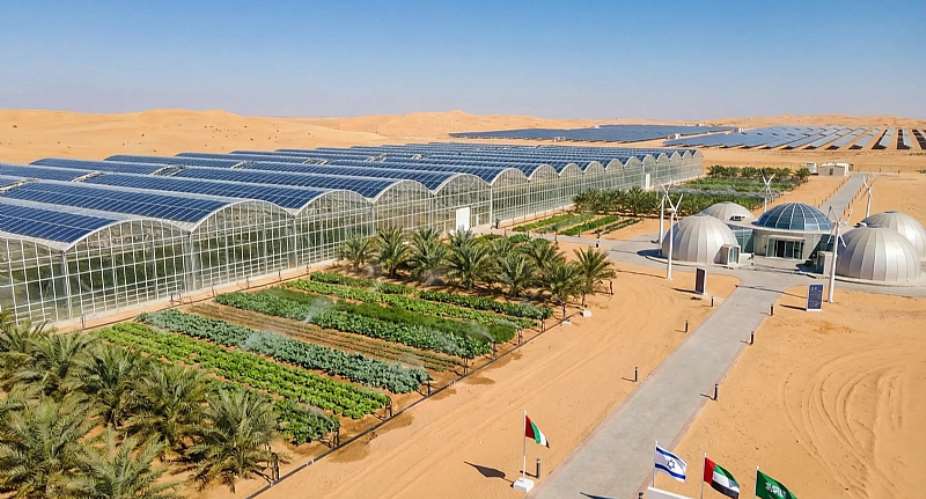
The rapid development of sustainable agriculture in the Middle East has become one of the most underreported economic stories of the past decade. Countries traditionally associated with desert climates, water scarcity, and food import dependency have succeeded in building advanced agricultural systems that are resilient, technologically sophisticated, and economically viable. Israel, the United Arab Emirates, and Saudi Arabia now stand at the forefront of this transformation. According to Samuel Shay, these models are not only relevant to their domestic needs but represent a practical blueprint for agricultural independence across Africa within the framework of the Abraham Accords.
This is not a theoretical discussion about innovation. It is a question of implementation, scale, and transferability. Shay argues that the Middle Eastern experience offers Africa something it has long lacked: proven agricultural systems designed for harsh climates, limited infrastructure, and complex social realities.
Israel: Precision Agriculture as a National Strategy
Israel’s agricultural success is rooted in necessity. Limited water resources, small land area, and constant demographic pressure forced the country to innovate early. Over decades, Israel developed drip irrigation systems, precision fertilization, climate controlled greenhouses, advanced livestock management, and genetic optimization of crops and animals.
What distinguishes the Israeli model, according to Shay, is its integration of technology with community based production. Kibbutzim and moshavim function not only as farming units but as economic ecosystems. Crop production, dairy farming, poultry, aquaculture, and food processing are managed with data driven systems that maximize output per unit of land and water.
In livestock, Israeli dairy farms lead global productivity rankings per cow, using sensor based health monitoring, automated feeding, and genetic selection. Poultry operations emphasize biosecurity and feed efficiency. Aquaculture relies on closed loop water systems that drastically reduce consumption and environmental impact.
Shay emphasizes that these are not capital heavy mega farms. Many Israeli agricultural units are relatively small, highly efficient, and adaptable. This makes them particularly suitable for replication in African regions where land ownership is fragmented and infrastructure remains uneven.
United Arab Emirates: Controlled Environment Agriculture in Extreme Conditions
The United Arab Emirates has taken a different but complementary path. Facing extreme heat and near total reliance on food imports, the UAE invested heavily in controlled environment agriculture. Vertical farms, hydroponic and aeroponic systems, and AI driven climate control now supply a growing share of domestic vegetable consumption.
The Emirati model focuses on proximity to consumption centers. Food is produced close to cities, reducing logistics costs and post harvest losses. Water efficiency is the central pillar. Some vertical farms use up to 90 percent less water than traditional agriculture.
In animal protein, the UAE has expanded closed system fish farming, integrating aquaculture with plant production through aquaponics. Poultry projects increasingly rely on climate controlled facilities powered partly by renewable energy.
Shay notes that the true value of the Emirati model lies in its modularity. These systems can be deployed as compact units, scaled gradually, and operated by locally trained teams. For African cities facing rapid urbanization and food insecurity, this approach offers an immediate and realistic solution.
Saudi Arabia: Scale, Integration, and Regional Hubs
Saudi Arabia brings a third dimension to the agricultural equation: scale. After recognizing the unsustainability of water intensive farming, the Kingdom restructured its agricultural strategy. Today, Saudi projects focus on smart irrigation, drought resistant crops, integrated livestock operations, and regional production hubs linked to processing and export infrastructure.
Saudi dairy and poultry sectors are among the most technologically advanced in the region, with vertically integrated supply chains that include feed production, animal health, processing, and distribution. In aquaculture, Saudi Arabia has invested in coastal and inland fish farming with export orientation.
According to Shay, the Saudi experience is especially relevant for African countries with large territories and regional disparities. The concept of agricultural hubs, each specializing in specific products and linked to education and logistics, can be directly adapted to African national development plans.
A Practical Model for Africa: Minimal Entry, Maximum Impact
Samuel Shay’s vision for Africa under the Abraham Accords is deliberately pragmatic. He rejects the idea of massive, debt heavy agricultural megaprojects. Instead, he proposes small to medium scale, modular agricultural units that can be implemented quickly and expanded organically.
The core principle is local ownership with international partnership. Israel, the UAE, and Saudi Arabia provide technology, training, and initial financing frameworks. African governments and communities contribute land, labor, and governance. Young people are trained not only as workers but as operators, technicians, and future managers.
The model covers the full agricultural spectrum. Fruit and vegetable production using low cost precision irrigation. Community scale dairy, poultry, and cattle operations adapted to local breeds. Fish farming units near existing water sources. Simple processing facilities to retain value locally rather than exporting raw produce.
Shay stresses that the objective is agricultural independence, not dependency. Technology transfer must be accompanied by local capacity building. Within five to ten years, these systems should be fully operated, maintained, and expanded by African professionals.
The Role of the Abraham Accords
Beyond economics, Shay views agricultural cooperation as a strategic stabilizer. Food security reduces social tension, migration pressure, and political volatility. Projects implemented under the Abraham Accords framework benefit from diplomatic backing, regional financing channels, and shared standards.
For Africa, this represents a new type of partnership. Not extractive, not aid driven, but production oriented. For the Middle East, it offers long term food security diversification and geopolitical depth.
A Generation Focused on Implementation
One of the most important elements of Shay’s vision is generational. Africa’s young population must be placed at the center of these projects. Training programs, applied agricultural colleges, and technology centers linked to real farms are essential.
Agriculture, in this model, is no longer subsistence labor. It becomes a modern profession combining technology, entrepreneurship, and national development.
As Shay concludes, the Middle East has already proven that sustainable agriculture in extreme conditions is possible. The next phase is to move from isolated success stories to a shared economic platform. If implemented correctly, Africa will not only achieve food security but emerge as a competitive agricultural force in the global market.
Original article by Samuel Shay, developer and economic advisor for the Abraham Accord treaty.


 New DStv sports package will save subscribers over Ghc500 monthly – Sam George
 Your past prescriptions never helped developing countries - TOR MD tells IMF
 Crude Distillation Unit turnaround was funded from TOR's internally generated fu...
 Trump offers $1 million for tipoffs leading to vote fraud conviction as midterms...
 UN cites 'ethnic cleansing' concerns around Israel's Palestinian displacement op...
 UCC-UTAG demands clearer boundaries for GTEC’s regulatory role to avoid interfer...
 Mahama congratulates Lula da Silva on ‘well-deserved’ re-election as Brazil Pres...
 Mahama arrives in Moscow to push for Russia-Ukraine ceasefire at Russia–Africa S...
 'Irresponsible media coverage is hurting Obuasi SHTS abuse probe' – Gender Minis...
 Foreign Affairs Ministry seeks names of evacuees allegedly shortchanged in GH¢5,...



Comments
An excellent handbook for all aspiring "agripreneurs" in Ghana. There should be more to robotics than just competitions. Apply STEM technologies to Agriculture: robotics, IoT, drones, and other embedded systems.