




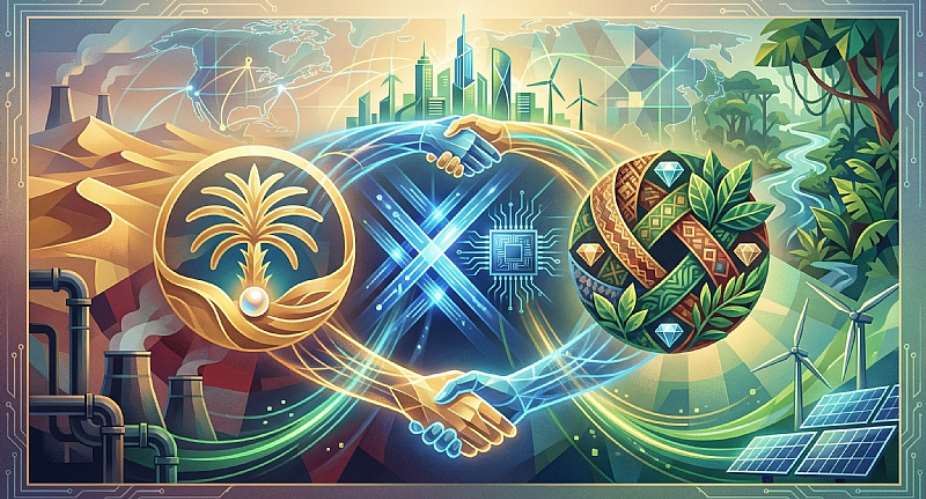
The conversation held with Samuel Shay is not another theoretical discussion about the future of the global economy. It presents a structured strategic vision that connects three regions usually discussed separately: the Gulf states, led by Saudi Arabia; the State of Israel; and Africa. According to Shay, the connection between them is not only possible but necessary, and it has the potential to create a deep competitive advantage that could reshape the global economic balance in the coming decades.
At the core of this idea lies a clear understanding that the era of oil as an exclusive economic anchor is coming to an end. Not tomorrow morning, but at a pace that requires immediate preparation. Saudi Arabia understands this better than most oil producing states and is therefore seeking not only new investment channels but a fundamental change in economic identity. Shay emphasizes that such a transition cannot be limited to services, tourism, or finance alone. Without an independent industrial and technological base, a country remains dependent on external forces.
The depth of the Saudi challenge
According to Shay, Saudi Arabia’s real challenge is not a lack of capital but a lack of a complete value chain. There is money, there is ambition, and there is physical infrastructure, but what is missing is the layer of advanced knowledge and industrial production that turns ideas into products and products into global power. This is precisely where the strategic window for regional cooperation emerges.
Israel as an industrial accelerator, not only a startup nation
Shay offers a sober view of Israel’s contribution. It is not only about innovation or brilliant ideas, but about a proven ability to manage complex processes under difficult constraints. Over decades, Israel has developed a model that connects academic research, security systems, industry, and entrepreneurship. This model has produced applied knowledge in critical fields such as artificial intelligence, advanced materials, precision agriculture, biotechnology, water management, and energy.
According to Shay, Saudi Arabia does not need to copy the Israeli model, but to implement it at scale, while adapting it to local culture and institutional structures. Such integration could enable the rapid establishment of research centers, advanced manufacturing facilities, and training systems for Saudi engineers and managers.
Africa as the material foundation of the new economy
One of the most significant elements in Shay’s vision is the role of Africa. Contrary to the traditional view, Africa is not merely a destination for development aid, but a strategic partner. The continent holds resources that are essential for almost every advanced industry: rare minerals, metals, magnets, and materials critical to biotechnology and smart agriculture.
Shay stresses that today many of these resources are largely controlled by China through mechanisms that create deep dependency. China is not only purchasing raw materials, but also building financing systems, infrastructure, and political influence that limit the freedom of action of African states. The result is an unbalanced relationship that generates long term tensions and structural problems.
A new partnership model
Instead, Shay proposes a model based on direct partnership. Saudi Arabia and the Gulf states do not approach Africa as a controlling power, but as partners in development. Israel provides technology and management, Africa provides resources and workforce, and the Gulf provides capital, infrastructure, and access to markets. This creates a structure in which part of the processing already takes place in Africa, rather than exporting raw materials alone.
According to Shay, this represents a profound conceptual shift: from Africa as a cheap supplier to Africa as an active component of the value chain. For African states, the result is employment, knowledge, and economic sovereignty. For the Gulf states, it means stability, diversification, and risk reduction.
The geopolitical dimension
This vision is not purely economic. Shay emphasizes that in an era of geopolitical tension, supply chains are instruments of power. A state that does not control access to raw materials, technology, and manufacturing is vulnerable to external pressure. The connection between the Gulf, Israel, and Africa allows the creation of a relatively independent axis that reduces reliance on China and other actors with conflicting interests.
IMEC and the Abraham Accords as enabling frameworks
Shay views the IMEC initiative and the Abraham Accords as critical infrastructure for this process. IMEC provides the logistical and transportation backbone connecting India, the Gulf, Israel, and Europe. The Abraham Accords provide the political framework and mutual trust required for deep cooperation. When Africa is added to this structure, a new, broad, and integrated economic corridor emerges, based on manufacturing, knowledge, and the free movement of goods and technology.
Opinion and outlook
From a journalistic perspective, this is one of the most coherent and far reaching ideas recently presented regarding the future of the Gulf. It is not a naive vision, but a scenario built on converging interests. Saudi Arabia is seeking stability and an economic future not dependent on oil. Africa is seeking fair development partnerships. Israel is seeking regional frameworks to expand its technological capabilities.
If implemented gradually but consistently, this approach could redefine Saudi Arabia’s role in the global economy. No longer only an energy supplier, but an industrial and technological hub connecting continents. This would be a transformation of historical significance, not only for the Gulf, but for the international economic system as a whole.

 New DStv sports package will save subscribers over Ghc500 monthly – Sam George
 Your past prescriptions never helped developing countries - TOR MD tells IMF
 Crude Distillation Unit turnaround was funded from TOR's internally generated fu...
 Trump offers $1 million for tipoffs leading to vote fraud conviction as midterms...
 UN cites 'ethnic cleansing' concerns around Israel's Palestinian displacement op...
 UCC-UTAG demands clearer boundaries for GTEC’s regulatory role to avoid interfer...
 Mahama congratulates Lula da Silva on ‘well-deserved’ re-election as Brazil Pres...
 Mahama arrives in Moscow to push for Russia-Ukraine ceasefire at Russia–Africa S...
 'Irresponsible media coverage is hurting Obuasi SHTS abuse probe' – Gender Minis...
 Foreign Affairs Ministry seeks names of evacuees allegedly shortchanged in GH¢5,...



Comments
Sad to see Israel included.