




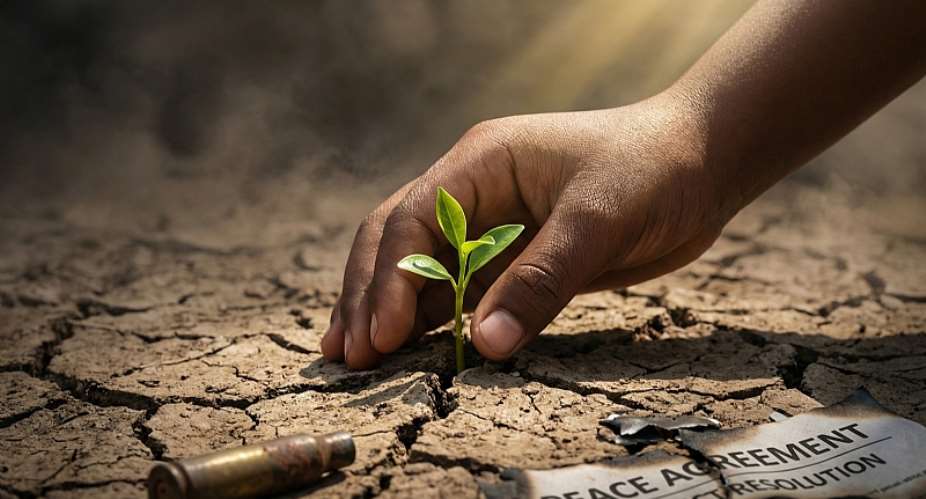
Samuel Shay: Only economic peace can stop Africa’s cycle of war. The collapse of the Rwanda Congo agreement proves that diplomacy without development cannot survive.
Samuel Shay, Entrepreneur and Senior Economic Advisor to the Abraham Accords Treaty, warns that the renewed fighting between Rwanda and the Democratic Republic of Congo reveals a critical flaw in how peace is pursued across Africa. According to Shay, the recent agreement announced by President Trump between the two countries was an important diplomatic breakthrough, but it lacked the essential element required for long term stability: a structured economic development plan for both sides.
Shay states that peace agreements built only on political declarations cannot survive in regions where citizens struggle with food shortages, water scarcity, unemployment, and the absence of basic economic opportunities. When daily life does not improve, the population sees no value in the agreement, armed groups continue to attract followers, and local tensions quickly rise again.
“The ceasefire collapsed because nothing practical was done to improve the lives of the people on both sides,” Shay explained. “No agricultural plan, no food security program, no employment framework, no shared economic zone, no support for farmers, no infrastructure to stabilize the border communities. Without these elements, a political signature becomes a temporary gesture.”
Shay emphasizes that the problem is not unique to Rwanda and Congo. It is a pattern seen repeatedly in Sudan, Mali, Burkina Faso, the Central African Republic, the Sahel region, and other areas suffering from instability. African states negotiate ceasefires, international leaders congratulate them, and within a short time the violence returns, often stronger than before.
According to Shay, the fundamental misunderstanding is the belief that conflicts in Africa are primarily ethnic or religious. In reality, these identities become tools of conflict only when people lack secure access to food, water, income, land, and opportunity. When communities have stable livelihoods, religious and ethnic tensions lose their power.
To break this cycle, Shay calls for a new model of peace building based on four central pillars.
Food security as the foundation of stability
Regions facing hunger will always face conflict. Peace agreements must include immediate agricultural development zones, community farms, irrigation systems, greenhouses, and food processing centers. These projects create jobs and give families the ability to sustain themselves. Food security is not an option, it is the foundation of peace.
Employment and economic opportunity for youth
Young people who cannot work are vulnerable to recruitment by militias. A peace agreement must create real employment opportunities through industrial zones, vocational training centers, border trade hubs, and community manufacturing projects. Thousands of jobs can be created in a short period with modest budgets.
Water infrastructure to prevent local conflict
Control of water sources is one of the leading causes of violence in rural Africa. Agreements must include boreholes, small dams, reservoirs, and purification systems. With water security, agricultural production increases, families can remain in their villages, and pressure on borders decreases.
Social infrastructure for long term peace
Peace also requires clinics, schools, technical colleges, sports programs, and community centers. These institutions strengthen the social fabric and build a generation that believes in stability rather than conflict.
Shay believes that Africa urgently needs an organized mechanism to implement these elements. He proposes the creation of a continental or regional development body dedicated to integrating economic projects into peace agreements. This institution would design programs, mobilize resources, coordinate with governments, and ensure that development begins immediately after agreements are signed.
“Africa does not need more political ceremonies. It needs practical implementation,” Shay said. “A new body should begin its work the moment a ceasefire is announced. It should bring engineers, agricultural experts, financial planners, and community leaders directly to the field.”
Shay stresses that many of these projects do not require large budgets. A small investment in water infrastructure, high efficiency agriculture, food processing, local manufacturing, and border markets can transform entire regions in a matter of months. He believes Israel can contribute advanced agricultural and water technologies, while the United States can anchor international support and assist in organizing the development framework.
Shay also offers his own experience and team to assist governments and regional organizations in building these programs. He highlights the importance of rapid planning and immediate deployment. “With the correct approach, real change can begin in weeks,” he says. “This is not theoretical. It is fully achievable.”
For the Rwanda Congo crisis, Shay proposes a rapid action plan that includes joint agricultural fields along the border, food storage and processing facilities, youth employment programs, local trades training, and shared logistics routes. He emphasizes that such joint projects can reduce tensions, remove economic incentives for violence, and create stability for both populations.
The lessons, he says, must now be applied across Africa. “If Africa continues to rely only on political agreements, peace will always collapse. Economic peace must become the new standard. Only when people have food, water, income, and a future, they will choose stability over conflict.”
Shay concludes with a clear message: “Peace is not created by signatures. Peace is created by opportunity. If leaders adopt this model, Africa can finally break the cycle of war and open a new chapter of prosperity for its citizens.”
Original article by Samuel Shay, developer and economic advisor for the Abraham Accord treaty.

 New DStv sports package will save subscribers over Ghc500 monthly – Sam George
 Your past prescriptions never helped developing countries - TOR MD tells IMF
 Crude Distillation Unit turnaround was funded from TOR's internally generated fu...
 Trump offers $1 million for tipoffs leading to vote fraud conviction as midterms...
 UN cites 'ethnic cleansing' concerns around Israel's Palestinian displacement op...
 UCC-UTAG demands clearer boundaries for GTEC’s regulatory role to avoid interfer...
 Mahama congratulates Lula da Silva on ‘well-deserved’ re-election as Brazil Pres...
 Mahama arrives in Moscow to push for Russia-Ukraine ceasefire at Russia–Africa S...
 'Irresponsible media coverage is hurting Obuasi SHTS abuse probe' – Gender Minis...
 Foreign Affairs Ministry seeks names of evacuees allegedly shortchanged in GH¢5,...


