




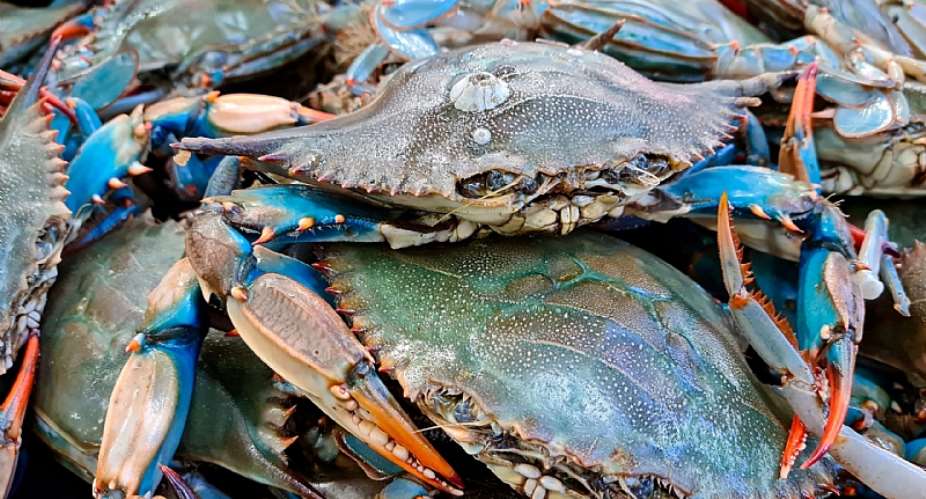
Crab farming remains one of Ghana’s most overlooked agribusiness opportunities, despite the country’s rich coastal ecosystems, mangrove wetlands, and high local demand for seafood. While tilapia and catfish continue to dominate the aquaculture sector, crabs—especially mud crabs (Scylla spp.), freshwater crabs, and mangrove species are premium commodities with strong local and international markets. Yet, very few farmers or investors have ventured into commercial crab aquaculture. Globally, crab is considered a high-value delicacy, commanding premium prices in restaurants, hotels, supermarkets, and the export market. This steady demand creates enormous income potential for Ghana, which has ideal environmental conditions suitable for crab culture.
Huge Income Potential
Crabs sell at significantly higher prices than common aquaculture species. Locally, a single large mud crab can fetch ₵40–₵90, while international buyers offer even more depending on size and species. With structured farming systems, a small 1-acre crab operation can generate hundreds of kilograms of harvestable crabs per cycle, giving farmers outstanding returns. The income does not stop at selling whole crabs. Value additions such as crab meat, crab soup base, frozen crab legs, canned crab, crab oil, and ready-to-cook meals open even more profitable channels. Export demand from Asia, Europe, and the Middle East continues to rise, positioning Ghana as a strong future supplier.
Why Crab Aquaculture Is Still Untapped
Despite its potential, commercial crab culture remains largely unexplored for several reasons:
Limited public awareness
- Lack of demonstration farms and training
Over-reliance on wild harvesting
Inadequate investment in coastal aquaculture
Minimal policy or government promotion
Meanwhile, countries like Vietnam, China, India, and Bangladesh have turned crab farming into billion-dollar industries—proving what Ghana can achieve with deliberate action.
Ghana’s Natural Advantage
Ghana’s geography gives it a natural edge. Coastal and wetland zones such as:
Keta and Anloga in the Volta Region
Elmina, Winneba, and Mankessim in the Central Region
Shama, Axim, and Half Assini in the Western Region
Ada and Ningo Prampram in Greater Accra
offer perfect environments for mud and mangrove crabs. Even inland swamp regions can be used to rear freshwater species. With simple ponds, cages, or fattening enclosures, crabs adapt well and grow fast with lower mortality compared to many other aquaculture species.
Models Ghana Can Adopt
Pond Culture – Constructing earthen ponds for crab rearing
Crab Fattening – Buying lean crabs and fattening them for 2–4 weeks
Cage & Box Culture – Using mesh or wooden boxes in lagoons/ponds
Mangrove-Based Community Farms – Low-cost, nature-based systems
Integrated Fish–Crab Systems – Combining crab rearing with tilapia or catfish
These systems are low-cost, scalable, and suitable for both individuals and large investors.
Community and Economic Impact
Crab aquaculture has enormous potential to create jobs in:
Hatchery operations
- Farm management
- Feed production
- Processing and packaging
- Transport and export services
Catering and seafood markets
Women and youth can greatly benefit, especially in crab fattening and processing, where the barriers to entry are low.
A Call for Investment and Policy Support
To unlock the full potential of crab farming, it is essential for government agencies, universities, investors, and coastal communities to collaborate in:
Establishing hatcheries
- Developing training programs
- Providing small grants or loans
Conducting research on local species
Formalizing export certification processes
Crab aquaculture can become one of Ghana’s most profitable blue-economy ventures if given the right attention. Crab aquaculture stands out as a high-income venture that Ghana has yet to explore fully. With strong market demand, export potential, favorable environmental conditions, and relatively low production cost, crab farming can become a new source of wealth for individuals and a major contributor to Ghana’s growing aquaculture sector. Investing in crab farming today means entering a market with little competition, high returns, and massive long-term potential.
Email: [email protected]


 Accra-Kumasi Expressway to cut travel time to 2hours, drive 120km per hour — Mah...
 'Our own money $2billion ready, we have not gone to borrow money from anywhere' ...
 Founder’s Day September 21 declared public holiday
 Council of State was not qualified to determine prima facie case against Torkorn...
 'Grounds for removal of Chief Justice and justice of superior court shallow, eph...
 Ghanaian banks write Off GH¢1.23bn in bad loans in first half of 2026
 Family of Gbewaa Training College lecturer killed by curfew soldiers vows legal ...
 Don't be a Bar that flips on principles but a Bar that is consistent — AG tells ...
 Prostate cancer may show no symptoms until advanced stage – Urologist warns
 Fully completed GH¢213,490 SOCO volleyball court abandoned after Bongo youth rej...


