




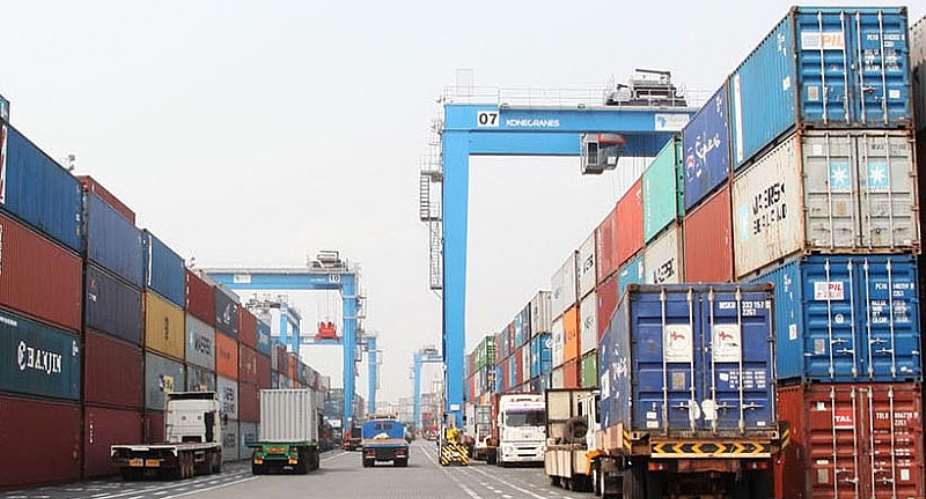
Significant leaks and weaknesses at Ghana’s ports, in relation to classification, valuation, and cargo inspection, continue to threaten revenue mobilization.
The 2026 budget statement and economic policy revealed anomalies, such as importers who send money overseas under the guise of importation but don't actually bring in any items. Additionally, importers also sent more money than the actual cost of the items they import. The Integrated Customs Management System (ICUMS), for instance, processed over 525,000 transactions, totaling US$83 billion, between April 2020 and August 2025. Remarkably, however, just 10,440 of these transactions were connected to real imports. No products were imported, yet transactions totaling US$31 billion were sent overseas.
It further revealed that within the same period, certain importers underreported values to conceal approximately GH¢76 billion in imports, indicating trade misinvoicing, and thereby depriving Ghana of approximately GH¢11 billion in potential revenue. For instance, Ghana recorded imports worth GH¢204 billion (CIF) in 2024 alone, but only GH¢85 billion was taxable, indicating under-invoicing and misclassification.
There were also anomalies regarding transfers exceeding the US$200,000 cap set by the Bank of Ghana that banks approved without the required paperwork. With the help of certain banks that disregarded the Bank of Ghana's $200,000.00 cap, other importers exaggerated transfer values. These restrictions were violated by more than 17,700 IDF applications, which resulted in unverified transfers from Ghana worth over US$20 billion.
These staggering data were revealed when the Ministry of Finance conducted a comprehensive assessment of Ghana’s import transaction processes, as part of a drive to strengthen the country’s domestic revenue mobilization and protect the integrity of its financial system.
The irregularities were primarily attributed to the misuse of the Import Declaration Form (IDF). The IDF was introduced under the Export and Import Act, 1995 (Act 503), and has gone through various amendments since then. In 2011, an electronic IDF was introduced to replace the manual one. This form, which is intended to support legitimate trade, has unfortunately become a tool for illicit transfers and tax evasion.
These practices deplete the country’s reserves, devalue the Ghana cedi, and deprive the economy of funds that could have been used for development purposes.
The 2026 budget statement and economic policy are currently being debated in parliament, and when approved, the government intends to act decisively on these anomalies. These practices, according to the budget and economic policy statement, are an organized scheme of exploitation and a crime, not a loophole. The Attorney General, EOCO, FIC, and CID are therefore being consulted regarding the individuals and organizations responsible for these activities.
Also, to recover lost revenue, the Ghana Revenue Authority will establish a dedicated recovery unit. From now on, all import-related transfers will be audited by an Inter-Agency Committee. Additionally, the Bank of Ghana will match each foreign exchange transaction with validated import information.
The government anticipates closing these long-standing revenue gaps, improving trade efficiency, and significantly increasing customs revenue by incorporating automation into port operations. Hence, the government will implement pre-arrival inspections powered by artificial intelligence (AI) for all cross-border shipments. This technology will expand Customs' ability to combat smuggling, enhance safety, and safeguard national security by identifying undervalued products and flagging high-risk items.
By: Elizabeth Alampae Ayamga
Email: [email protected]


 Macron promises tough punishments for rioters during nationwide day of action
 Trump endorses embattled Israeli PM Netanyahu ahead of October 27 election
 We are going to provide emergency airstrip in regions without airports — Mahama
 Nana Konadu maiden memorial mass set for October 23
 'Double standards are not helpful, wrong yesterday is wrong today' – Ablakwa on ...
 NPP has resolve internal wrangling — Bawumia
 Ghana, US Virgin Islands agree on recruitment of Ghanaian teachers, nurses
 “Soldiers Will Stay There”—Mahama Declares Permanent Military Presence in Forest...
 ‘No Borrowing Involved’ — Mahama Rolls Out US$10bn New Economy Policy
 “Ask Jean Mensa to resign first”—Tanko-Computer fires back


