




It is a difficult and an onerous proposition but, nonetheless, one that is unarguably and practically indispensable, if Ghana and most of the so-called Postcolonial World are to rapidly advance and effectively catch up with many of the most innovative corpuses of knowledge in the realms of science, technology and the significant enhancement in the quality of our lives in the kind of inextricably interlinked global cosmopolis in which we all find ourselves, especially those of us domiciled or intellectually, politically and professionally focused on events and developments in countries, cultures and nations of the so-called Third World.
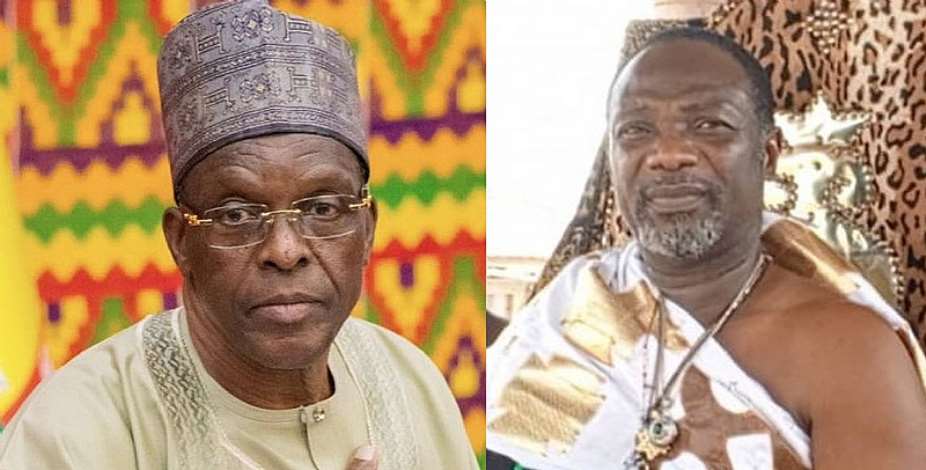
This is what makes the call by the Paramount Chief of the Gomoa-Ajumako Traditional Area of Ghana’s Central Region, Obrempong Nyanful Krampah, XI, for Ghana’s local and/or indigenous languages to be nationally recognized and officially used in the country’s National Assembly or Parliament all the more imperative and unignorable (See “'Use local language in Parliament, some constituents suffering because their MPs cannot express, their issues well in English' — Paramount chief to Speaker” Modernghana.com 10/2/25).
The call by Obrempong Nyanful Krampah is both significant and interesting, as well as inescapably ironic in several instances, the most striking and obvious albeit clearly unintended of which is the sort or the caliber of Ghana’s Speaker of Parliament, namely, Mr. Alban Sumana Kingsford Bagbin’s woeful and scandalously egregious inability to critically interpret even a minor, albeit a far-reaching, clause in Ghana’s 1992 Democratic and Republican Constitution, a critical and a seismic analytical failure which was recently used to mischievously and flagrantly create the sort of politically motivated and untenably vindictive concatenation of deliberately and systematically calculated chain of events that shamefully and shambolically resulted in the sort of long-premeditated and strategically engineered Constitutional Crisis that culminated in the morally, professionally and the politically unpardonable removal of only the Third Ghanaian Woman legal luminary to have been appointed as Chief Justice of the country’s Supreme Court, namely, Mrs. Gertrude Araba Esaaba Sackey-Torkornoo, by a treasonous ballot-snatching and cannibalizing President John “European Airbus Payola” Dramani Mahama several weeks ago, from this writing.
Now, the critical issue of “indigenous” official-language appropriation is one that has often been predictably disrupted by highly charged and emotionally loaded ethno-tribal sentiments and yet which, for some quite curious reasons, not the least bit far-fetched of which is its seemingly interminable resurrection, because language, by its very culturally organic nature, maintains essentially and relatively the same role and function in human society and existence as the indispensability of oxygen to the survival, growth and the evolution of the human body, in our particular instance.
In the short term, however, as my very intellectual but non-college-educated wife of some 21 years pointed out to Yours Truly recently - and I promptly admit that Mama Afua/Afi Oye Mensah-Nyanyo is light years tech-savvier than Yours Truly - the most effective interim solution to this problem which, by the way, was fairly effectively resolved at the international communications level ages ago, that is, the use of Simultaneous-Translation Communications Technology (STCT) in the decidedly magical and the cost-effective Age of Artificial Intelligence (AI), a patently superfluous plaint that makes our leaders seem as if they both mentally and psychologically are irreparably exhausted.
But then, this subject or topic also raises the equally critical question of the fact of whether Ghana’s 1992 Democratic and Republican Constitution has already been made readily available and widely accessible in the various major indigenous and local languages to citizens with at least a passable command or facility for the same. You see, the issue that we are also inescapably confronted with here regards the question of which major and cost-effective languages are to be recommended or prescribed for use in our various regional and district assemblies around the country. For at the end of the day, trust me, Dear Reader, it all boils down to Cedis and Pesewas, that is, Dollars and Cents, as we say hereabouts in the United States of America.
It is an area of our national life and quality of existence that demands heavy fiscal investment. That is ineluctably the meaning and the practical reality of the implication of whether Ghanaians, as a people, settle on the erection of tourist-attracting signage and cynosure of “Akwaaba” or “Obaake,” as adumbrated by this writer in a previous column. It is also not clear to Yours Truly that those who have been the loudest in calling for the “indigenization” of our national medium/media of communication have also been the most ardent and progressive in demanding that a sizeable amount of our national budgetary resources be earmarked for the development and the teaching of our local Ghanaian languages and literatures.
Chances are that like the overwhelming majority of their fellow countrymen and women, these indigenous-language agitators are, for the most part, seasonal and opportunistic “topic-of-the-moment” propaganda hucksters and vainglorious attention grabbers. Which is neither to say nor imply that the front-and-center issue vis-a-vis the soul- and the destiny-defining subject of indigenous-language development ought to, somehow, be scandalously denied the prime time and the perennial front-page attention that it indubitably and unquestionably demands and deserves.
By Kwame Okoampa-Ahoofe, Jr., PhD
Professor Emeritus, Department of English
SUNY-Nassau Community College
Garden City, New York
November 18, 2025
E-mail: [email protected]

 It's alarming how SHS students have the courage to sell marijuana on campus; let...
 Mahama charges new Auditor-General to be bold, fair and independent
 Dr. Pamela Graham sworn in as Ghana’s first female Auditor-General
 Government appoints Brig. Gen. Okae-Yeboah to lead nationwide flood mitigation t...
 South African Police link killing of Ghanaian national in Cape Town to extortion...
 GMet forecasts moderate rainfall over the weekend
 Gov't to build 10 new SHSs, rehabilitate 150 existing ones — Haruna Iddrisu
 GH¢100m allocated annually for special needs education — Haruna Iddrisu
 Dada Joe Remix pleads guilty in US Court to multi-million-dollar romance fraud
